PromptOps: IDE for CLI AI Coding Agents





PromptOps: The Operating System for CLI AI Coding Agents
Introduction
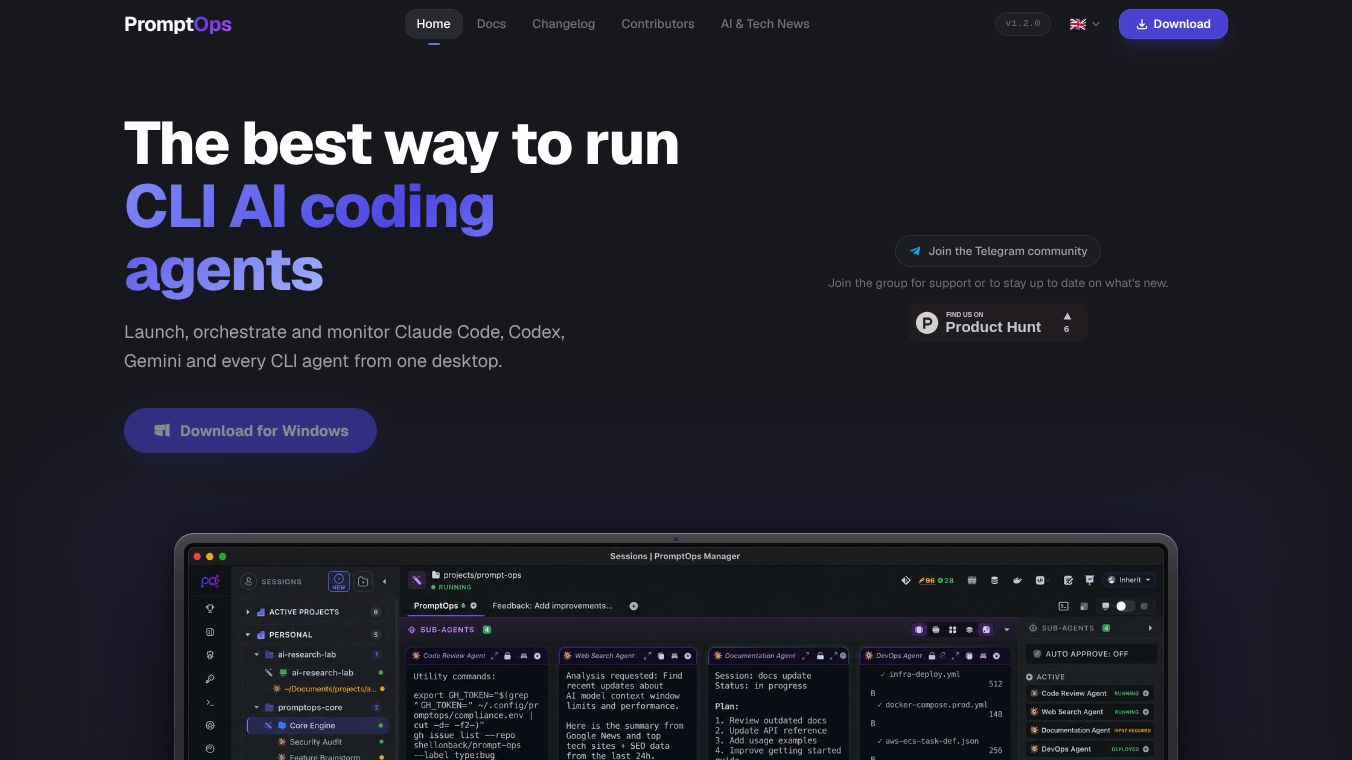
PromptOps is a specialized desktop platform designed to help developers manage and coordinate teams of AI coding agents. While many tools focus on writing single prompts, PromptOps treats prompts as structured assets that can be versioned, shared, and improved over time. The platform acts as a central command center where users can orchestrate multiple AI agents to work together on complex coding tasks. Instead of manually switching between different tools or providers, developers can run a full workflow from one interface. This system transforms the way teams approach AI-assisted development by moving from simple prompt usage to full operational automation.
Benefits
PromptOps offers several key advantages for development teams looking to scale their AI usage. First, it provides a unified workspace that integrates Git management, database exploration, and Docker monitoring directly into the AI workflow. This eliminates the need to jump between multiple applications. Second, the platform supports multi-agent orchestration, allowing users to spawn specialized sub-agents for tasks like security audits, test running, and code review. These agents can communicate with each other automatically to ensure high-quality output. Third, PromptOps includes a shared prompt library that lets teams create, version, and approve prompts using a process similar to pull requests. This ensures that every team member uses the best and most reliable prompts. Finally, the system supports various AI providers, so teams can choose the best model for each specific task without changing their workflow.
Use Cases
PromptOps is designed for software development teams that want to automate repetitive and complex coding tasks. One common use case is automated code review, where the platform spawns multiple agents to check for security issues, run tests, and suggest improvements in parallel. Another use case is data entry and extraction, where the system can process unstructured documents like PDFs or invoices and convert the data into structured formats with high accuracy. Teams also use it for report generation, pulling data from multiple sources to create weekly summaries in minutes instead of hours. The platform is also useful for managing large codebases, as it can integrate with Docker containers and provide real-time monitoring of the development environment. It is particularly valuable for teams that need to scale their AI usage across multiple projects while maintaining control and consistency.
Pricing
Pricing details for PromptOps are not available in the provided information. The article focuses on the features and operational principles of the platform but does not mention specific subscription tiers, costs, or licensing models. Interested users would need to visit the official website or contact the vendor directly for current pricing information.
Vibes
The provided article does not include specific user reviews, testimonials, or public reception data. While the text describes the platform as a significant evolution in AI-assisted software development and highlights potential productivity gains in various scenarios, it does not quote actual user feedback or third-party evaluations. The content presents the technology as a robust solution based on established principles of Prompt Operations rather than relying on community sentiment.
Additional Information
The article explains that PromptOps is built on seven core principles, including operational focus, measurable outcomes, and human oversight. It distinguishes itself from simple prompt engineering by emphasizing end-to-end workflow automation and business process integration. The platform is designed to be model-agnostic, meaning it works with various large language models from providers like OpenAI, Anthropic, and Google. Implementation typically involves a discovery phase to identify automatable tasks, followed by design, optimization, and security compliance steps. The system is intended to augment human workers by handling repetitive tasks, allowing teams to focus on creative and strategic work. It also supports enterprise needs with features like dedicated hosting, encryption, and complete audit trails for data security.
This content is either user submitted or generated using AI technology (including, but not limited to, Google Gemini API, Llama, Grok, and Mistral), based on automated research and analysis of public data sources from search engines like DuckDuckGo, Google Search, and SearXNG, and directly from the tool's own website and with minimal to no human editing/review. THEJO AI is not affiliated with or endorsed by the AI tools or services mentioned. This is provided for informational and reference purposes only, is not an endorsement or official advice, and may contain inaccuracies or biases. Please verify details with original sources.

Comments
Please log in to post a comment.