Generative MUI
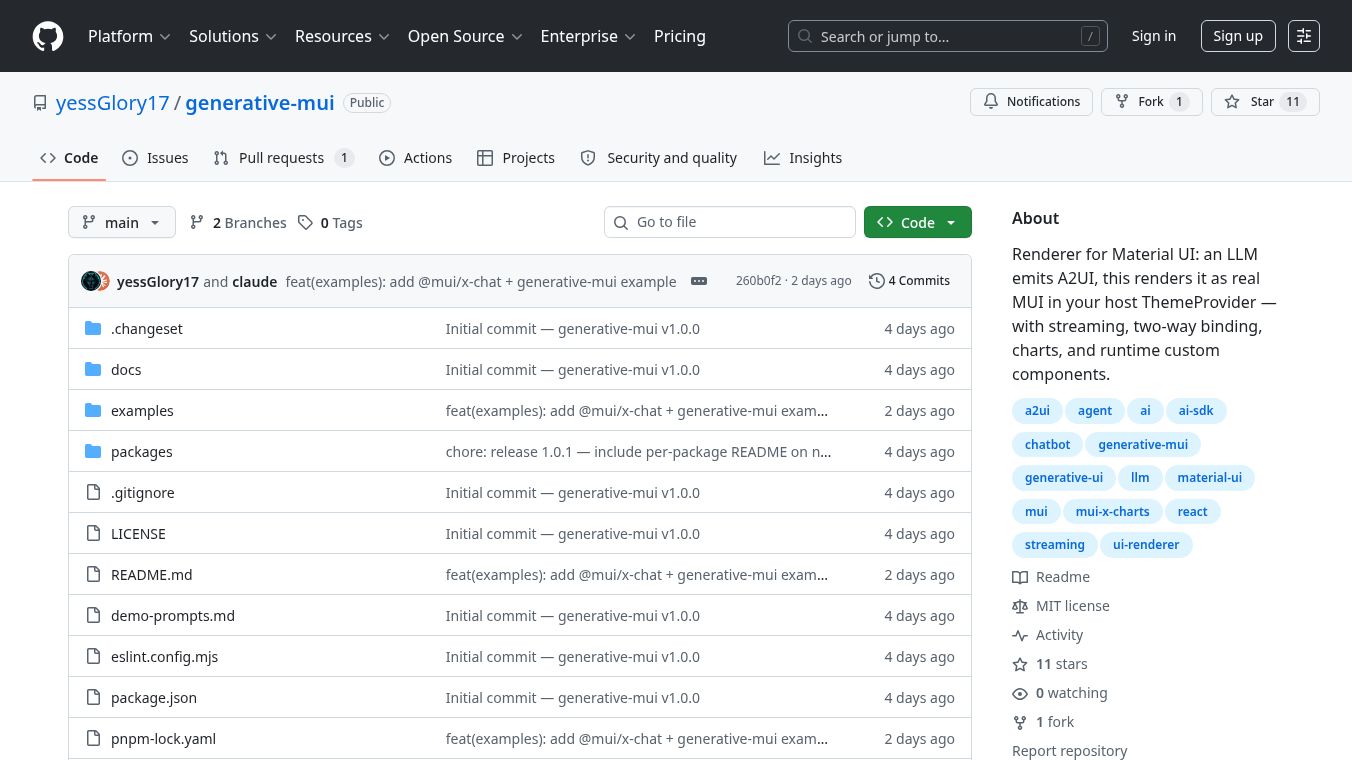





Generative MUI: Let the LLM Build the UI — Not You
Overview
Generative MUI is a library designed to bridge the gap between Large Language Models and Material UI. It enables agents to generate real, working Material UI components based on natural language descriptions, rather than returning raw HTML or requiring manual code writing. The system operates on a unique principle: the model emits data, not code. Specifically, it uses a format called A2UI, which is a flat, schema-validated list of components referenced by ID, bound to a separate data model via JSON-Pointers. This approach ensures safety, theme consistency, and deterministic rendering within the host application's existing MUI theme.
Benefits
Generative MUI offers several key advantages over traditional methods of integrating AI-generated interfaces. First, it eliminates the need for developers to manually write components for every scenario, which is often slow and repetitive. Second, it avoids the security risks associated with trusting models to output raw HTML, which can lead to vulnerabilities and broken themes. By using a structured data description, the library guarantees that no unregistered types are rendered and that styling properties from the agent never bypass the host theme. The system also supports true two-way binding, meaning user input updates the data model instantly and reflects in the UI. Additionally, the architecture is resilient, handling untrusted agent output gracefully by degrading to placeholders if a stream is truncated or an error occurs.
Use Cases
Generative MUI is ideal for scenarios where dynamic, AI-driven interfaces are needed without compromising on safety or design consistency. It works well in React applications using Material UI, allowing developers to integrate AI agents that can build forms, dashboards, or chat interfaces on the fly. The library supports various stack configurations, including Vite with React SPAs, Next.js App Routers, and even MUI chat components. It is particularly useful for building applications where the UI structure needs to change based on user input or AI decisions, such as in conversational agents or adaptive dashboards. Developers can also extend the library with custom components, making it flexible for unique project requirements.
Pricing
Pricing details are not available for Generative MUI as it appears to be an open-source project hosted on GitHub.
Vibes
Public reception and specific reviews are not available in the provided information. However, the project's architecture and design principles suggest a strong focus on security, flexibility, and developer experience.
Additional Information
Generative MUI is an open-source project hosted on GitHub. It is built on four pure layers, ensuring that the first three layers are framework-agnostic. The project enforces a strict one-way dependency structure to maintain clarity and modularity. The test suite covers JSON-Pointer round-trips, SurfaceStore determinism, drift against catalog.json, and zero accessibility violations. The project is actively maintained, with contributions and testing instructions available for developers who wish to participate.
This content is either user submitted or generated using AI technology (including, but not limited to, Google Gemini API, Llama, Grok, and Mistral), based on automated research and analysis of public data sources from search engines like DuckDuckGo, Google Search, and SearXNG, and directly from the tool's own website and with minimal to no human editing/review. THEJO AI is not affiliated with or endorsed by the AI tools or services mentioned. This is provided for informational and reference purposes only, is not an endorsement or official advice, and may contain inaccuracies or biases. Please verify details with original sources.



Comments
Please log in to post a comment.