Cognato AI
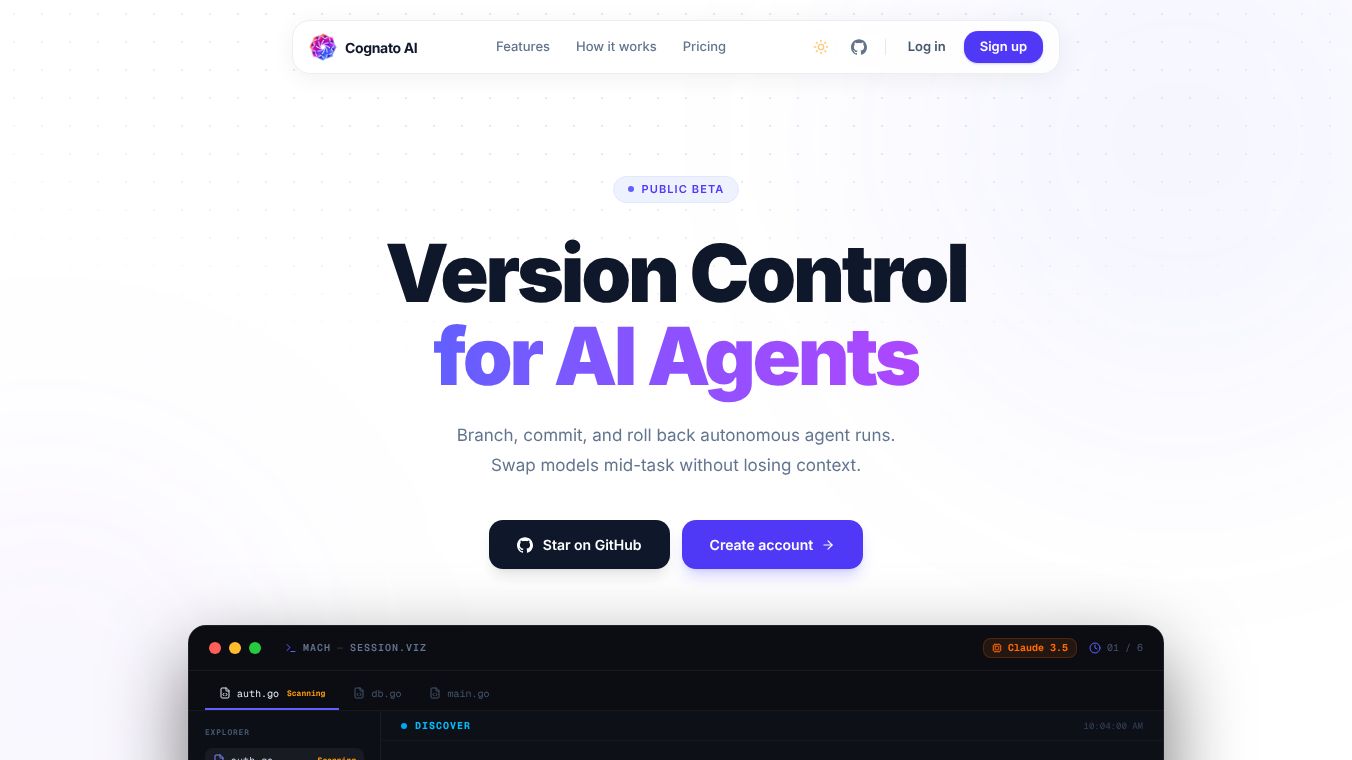





Version Control for AI Agents: Introducing Mach
Research Context and Background
Mach is an open-source framework designed to bring Git-like version control to autonomous AI agents. It enables developers to branch, commit, and roll back agent runs, while allowing for model swaps mid-task without losing context. Traditional AI execution lacks the version control capabilities necessary for robust engineering. When AI agents encounter obstacles, developers face significant challenges because they cannot inspect the agent's thought process, rewind to a state before a wrong decision, or seamlessly transfer the exact context to a different model. Mach solves this problem by providing infinite control over agent workflows.
Benefits
Mach offers several key advantages for developers and teams working with AI agents. It provides snapshot memory states where full working-set context is committed as diff-able and indexable snapshots. Teams can start with one model's reasoning, hit a blocker, serialize the context, and resume with a different model with zero re-prompting. This model-agnostic handoff allows for flexibility in choosing the best tool for the job. The system also supports parallel branches where any session can be forked into independent sub-agents that race to a solution, with the best result merged back. Users can time-travel and roll back to any commit, apply a corrected prompt, and replay the session without starting over. Additionally, the system offers enterprise-grade compliance with fine-grained permissions on file writes, network calls, and shell access, along with immutable audit trails ready for SOC 2 Type II compliance.
Use Cases
Mach is useful in various scenarios where AI agents are used for complex tasks. For example, consider a scenario where an agent is building an authentication module. An agent is spawned on a branch and scans the workspace. If the agent encounters an error like a nil pointer dereference in the auth middleware, the Mach protocol locks the session, serializes the full context, and hands off the task to a different model. The new model restores the context, applies a fix, and runs a test suite successfully. The session changes are then committed and pushed to the trunk registry. This workflow is applicable to individual developers working on local projects as well as large enterprises needing shared cloud registries, team collaboration features, and webhook integrations. It is also suitable for teams requiring custom private deployments with private clusters, Single Sign-On, granular Role-Based Access Control, and dedicated support.
Pricing
Mach offers different deployment options to suit various needs. The open-source version is free and local-first, requiring no account. It supports unlimited local sessions, model-agnostic handoffs, and is MIT licensed. The Dev Cloud option is in early access and offers a hosted solution with shared cloud registries, a web dashboard for logs, team collaboration features, and webhook integrations. The Enterprise option provides custom private deployments featuring private clusters, Single Sign-On, granular Role-Based Access Control, and dedicated support. Specific pricing details for the Dev Cloud and Enterprise options are not publicly available.
Vibes
Mach represents a significant step forward in multi-agent engineering, transforming AI agent execution from a linear, opaque process into a version-controlled, auditable, and collaborative workflow. The open-source nature of the project and its MIT license suggest a commitment to community-driven development and accessibility. The ability to handle complex tasks with multiple models and the robust compliance features indicate that Mach is well-suited for both individual developers and large organizations.
Additional Information
Mach is an open-source project with an MIT license. It is structured to scale from individual developers to large enterprises. The project includes a free CLI requiring no account for local use and offers a hosted solution in early access for teams. Enterprise customers can opt for custom private deployments with advanced security and support features. The project aims to provide a robust solution for version control in AI agent workflows, making it easier for developers to manage and collaborate on complex AI tasks.
This content is either user submitted or generated using AI technology (including, but not limited to, Google Gemini API, Llama, Grok, and Mistral), based on automated research and analysis of public data sources from search engines like DuckDuckGo, Google Search, and SearXNG, and directly from the tool's own website and with minimal to no human editing/review. THEJO AI is not affiliated with or endorsed by the AI tools or services mentioned. This is provided for informational and reference purposes only, is not an endorsement or official advice, and may contain inaccuracies or biases. Please verify details with original sources.

Comments
Please log in to post a comment.