gater
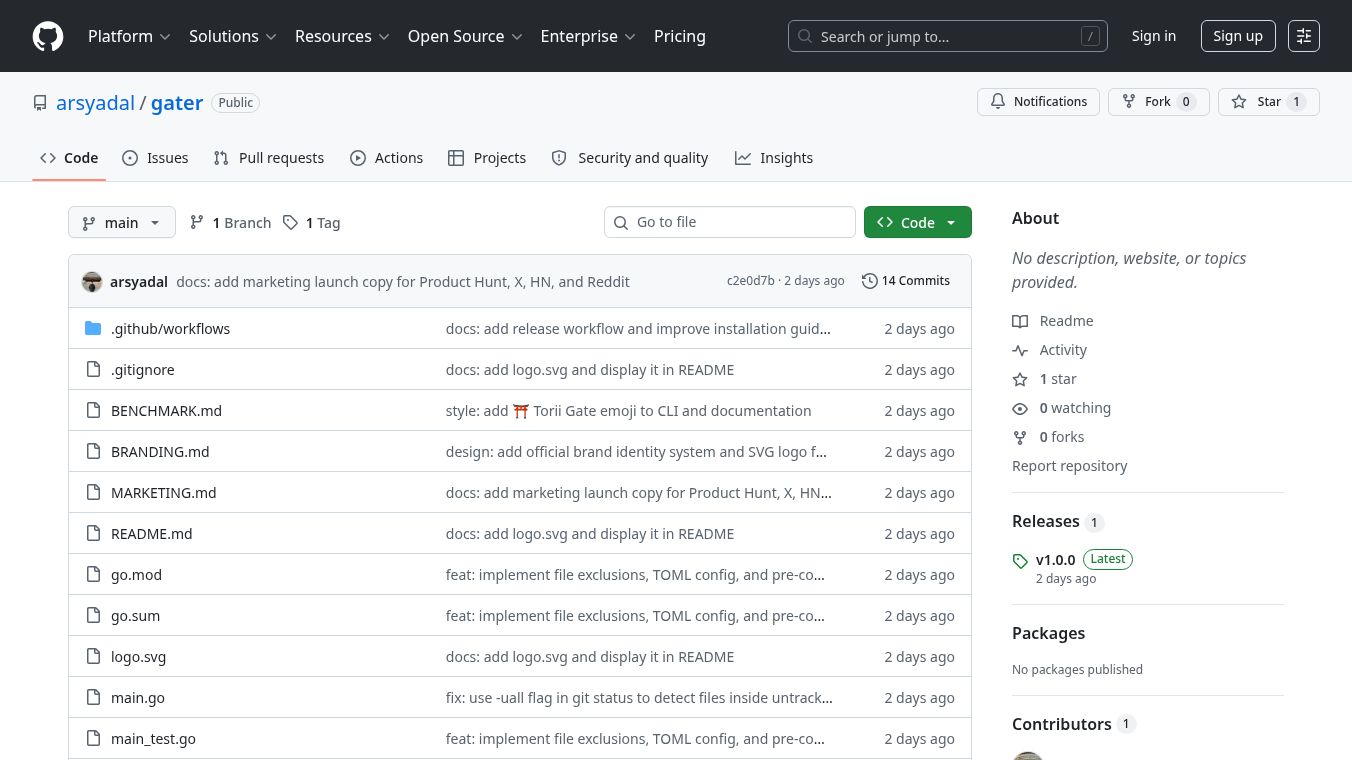





Gater: The Zero-Token Architectural Gatekeeper for AI Coding Agents
Research Context and Background
Gater is a lightweight software tool designed to help developers keep their code clean when using artificial intelligence assistants. It acts as a strict gatekeeper that stops AI coding agents from breaking the rules of good software architecture. The tool runs locally on a developer's computer and does not send any code to the cloud, which means it is fast and private. It is written in the Go programming language and works as a command-line tool that can also connect to AI assistants through a standard protocol called Model Context Protocol.
Benefits
Gater offers several major advantages for teams that use AI to write code. First, it is incredibly fast. It can scan a large project with thousands of files in less than three milliseconds. This speed ensures that it does not slow down the development workflow. Second, it is completely free to use in terms of cost. Unlike many AI tools that charge per word or line of code, Gater uses zero tokens. This makes it a cost-effective solution for large projects. Third, it prevents bad code from being saved. By stopping violations before they happen, it saves engineers from wasting time on manual code reviews and fixing architectural mistakes later. Finally, it works with any programming language, making it versatile for different types of software teams.
Use Cases
Gater is most useful for development teams that rely on AI agents like Claude Code, Cursor, or Copilot to build applications. It is ideal for projects that require strict separation of concerns, such as keeping database logic separate from web interface logic. Developers can use it as a pre-commit hook, which means it automatically checks code before it is saved to the version control system. If the AI tries to put a database query directly into a web handler, Gater will catch the error and stop the commit. Teams can also use it as an MCP server to give their AI assistants real-time feedback on architectural rules. It is suitable for any project using TypeScript, Python, Go, PHP, or other languages where maintaining a clean structure is important.
Pricing
Gater is released under the MIT License. This means it is completely free for both personal and commercial projects. There are no hidden costs or subscription fees to use the tool.
Vibes
As a newly released open-source tool, there are no public reviews or testimonials available yet. However, the project has gained attention in the developer community for solving a specific and growing problem: the tendency of AI agents to create messy, interconnected code known as "AI spaghetti." The tool is designed to be a practical solution for teams looking to maintain high code quality without incurring extra costs or slowing down their AI-assisted workflow.
Additional Information
Gater was created by Arsyad Al and is hosted on GitHub. The project is written in Go and does not require any external dependencies to run. Pre-compiled binaries are available for macOS, Linux, and Windows, so users do not need to install the Go programming language to use it. The tool supports configuration through simple JSON or TOML files, allowing teams to define their own rules for what is allowed and what is forbidden in their code. It is designed to be a local-only solution, ensuring that code remains private and never leaves the developer's machine.
This content is either user submitted or generated using AI technology (including, but not limited to, Google Gemini API, Llama, Grok, and Mistral), based on automated research and analysis of public data sources from search engines like DuckDuckGo, Google Search, and SearXNG, and directly from the tool's own website and with minimal to no human editing/review. THEJO AI is not affiliated with or endorsed by the AI tools or services mentioned. This is provided for informational and reference purposes only, is not an endorsement or official advice, and may contain inaccuracies or biases. Please verify details with original sources.


Comments
Please log in to post a comment.