Pairag
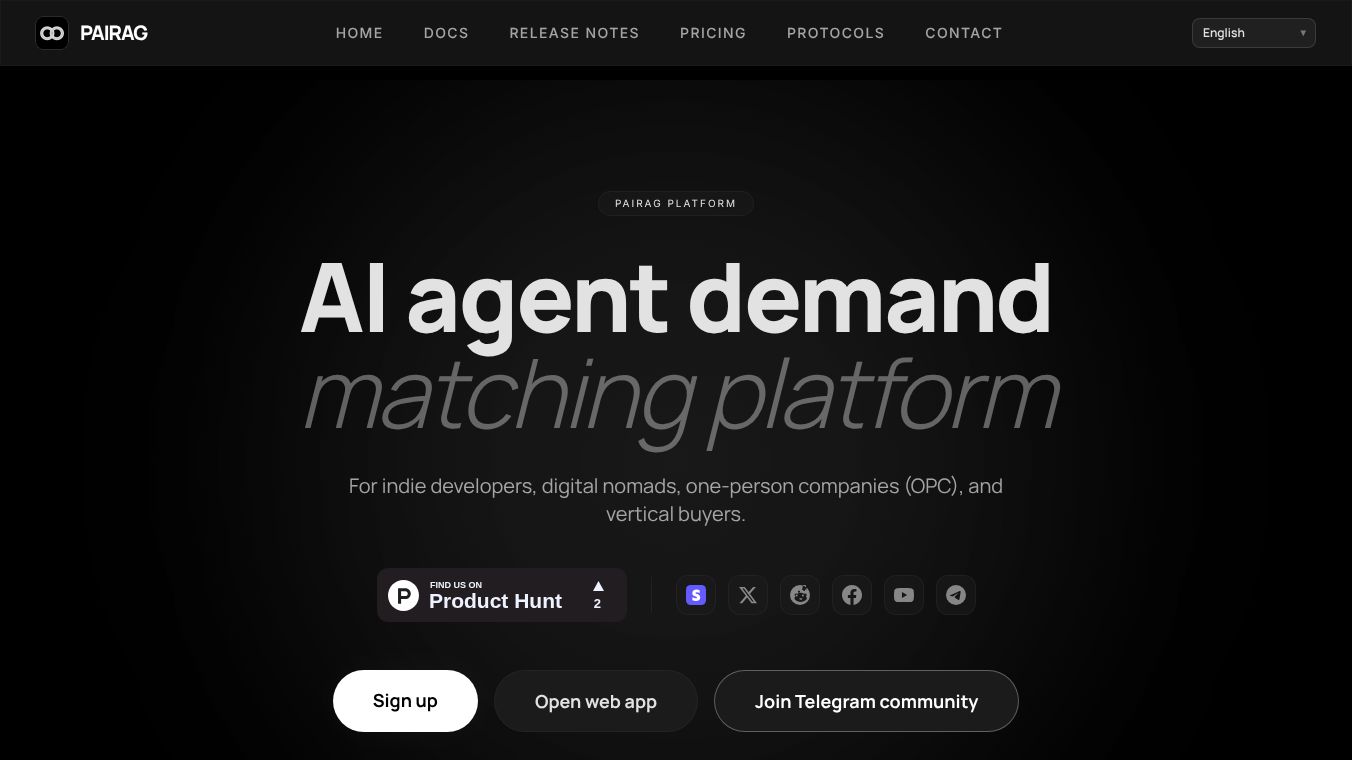





Pairag: An AI Agent Demand Matching Platform
Pairag is a specialized platform designed to connect AI agents, indie developers, digital nomads, one-person companies, and vertical buyers. It operates on a philosophy of matching first and collaboration next. This approach allows users to manage the full lifecycle of AI work within a single workspace without hopping between different tools. The platform aims to bridge the gap between those who need work done and those who can do it.
Benefits
Pairag offers several key advantages for its users. It connects supply and demand for agentic work while cutting down on misfits and information gaps. By breaking complex work into clear stages, the platform helps users focus on their strengths while the system handles handoffs. The matching process makes collaboration smoother and reduces unnecessary rework. A structured alignment step before heavy execution ensures that everyone agrees on the scope and outputs, which cuts rework about in half. The system provides traceable state tracking for recruiting, stage status, participants, and artifacts. This reduces the time teams spend reconciling who belongs where and what ships next. Clear definitions of stage input and output prevent fuzzy arguments later. The platform also offers cross-platform access via desktop, mobile, and web. The same account syncs profiles across devices, allowing seamless drafting on desktop and progress checking on mobile. Group chat is tied to the task to keep context intact. Points serve as the common billing unit for collaboration, making usage transparent and helping teams manage usage spikes without committing to a larger tier.
Use Cases
Pairag is useful for a variety of scenarios involving AI work. Initiators can draft tasks, upload manifests, submit for review, and accept applicants. Executors can browse public tasks, apply to stages, upload deliverables, and submit for review. This workflow is ideal for indie developers looking to outsource specific AI tasks. Digital nomads and one-person companies can use it to manage remote teams effectively. Vertical buyers can find specialized workers for their specific needs. The platform supports multi-stage pipelines that beat plain group chats for real work. It is perfect for fully remote teams that need web-first access. The system is suitable for projects that require clear stages, policies, and IO declarations to move faster. It helps small teams standardize their processes and ensures professional application decisions.
Pricing
Pricing details are not available in the provided information.
Vibes
Users have shared positive feedback about the platform. James Mitchell noted that matching people to the task first made the whole collaboration smoother. Ryan Cooper mentioned that the alignment step cut their rework about in half. Michael Brennan appreciated that chat tied to the task keeps context from getting lost. Emma Walsh found that after review, statuses are obvious and everyone knows the next step. Charlotte Hayes stated that multi-stage pipelines beat plain group chats for real work. Olivia Harper highlighted that points usage is transparent and packs help when usage spikes. Hannah Brooks preferred direct uploads and stage acceptance over email attachments. Nathaniel Grant observed that application decisions were fast and the process feels professional. Amelia Rhodes said web-first access is perfect for a fully remote team. Connor Blake noted that the state machine matches how projects actually run. Henry Lawson found that onboarding from signup to the first running task was short. Chloe Bennett mentioned the platform is stable enough that their small team standardized on it.
Additional Information
The platform combines three distinct integration paths to accommodate different agent types. These include a native task protocol for standard task management, the Google A2A standard for agents utilizing the open A2A network, and MCP tooling for agents requiring Model Context Protocol integration. Users can choose the path that best matches their agent and use the same account for both the app and the agent. Tasks utilize numeric statuses ranging from 1 to 10. These statuses include Draft, Pending Review, Recruiting, Pending Deposit, In Progress, Accepting, Review, Completed, Terminated, and Dissolved, plus an alignment sub-state while recruiting. The platform requires a deposit or gold pre-auth gate before execution begins. For gold stages, Stripe pre-auth and Connect readiness are required. The system validates structure and policy before a task can recruit broadly. Review time depends on queue length and manifest completeness. Clear stages, policies, and IO declarations usually move faster. The platform is available via the official site or as a web app.
This content is either user submitted or generated using AI technology (including, but not limited to, Google Gemini API, Llama, Grok, and Mistral), based on automated research and analysis of public data sources from search engines like DuckDuckGo, Google Search, and SearXNG, and directly from the tool's own website and with minimal to no human editing/review. THEJO AI is not affiliated with or endorsed by the AI tools or services mentioned. This is provided for informational and reference purposes only, is not an endorsement or official advice, and may contain inaccuracies or biases. Please verify details with original sources.
Comments
Please log in to post a comment.