OpenComputer
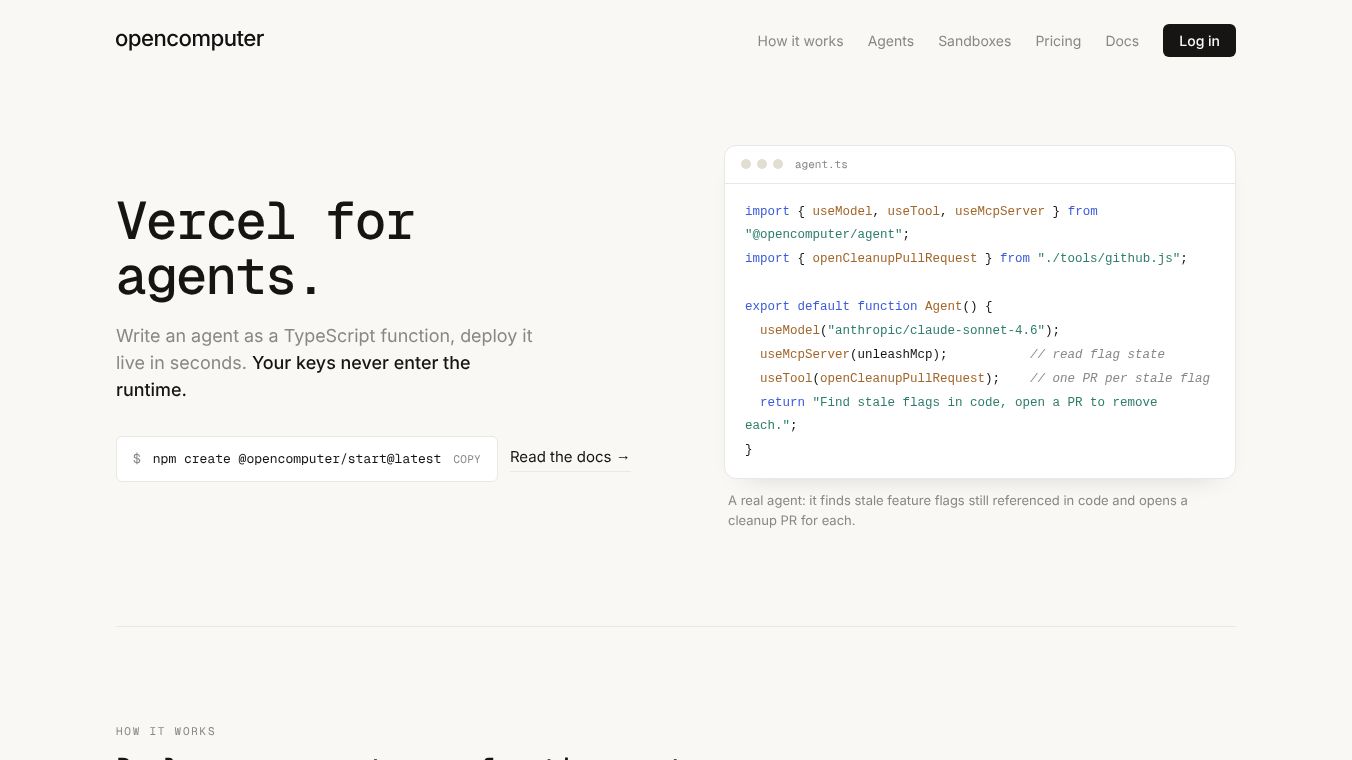





Vercel for Agents: Deploy Intelligent Agents as Functions
Overview
OpenComputer is a platform that lets developers build and run intelligent agents as simple TypeScript functions. Think of it as a way to turn code into a live, working assistant that can perform complex tasks on a real Linux computer. The main goal is to keep your API keys and secrets safe while giving the agent full power to do its job. It handles the hard parts like running loops, managing sessions, and streaming results so developers can focus on writing the logic.
Benefits
OpenComputer offers several key advantages for building and deploying agents. First, it keeps your secrets secure. The platform ensures that API keys never enter the main runtime environment. Instead, secrets are injected only when needed for a specific task, and the system masks them in logs to prevent leaks. Second, it provides a full Linux environment. Agents have access to a real microVM with a shell, file system, and package managers. This means they can install software, run browsers, process media files, and clone code repositories just like a normal computer. Third, it simplifies deployment. Developers can write their agent code and deploy it with a single command. The platform automatically handles versioning, streaming output, and session management. Finally, it offers flexible session control. Users can pause, resume, or steer an agent mid-run, and idle sessions automatically hibernate to save costs.
Use Cases
OpenComputer is designed for a wide range of automated tasks. Developers can use it to build agents that monitor code repositories and automatically open pull requests to clean up stale flags. It is also useful for media processing tasks where an agent needs to run video tools like ffmpeg. The platform supports browser automation, allowing agents to interact with websites or perform web-based workflows. For teams, it enables scheduled automation. Users can set up cron jobs to run hygiene tasks on specific days and times, with automatic notifications sent to Slack. Advanced users can also use the direct sandbox API to manage their own custom loops and rules while still benefiting from the secure compute infrastructure. The platform scales automatically, so it works for small scripts as well as large, continuous operations.
Pricing
OpenComputer uses a pay-as-you-go model with prepaid plans available. New users get $10 in free credits to start. The pricing is based on two main meters: token usage for model calls and machine time for compute resources. Model calls are billed at the standard API rates with no markup. Machine time is charged per second based on the resources used. Sessions start with a baseline of 2 GB of RAM and 1 vCPU but can burst to higher specs if needed. There are several tiers to choose from. The Pro plan costs $20 per month and includes a 10x credit multiplier. The Max plan costs $200 per month and is designed for running multiple machines 24/7. Enterprise customers can negotiate custom terms for self-hosted connections and volume pricing. A session running for ten minutes a day on the default machine costs about $1 per month.
Vibes
The platform is designed to be developer-friendly and secure. Reviews and documentation highlight the ease of deployment and the robustness of the Linux environment. Users appreciate the ability to bring their own API keys and the flexibility to switch between managed agents and direct sandbox access. The security model, where secrets are bound to specific origins and masked in logs, is a major selling point for teams handling sensitive data. The community response has been positive, with developers praising the clear code examples and the seamless integration of AI models with real-world computing tasks. The platform feels like a natural evolution of serverless computing, tailored specifically for the needs of autonomous agents.
Additional Information
OpenComputer is built on the same infrastructure used by Vercel for serverless functions, ensuring high reliability and performance. The platform supports various AI models, allowing users to specify which model to use for each request. It also integrates with Model Context Protocol (MCP) servers to enable agents to interact with external tools and data sources. The team is focused on expanding features like persistent storage across sandboxes to further enhance the capabilities of long-running agents. Partnerships with major AI model providers ensure that users have access to the latest and most powerful models without needing to manage complex integrations themselves.
This content is either user submitted or generated using AI technology (including, but not limited to, Google Gemini API, Llama, Grok, and Mistral), based on automated research and analysis of public data sources from search engines like DuckDuckGo, Google Search, and SearXNG, and directly from the tool's own website and with minimal to no human editing/review. THEJO AI is not affiliated with or endorsed by the AI tools or services mentioned. This is provided for informational and reference purposes only, is not an endorsement or official advice, and may contain inaccuracies or biases. Please verify details with original sources.
Comments
Please log in to post a comment.