Lineation
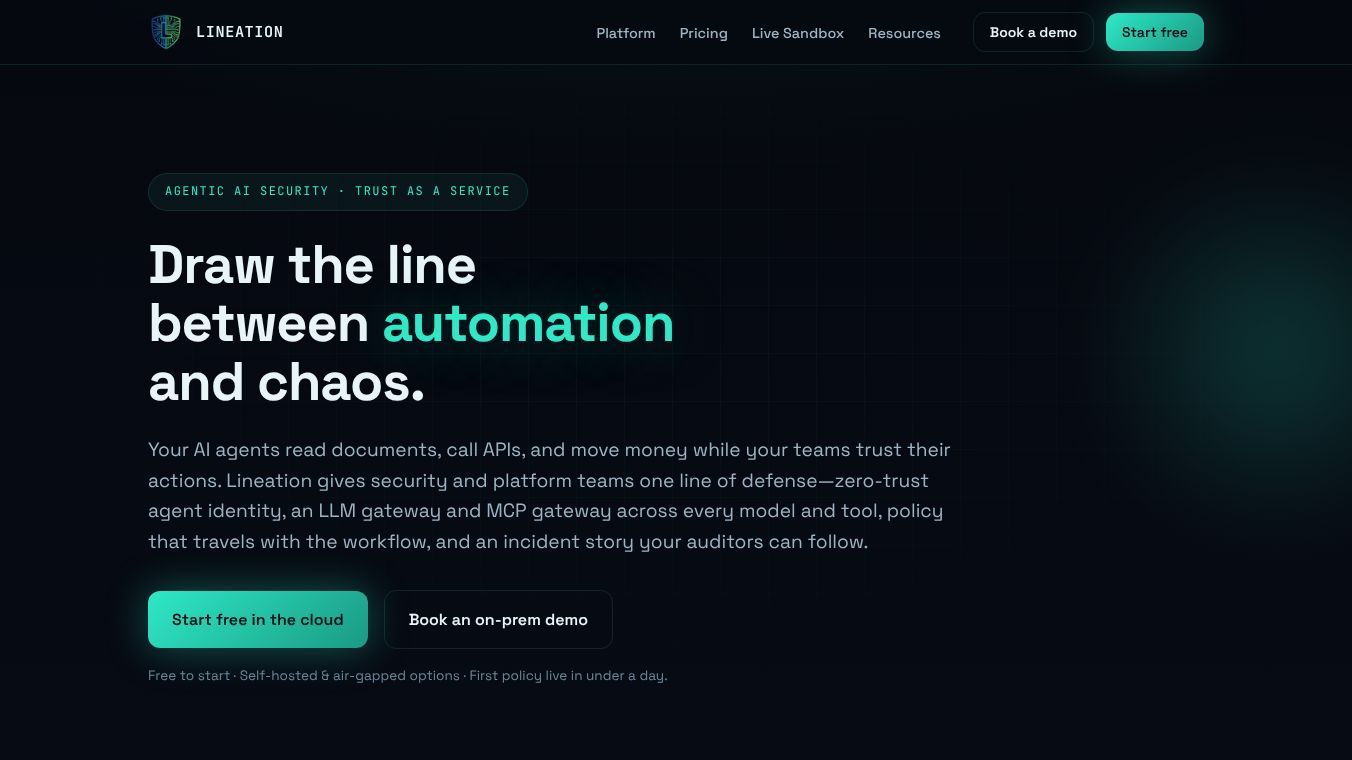





Lineation: Drawing the Line Between Automation and Chaos in Agentic AI
Research Context and Background
As artificial intelligence agents become more powerful, they can now read documents, call external tools, and even move money on their own. This shift has created a new security challenge. Traditional security methods that worked for simple software no longer fit this dynamic environment. Risks now come from hidden attacks, tools that have too much power, and data leaving systems without permission. These problems happen across many different cloud providers and are hard to track. Security teams often spend hours guessing what went wrong because their tools only show partial information. Lineation was built to solve this problem by providing a single, clear view of what AI agents are doing from start to finish.
Benefits
Lineation acts as a central control point for security teams. It offers three main layers of protection to help organizations manage AI safely.
First, it provides deep visibility. The platform can see what every AI agent is doing in real time. It connects with major providers like OpenAI, Google, and Microsoft to show a complete picture. It can also find unauthorized agents that employees might be using without telling the security team. This helps teams understand exactly how their AI systems are behaving.
Second, it gives teams control over actions. Lineation uses a strict rule that nothing happens unless it is allowed. It checks every request before it reaches production systems. Teams can set rules that require human approval for important tasks. It also keeps permanent records of every action taken, which is essential for passing audits and proving compliance with laws like HIPAA or the EU AI Act.
Third, it offers active defense. The platform can block malicious inputs before they reach the AI. It automatically removes sensitive personal information from outputs to protect privacy. It can also run agents in isolated environments and has a kill switch to stop an agent immediately if it starts acting strangely.
Use Cases
Lineation is designed for organizations that are building or using autonomous AI workflows. It is useful for companies that want to move fast with AI but still need to stay safe.
Security teams can use Lineation to quickly investigate incidents. Instead of spending hours searching through different logs, they can see the full story of an event in minutes. This helps them fix problems before they cause real damage.
Compliance officers can use the platform to meet strict regulations. The built-in templates help organizations show they are following rules for data privacy and safety. The detailed records make it easy to prove to auditors that their AI systems are under control.
Development teams can use Lineation to test their AI applications safely. They can run agents in a sandboxed environment to see how they behave without risking real data or systems. This allows them to catch errors and security flaws early in the development process.
Pricing
Lineation offers flexible options to fit different needs. Organizations can start for free in the cloud to test the platform. For larger enterprises with specific security requirements, Lineation also supports self-hosted and air-gapped deployments. This means companies can run the software on their own servers if they need to keep their data completely isolated from the internet.
Vibes
Early users and design partners have reported significant improvements after adopting Lineation. One major benefit is the speed of incident response. Teams that used to spend about two hours figuring out what went wrong can now do it in less than five minutes. Another positive outcome is better policy coverage, with many partners achieving over 80% of their workflows under strict security rules. The platform also maintains a low rate of false alarms, ensuring that security teams are not distracted by unnecessary alerts. Users appreciate how quickly they can get started, with the first security policy often live in under one day.
Additional Information
Lineation is built to align with major industry standards like OWASP and NIST. These are widely used guidelines for AI safety and security. However, it is important to note that Lineation is not officially certified by these organizations. The platform uses these standards to create templates and guides that help companies implement best practices. This approach allows organizations to follow proven methods without relying on a single vendor for certification.
This content is either user submitted or generated using AI technology (including, but not limited to, Google Gemini API, Llama, Grok, and Mistral), based on automated research and analysis of public data sources from search engines like DuckDuckGo, Google Search, and SearXNG, and directly from the tool's own website and with minimal to no human editing/review. THEJO AI is not affiliated with or endorsed by the AI tools or services mentioned. This is provided for informational and reference purposes only, is not an endorsement or official advice, and may contain inaccuracies or biases. Please verify details with original sources.


Comments
Please log in to post a comment.