Kimi K2.7 Code
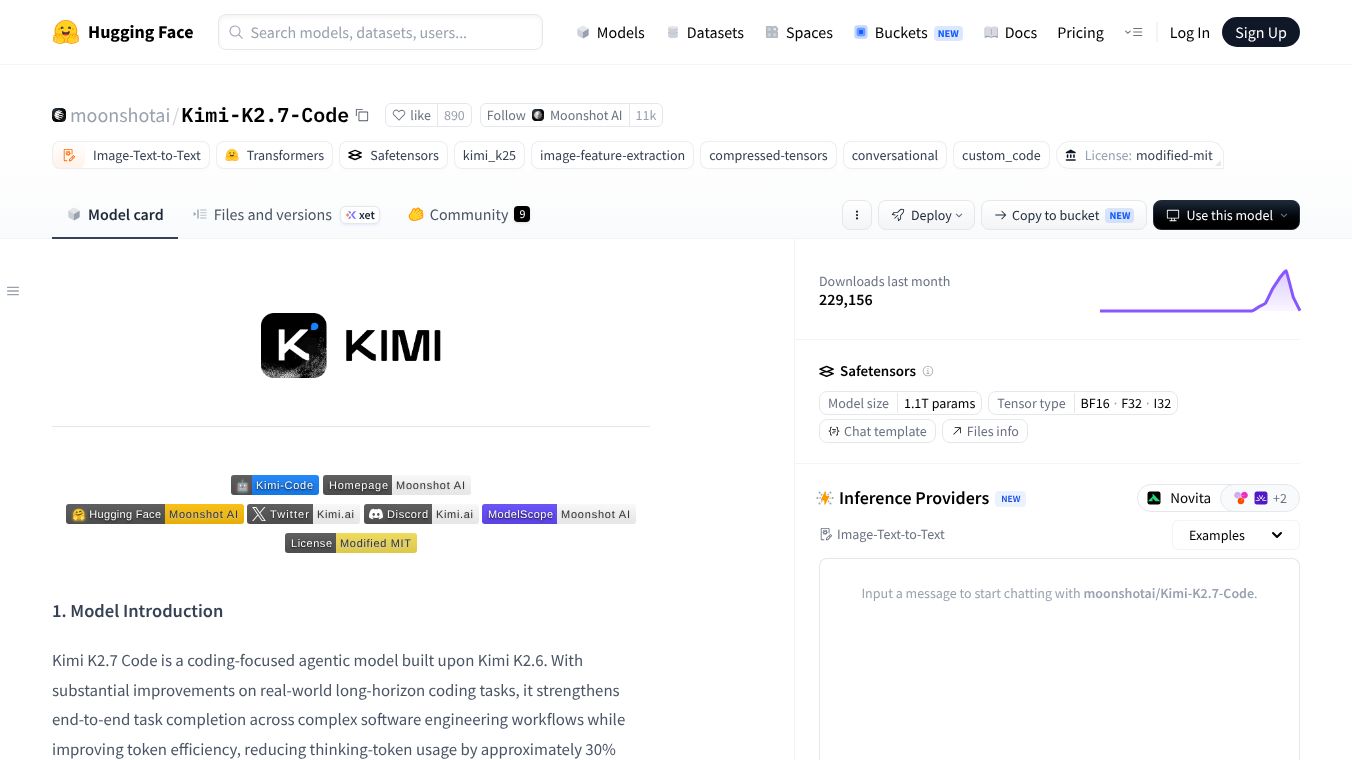





Kimi K2.7 Code: An Open-Source, Coding-Focused Agentic Model
Overview
Kimi K2.7 Code is an open-source, coding-focused agentic model developed by Moonshot AI. Designed specifically for long-horizon software engineering tasks, it delivers superior coding and agent performance compared to its predecessor, K2.6. The model is optimized for real-world workflows such as refactoring codebases, implementing features across multiple files, and debugging over extended sessions. Key improvements include higher end-to-end task success rates and a significant reduction in reasoning efficiency costs.
Benefits
Kimi K2.7 Code demonstrates substantial gains over K2.6 across various benchmarks, covering both coding capability and autonomous agent execution.
Coding Capability
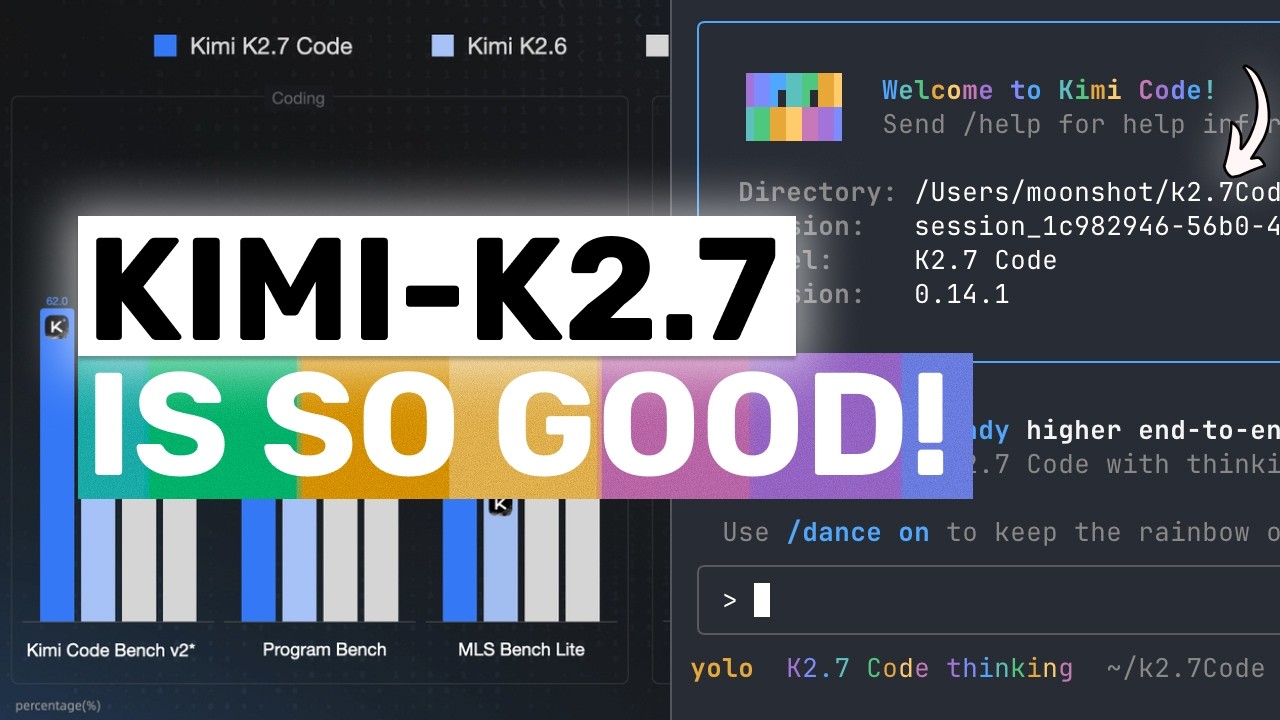
On internal and external coding benchmarks, K2.7 Code shows significant performance lifts:*Kimi Code Bench v2:+21.8% improvement (Score: 62.0 vs. 50.9).*Program Bench:+11.0% improvement (Score: 53.6 vs. 48.3).*MLS Bench Lite:+31.5% improvement (Score: 35.1 vs. 26.7).
Agentic Task Execution
The enhanced coding capability translates to stronger autonomous performance. On benchmarks measuring agent task execution (Kimi Claw 24/7 Bench, MCP Atlas, and MCP Mark Verified), K2.7 Code improves by approximately 10% over K2.6.
Reasoning Efficiency
A critical optimization in K2.7 Code is the reduction of "overthinking." The model cuts thinking-token usage by approximately30%on average compared to K2.6. This efficiency leads to faster responses in interactive sessions, lower API costs in production, and the ability to complete more work within the same context budget.
Model Architecture
Kimi K2.7 Code is built on a robust Mixture-of-Experts (MoE) architecture designed for high performance and efficiency.
- Architecture:Mixture-of-Experts (MoE) with Multi-head Latent Attention (MLA).
- Parameters:1 Trillion total parameters with 32 Billion activated parameters per token.
- Context Length:Supports a 256K context window (262,144 tokens), suitable for repository-scale codebases.
- Vision Encoder:Includes MoonViT, a 400M-parameter vision encoder.
- Layers:61 layers total (including 1 dense layer).
- Experts:384 experts with 8 selected per token; 1 shared expert.
- Vocabulary Size:160K.
- Activation Function:SwiGLU.
The full model weights are open-sourced and available on Hugging Face, accompanied by deployment guides and documentation.
Multimodal Capabilities
Kimi K2.7 Code utilizes a natively multimodal architecture. In addition to its specialized coding and agentic capabilities, it supports text, image, and video input.
Usage and Access
Kimi K2.7 Code is accessible through two primary channels:1.Kimi Code:Available via the web interface, terminal, and IDE plugins.2.Kimi API:Available on the open platform for programmatic access.
Thinking Mode Requirement
Kimi K2.7 Codedoes not support non-thinking mode. It always runs with thinking enabled on both the Kimi API and Kimi Code. If a request is made with thinking disabled in the Kimi Code interface, it is automatically served by the general-purpose K2.6 model instead.
Pricing
Kimi Code Plans (Monthly, Annual Billing)These plans include weekly refreshed usage limits and are suitable for users utilizing the terminal and IDE plugins.*Moderato ($15/month):Best for users needing weekly refreshed quotas and multi-device access for regular workflows.*Allegretto ($31/month):Best for advanced users requiring larger weekly limits and increased concurrency.*Allegro ($79/month):Best for intensive development tasks, complex projects, and larger workloads.*Vivace ($159/month):Best for users needing the highest weekly quotas for complex projects and large codebases.
Kimi API Pricing (Per-Token Billing)*Model:kimi-k2.7-code*Context Window:262,144 tokens*Input Price (Cache Hit):$0.19 per 1M tokens*Input Price (Cache Miss):$0.95 per 1M tokens*Output Price:$4.00 per 1M tokens*Note: The API supports automatic context caching to lower input costs for reused context. Prices exclude applicable taxes.
Comparison: K2.7 Code vs. K2.6
While K2.7 Code is purpose-built for coding tasks, Moonshot AI recommendsK2.6for general-purpose work such as writing, analysis, and conversation, as it offers more well-rounded capabilities. K2.7 Code should be selected specifically for complex software engineering workflows requiring deep coding reasoning and agentic execution.
Benchmark Data Summary
| Benchmark Category | Benchmark Name | Kimi K2.6 | Kimi K2.7 Code | GPT-5.5 | Claude Opus 4.8 |
|---|---|---|---|---|---|
| Coding | Kimi Code Bench v2 | 50.9 | 62.0 | 69.0 | 67.4 |
| Program Bench | 48.3 | 53.6 | 69.1 | 63.8 | |
| MLS Bench Lite | 26.7 | 35.1 | 35.5 | 42.8 | |
| Agentic | Kimi Claw 24/7 Bench | 42.9 | 46.9 | 52.8 | 50.4 |
| MCP Atlas | 69.4 | 76.0 | 79.4 | 81.3 | |
| MCP Mark Verified | 72.8 | 81.1 | 92.9 | 76.4 |
Note: Benchmarks were tested via Kimi Code CLI with thinking enabled (temperature 1.0, top-p 0.95, 262,144-token context). GPT-5.5 was evaluated in Codex (xhigh) and Opus 4.8 in Claude Code (xhigh).
This content is either user submitted or generated using AI technology (including, but not limited to, Google Gemini API, Llama, Grok, and Mistral), based on automated research and analysis of public data sources from search engines like DuckDuckGo, Google Search, and SearXNG, and directly from the tool's own website and with minimal to no human editing/review. THEJO AI is not affiliated with or endorsed by the AI tools or services mentioned. This is provided for informational and reference purposes only, is not an endorsement or official advice, and may contain inaccuracies or biases. Please verify details with original sources.


Comments
Please log in to post a comment.