AI Coding Tools Guide





AI Coding Tools Guide: Your 2026 Workflow Companion
Introduction
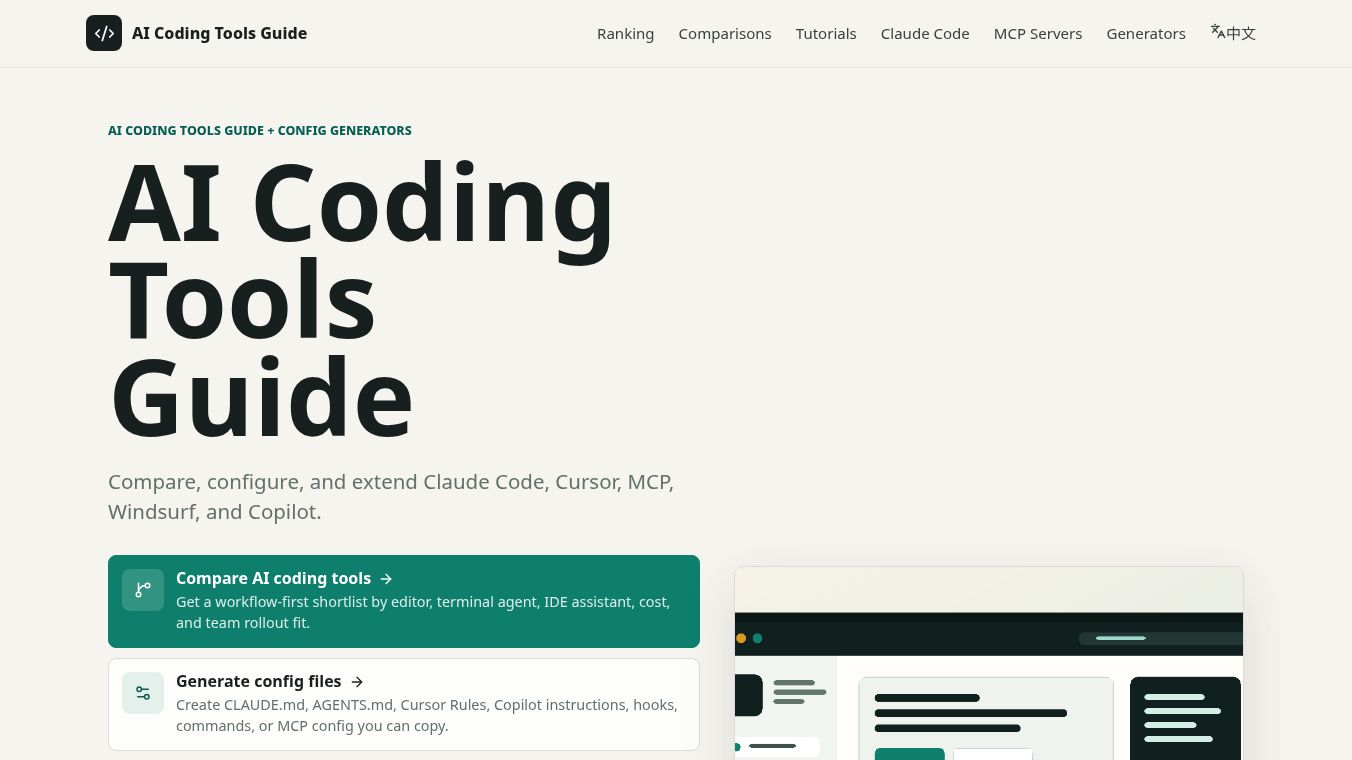
The AI Coding Tools Guide is a comprehensive resource designed to help developers and teams choose the best artificial intelligence tools for their coding needs. Published for 2026, this guide moves beyond simple feature lists to focus on how tools fit into real daily workflows. It ranks various AI coding assistants based on their ability to help users complete reviewable code changes rather than just generating small code snippets. The guide evaluates tools based on five key areas: how well they fit a specific workflow, how they handle project context, how easy it is to validate their work, how simple it is for teams to adopt them, and how easy it is for humans to review the code they produce.
Benefits
The main advantage of using this guide is that it saves time and reduces confusion in a fast-moving market. AI coding tools change quickly, and picking the wrong one can slow down a team. This guide helps users make informed decisions by comparing tools side by side. It highlights which tools are best for specific tasks like debugging, refactoring, or building new features. The guide also emphasizes the importance of human review, ensuring that developers do not blindly accept code generated by AI. By focusing on workflow fit, the guide helps teams avoid tools that look good on paper but fail in daily practice. It also provides a clear checklist for testing tools in real projects before committing to them.
Use Cases
This guide is useful for a wide range of developers and teams. Individual developers can use it to find the right tool for their daily editing tasks or for handling larger coding projects. Small teams can use the recommended stacks to combine different tools for maximum efficiency. For example, a small team might use one tool for fast daily edits and another for larger implementation tasks. Enterprise teams can find guidance on which tools offer the best security and policy controls for large organizations. Developers who prefer working in the terminal can find recommendations for command-line agents. Frontend teams can discover tools that integrate well with browser testing. The guide also helps teams decide whether to stick with one tool or use a combination of tools based on their specific needs.
Pricing
The guide does not list specific pricing details for each tool. It advises readers to verify current plans and pricing before standardizing on any tool. This is because pricing and access to models can change frequently. The guide suggests that teams should check the latest plans directly with the tool providers. It notes that some tools may have different allowances or credit systems that can change over time. Users are encouraged to evaluate the cost against the value provided by each tool in their specific context.
Vibes
The guide reflects a practical and cautious approach to adopting AI coding tools. It acknowledges that the landscape is changing rapidly and that what works today might not work tomorrow. The tone is helpful and realistic, emphasizing that there is no single best tool for everyone. It encourages teams to test tools in their own repositories to see how they perform in real scenarios. The guide suggests a quarterly review of tool choices to ensure they remain relevant. It also notes that open-source tools remain valuable for teams that need local control or explicit approval steps. The overall sentiment is one of empowerment, giving developers the knowledge to choose tools that fit their unique workflows rather than following trends blindly.
Additional Information
The guide was created with a focus on workflow-first principles. It was designed to help teams choose tools based on their specific needs rather than generic rankings. The evaluation criteria were developed to address common pain points in AI coding adoption. The guide recommends that teams run a standard test set of tasks to compare tools fairly. This test set includes fixing bugs, adding features, refactoring code, updating tests, and running build checks. The guide also mentions that some tools have moved through acquisition or transition phases, so users should check the maintenance status of each project. It provides recommended stacks for different team sizes and environments, such as a GitHub-first team or an open-source local path team.
This content is either user submitted or generated using AI technology (including, but not limited to, Google Gemini API, Llama, Grok, and Mistral), based on automated research and analysis of public data sources from search engines like DuckDuckGo, Google Search, and SearXNG, and directly from the tool's own website and with minimal to no human editing/review. THEJO AI is not affiliated with or endorsed by the AI tools or services mentioned. This is provided for informational and reference purposes only, is not an endorsement or official advice, and may contain inaccuracies or biases. Please verify details with original sources.


Comments
Please log in to post a comment.