Chista





The Economics of Shipping: Lessons from Building Chista
What is Chista
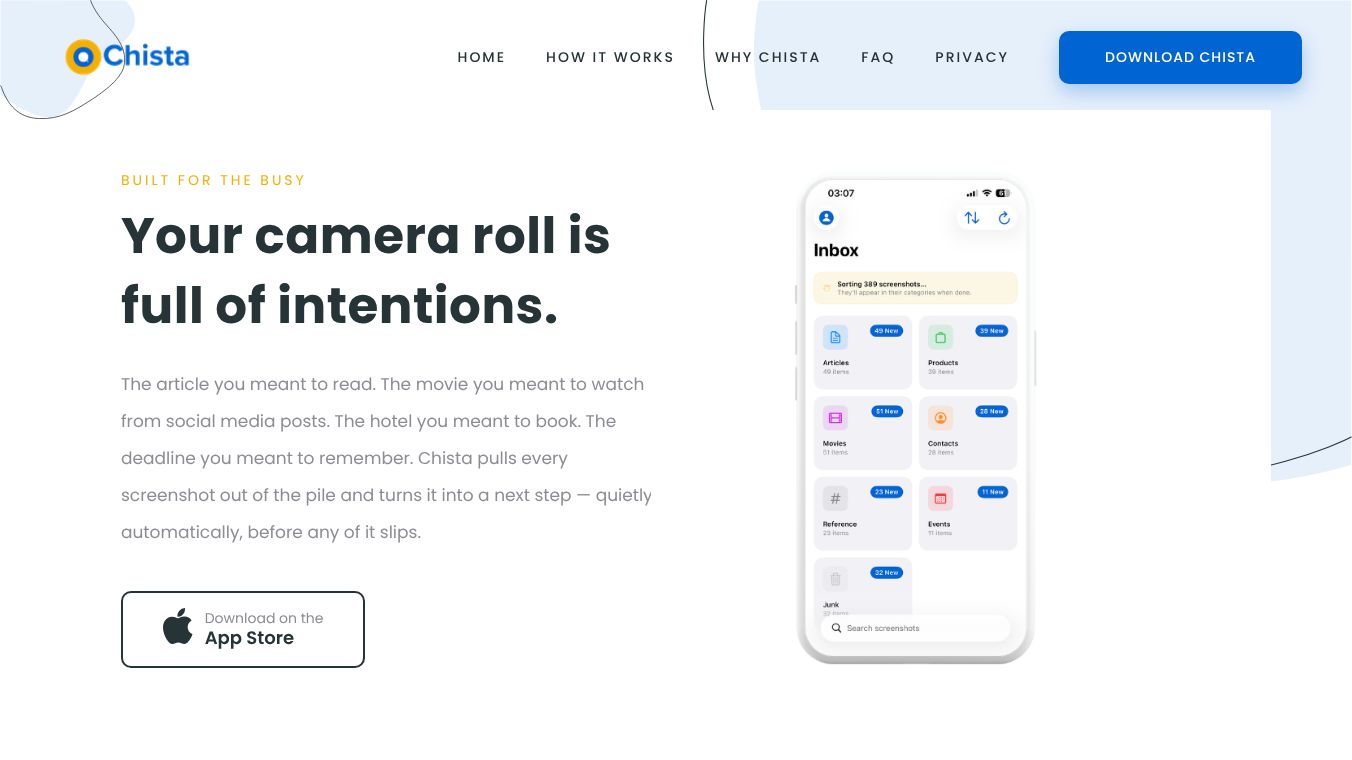
Chista is a simple application designed to solve a common problem. Many people take screenshots of articles they want to read later, recipes for future cooking, movie names from social media posts, job postings, tenders, and products they intend to revisit. However, most of these screenshots never get seen again. They eventually get buried and forgotten in a digital graveyard. Chista was built to organize these screenshots and surface the content that actually matters before it is lost forever.
The app was developed in just thirty days and is now live on the App Store. This rapid transition highlights how the cost of building software has changed. The total cost to build and ship Chista was approximately $300. This budget included an Apple Developer Account for $99, a domain name for $10, and OpenAI API credits for $100. Hosting was handled using a free tier from Cloudflare. Five years ago, building a tool like Chista would have required a significantly larger budget, more personnel, and much more time. Today, the barrier to entry has collapsed, allowing individuals to move from idea to shipped product in just weeks.
Benefits
The main benefit of Chista is that it stops good ideas from disappearing. Users often capture important information like recipes or job postings but never look at them again. Chista organizes these screenshots so they can be found easily. This ensures that valuable content is not lost in a cluttered gallery. The app also demonstrates how modern tools can be built quickly and affordably. It shows that creating useful software no longer requires a large team or a huge budget. The core insight is that software is starting to behave like content. The cost of creation is decreasing, and the time to launch is shrinking. This allows more people to build tools that solve real problems.
Use Cases
Chista is useful for anyone who takes screenshots of information they want to keep. It is perfect for students who capture articles for research. It helps cooks save recipes they find online. It is also great for job seekers who want to bookmark job postings or tenders. Users can save product details they plan to buy later. The app works on iOS devices since it is available on the App Store. It helps users manage their digital notes by turning a chaotic collection of images into an organized system. This is especially helpful in an era where the ability to build software is widespread, but curating value remains a critical task.
Pricing
The total cost to build and ship Chista was approximately $300. This included an Apple Developer Account for $99, a domain name for $10, and OpenAI API credits for $100. Hosting was handled using a free tier from Cloudflare. Other expenses were mostly free tiers. This low cost shows how accessible modern software development has become.
Vibes
The development of Chista was a quick journey from idea to app store in just thirty days. This rapid transition reflects a shift in the industry where the difficult part has moved from writing the code to deciding what should exist. The project highlights a fascinating shift where the ability to build is widespread, but the curation of value remains the critical hurdle. The success of such a small budget project shows that individuals can now create and launch tools that solve persistent problems without needing a large team or significant funding.
Additional Information
Chista was built by an individual developer who leveraged modern tools to reduce costs and time. The project used an Apple Developer Account, a domain name, OpenAI API credits, and free hosting from Cloudflare. The development timeline was only thirty days. This project serves as a case study for how the economics of software creation have changed. It shows that the primary challenge is no longer the technical act of writing software but rather deciding what value to create. The project was completed without a large team or significant coordination, demonstrating the power of modern development tools and services.
This content is either user submitted or generated using AI technology (including, but not limited to, Google Gemini API, Llama, Grok, and Mistral), based on automated research and analysis of public data sources from search engines like DuckDuckGo, Google Search, and SearXNG, and directly from the tool's own website and with minimal to no human editing/review. THEJO AI is not affiliated with or endorsed by the AI tools or services mentioned. This is provided for informational and reference purposes only, is not an endorsement or official advice, and may contain inaccuracies or biases. Please verify details with original sources.

Comments
Please log in to post a comment.