WouldPietEat
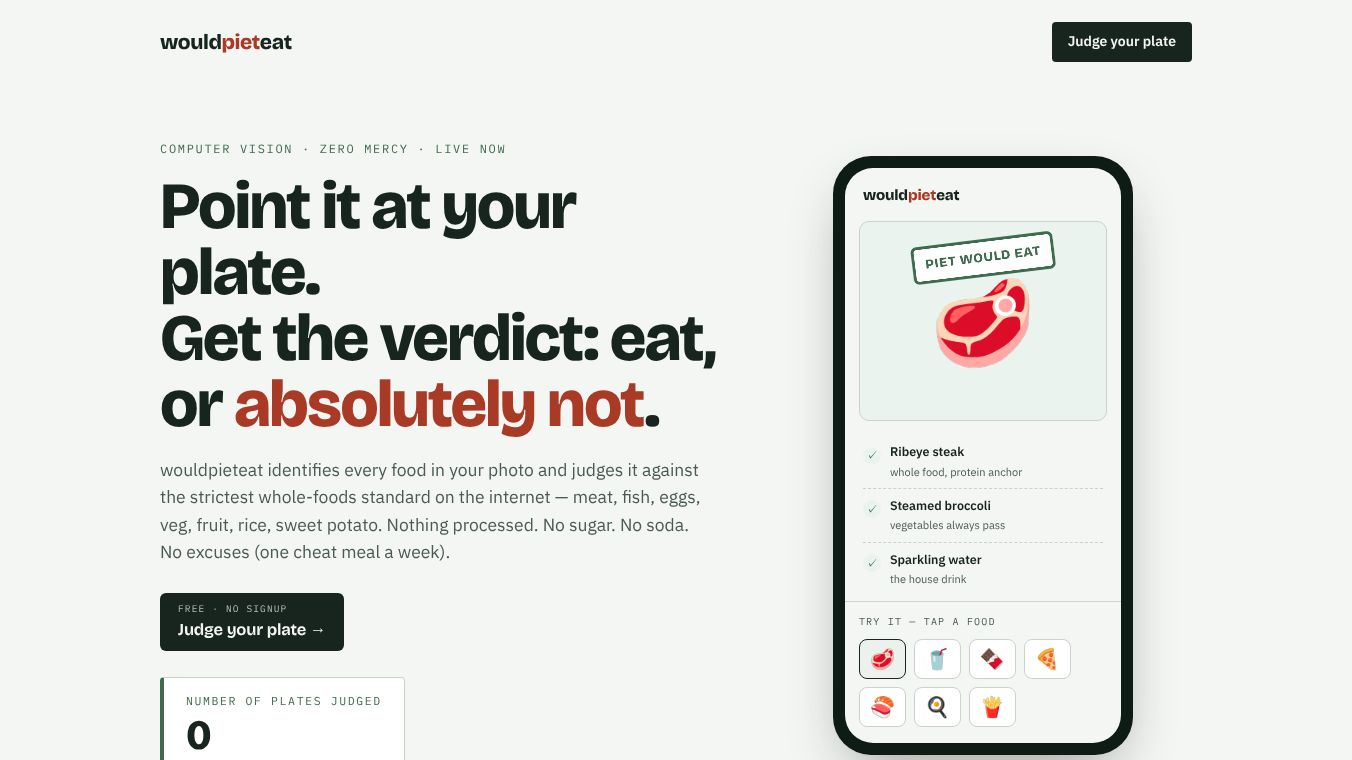





WouldPietEat: An AI-Powered Whole-Foods Diet Referee
WouldPietEat is an independent application designed to act as a strict diet referee for users following a whole-foods lifestyle. By using advanced computer vision, the app analyzes photos of food and drinks to determine if they follow a rigorous set of dietary rules. The tool is modeled on the whole-foods principles often discussed by Dutch indie hacker Pieter Levels, though it is an independent parody app with no affiliation to or endorsement by Levels himself.
Benefits
The main advantage of WouldPietEat is its simplicity. Users do not need to scan barcodes, manually log meals, or search through databases. They simply take a photo of their food, and the app handles the rest. The service uses a frontier vision-language model to identify every distinct food and drink item in an image. It then checks each item against a strict ruleset and provides a one-line reason for any rule violations. The app delivers a single overall verdict for the entire photo, making it easy to see if a meal passes the test.
Another key benefit is the clear binary standard. The app operates on the philosophy that items are either whole foods or they are not. There are no loopholes for ultra-processed items, even on a designated cheat day. This strict approach helps users stay accountable to their dietary goals without ambiguity. The app also allows users to share their verdicts easily on social media platforms like Instagram and X, which adds a fun social element to the diet tracking process.
Use Cases
WouldPietEat is ideal for anyone who wants to track their diet without the hassle of traditional logging apps. Users can photograph a plate, a snack, a drink, or even an entire fridge shelf. The app is particularly useful for people who want to ensure they are eating whole foods like steak, chicken, fish, eggs, vegetables, fruit, rice, sweet potato, plain yogurt, nuts, water, sparkling water with lemon, and black coffee.
The app is also helpful for managing cheat meals. It offers three distinct verdicts to handle different eating scenarios. If a user eats a clean plate of whole foods, they get a "PIET WOULD EAT" stamp. If they eat borderline items like burgers on buns, pizza, or sushi with sauces, the app marks it as a "CHEAT MEAL ONLY" to remind them they are using their weekly exception. If the plate contains ultra-processed items, candy, chocolate, soda, alcohol, delivery fries, or soy meat, the app issues a "WOULD NOT EAT" stamp. This system ensures that junk food fails the standard immediately, even on cheat days.
Pricing
The service uses a freemium model to remain accessible. The free tier allows users to make five judgments per day. This includes full verdicts, Piet Scores, and all sharing features. For users who want unlimited judgments without a subscription, there is a one-time payment of $9 for a Cheat Day Pass. This single payment unlocks unlimited use forever.
Vibes
While there are no formal reviews or testimonials in the provided information, the app is designed with a sense of humor and accountability in mind. The verdicts are presented as stamps, such as a "clean plate" green stamp for good meals or a "would not eat" stamp for junk food. The tone is playful yet strict, treating diet adherence like a game with clear rules and consequences. The ability to share these verdicts on social media suggests a community aspect where users might post their meals for others to judge or celebrate.
Additional Information
It is important to note that WouldPietEat is an independent build. Pieter Levels has no involvement with the app and has not endorsed it. The app is strictly for entertainment and accountability purposes. It is not health or nutrition advice. A "would not eat" stamp on a birthday cake is a joke, not a medical opinion. Users should consult a professional for actual dietary guidance. The app acknowledges that ambiguous items, such as determining if yogurt is plain or flavored, are judged conservatively. Every ruling includes reasoning to allow users to appeal to common sense if necessary.
This content is either user submitted or generated using AI technology (including, but not limited to, Google Gemini API, Llama, Grok, and Mistral), based on automated research and analysis of public data sources from search engines like DuckDuckGo, Google Search, and SearXNG, and directly from the tool's own website and with minimal to no human editing/review. THEJO AI is not affiliated with or endorsed by the AI tools or services mentioned. This is provided for informational and reference purposes only, is not an endorsement or official advice, and may contain inaccuracies or biases. Please verify details with original sources.
Comments
Please log in to post a comment.