VeritasGraph
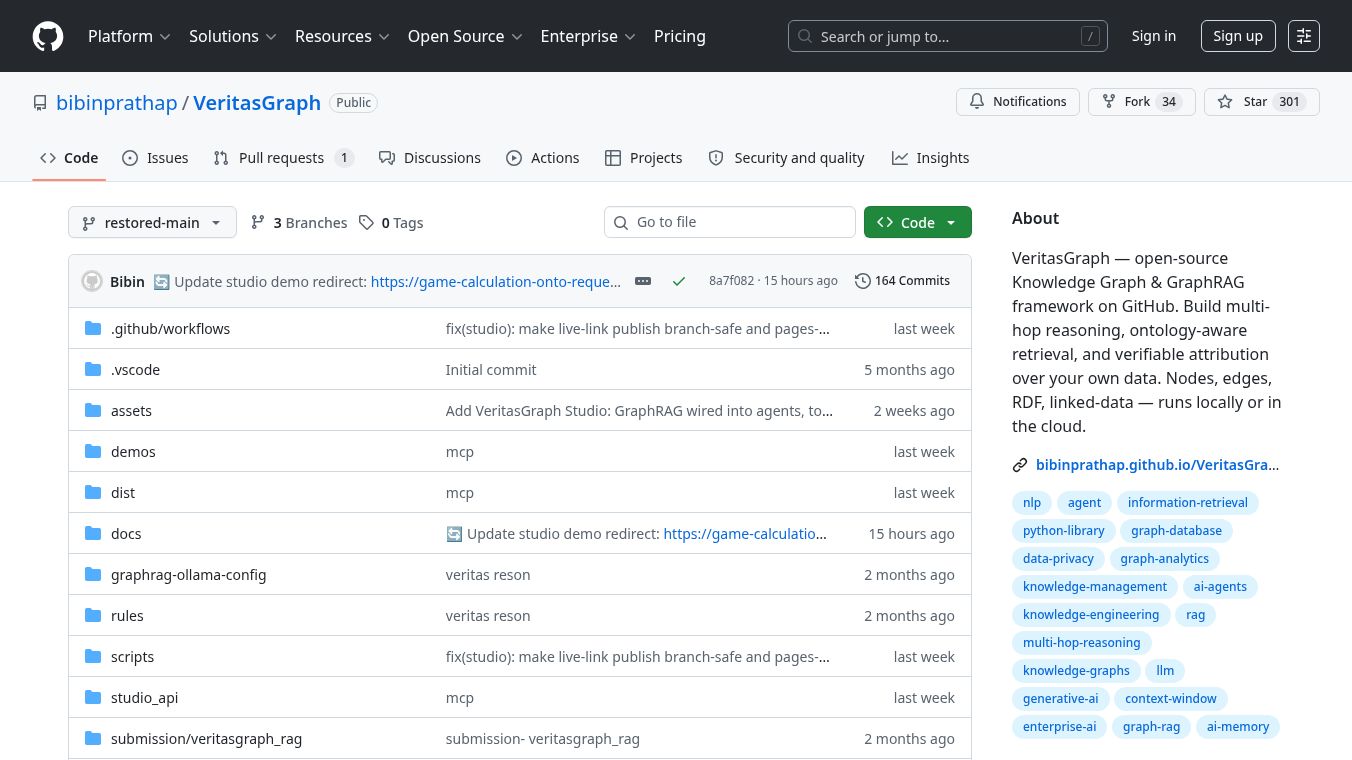





VeritasGraph: The Governed, On-Prem GraphRAG & Agent Framework
Research context and background
VeritasGraph is an open-source tool designed to help organizations build smart AI agents that work with their own private data. Unlike standard AI tools that simply guess answers based on how similar words sound, VeritasGraph uses a special system that understands how information connects. It combines a clear, hierarchical structure like a table of contents with a knowledge graph that maps out relationships between facts. This allows the system to find accurate answers and explain exactly where the information came from. The tool is built to run on a company's own servers for maximum privacy or in the cloud for flexibility. It is licensed under the MIT license, which means anyone can use, modify, and share it for free.
Benefits
VeritasGraph offers several key advantages over traditional AI search tools. First, it provides 100% verifiable citations. Every answer the AI gives includes a direct link back to the specific part of the document used, so users can always check the source. Second, it supports multi-hop reasoning. This means the system can connect dots across different sections of a document to answer complex questions that require linking multiple pieces of information together. Third, it offers full control over data privacy. Users can run the entire system offline on their own hardware, ensuring sensitive data never leaves their premises. Finally, it includes a built-in visual explorer that lets users see the connections between ideas as a map, making it easier to understand complex topics. The tool also features a studio workspace that allows developers to build, test, and manage AI agents with built-in safety rules to prevent errors.
Use Cases
VeritasGraph is useful for many different scenarios where accuracy and data privacy are critical. It is ideal for enterprise search systems where employees need to find specific policies or technical manuals within large document collections. It works well for compliance assistants that must check financial records or HR data against strict company rules to detect violations. Researchers can use it as a copilot to analyze academic papers or reports, as the system can trace claims back to the original text. It is also suitable for building agent memory systems that need to remember and connect past interactions with users. The tool supports various deployment modes, making it accessible for quick demos using cloud APIs or for full production environments using local models and databases.
Pricing
VeritasGraph is completely free to use. It is released under the MIT License, which allows anyone to download, install, and modify the software without any cost. There are no hidden fees or subscription tiers. Users only need to cover the cost of their own hardware or cloud computing resources if they choose to run the system. The project is open-source, meaning the community can contribute to its development and improvement.
Vibes
As an open-source project, VeritasGraph has gained attention from developers and researchers interested in sovereign AI and verifiable reasoning. The project page on GitHub serves as the central hub for the community to access the code, documentation, and examples. Users appreciate the clear comparison with other tools like Vector RAG and PageIndex, which highlights its unique ability to combine tree navigation with graph reasoning. The project acknowledges its foundations on work from Microsoft and other open-source communities, showing a collaborative spirit. While there are no formal customer testimonials in the provided text, the detailed documentation and active development suggest a strong commitment to transparency and utility for technical users.
Additional Information
VeritasGraph was developed by Bibin Prathap and was presented at the International Conference on Applied Science and Future Technology in 2025. The framework builds upon foundational work from several well-known projects including HopRAG, Microsoft GraphRAG, LangChain, LlamaIndex, and Neo4j. It supports a wide range of AI models, allowing users to mix and match local models like Ollama with cloud providers like OpenAI or Groq. The system requires specific hardware for full production use, such as a CPU with 16 cores, 64GB of RAM, and a GPU with 24GB of VRAM. For those who need a quick start, the project provides a Docker setup that allows the full stack to run in about five minutes. The tool also includes features for integrating with the Model Context Protocol, enabling connections to other tools like Chrome DevTools and Unity.
This content is either user submitted or generated using AI technology (including, but not limited to, Google Gemini API, Llama, Grok, and Mistral), based on automated research and analysis of public data sources from search engines like DuckDuckGo, Google Search, and SearXNG, and directly from the tool's own website and with minimal to no human editing/review. THEJO AI is not affiliated with or endorsed by the AI tools or services mentioned. This is provided for informational and reference purposes only, is not an endorsement or official advice, and may contain inaccuracies or biases. Please verify details with original sources.
Comments
Please log in to post a comment.