Verify LLM API
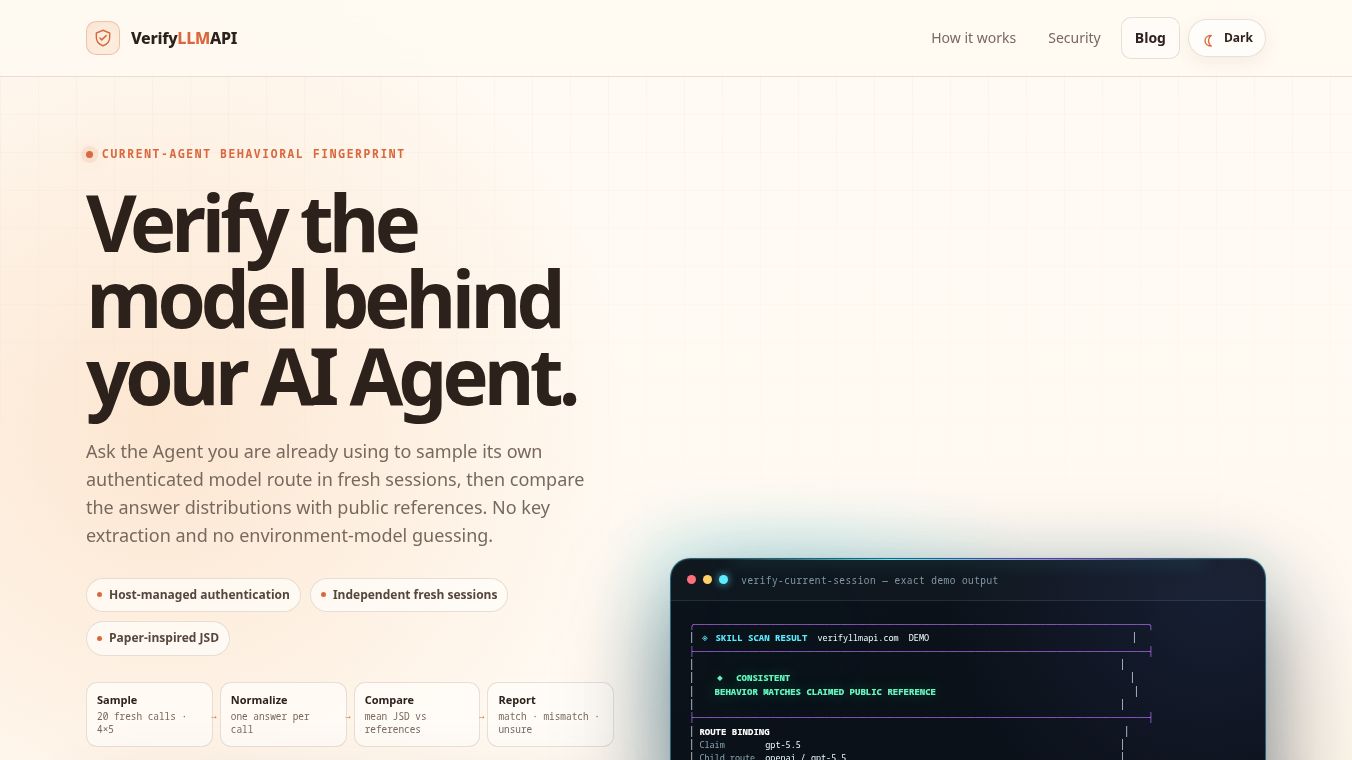





Verify the Model Behind Your AI Agent
Overview
Verify LLM API is a tool designed to help developers confirm which specific AI model their software agents are actually using. In the world of artificial intelligence, it is common for agents to claim they are using a powerful model like GPT-4 or Claude 3, but there is no easy way to know for sure without complex setup. This tool solves that problem by asking the agent to run a simple test and comparing its answers to known public data. It provides a clear report on whether the agent is behaving like the model it claims to be.
The process is secure and requires no special handling of passwords or API keys. The tool uses the login information already set up on the user's computer. It runs the test in fresh, temporary sessions to ensure the results are accurate and not influenced by previous work. The final output tells the user if the model matches the expected reference or if there is a mismatch.
Benefits
- No Credential Handling: The biggest advantage is security. The tool does not read, store, or require the user to input API keys, cookies, or login tokens. It relies on the host machine's existing login status to run the checks.
- Simple Three-Step Process: Users do not need to understand complex code to use it. The workflow involves sending a prompt, making a set of fresh requests, and comparing the results. This makes it accessible for teams that want to verify their agents quickly.
- Behavioral Verification: Instead of relying on model names or file settings, the tool looks at how the model answers questions. It uses a statistical method called Jensen-Shannon divergence to measure if the answers match the expected pattern for a specific model.
- Fresh Session Isolation: Every test runs in a brand new session. This prevents the tool from getting confused by old data or cached results, ensuring that the verification is based on the current state of the agent.
- Clear Reporting: The system provides a straightforward report that says whether the model matches, does not match, or if the result is unsure. It includes details like the reference used and the specific threshold for a match.
Use Cases
- Security Audits: Companies can use this tool during security reviews to ensure their AI agents are not accidentally connected to cheaper or less secure models than intended.
- Development Testing: Developers can run this check whenever they update their code or change their AI provider to confirm the agent is still using the correct model.
- Quality Assurance: Teams can automate this check to ensure consistency across different agents. If an agent suddenly starts giving different answers, this tool can help identify if the underlying model has changed.
- Third-Party Endpoint Testing: The tool can also be used to test direct connections to third-party AI endpoints. Users can supply the base URL and model details to verify those external connections as well.
Pricing
The provided article does not contain specific pricing details for Verify LLM API. It focuses on the technical functionality and security features of the tool rather than its cost structure.
Vibes
The article does not include specific user reviews, testimonials, or public reception data. The tone of the documentation is professional and technical, aimed at developers who need to understand the mechanics of the verification process.
Additional Information
The tool is built on a method that uses behavioral evidence rather than cryptographic proof. This means it can detect if a model is inconsistent or drifting from its expected behavior, but it cannot provide 100% mathematical certainty about the exact model identity. The standard check uses 20 fresh model requests, while more thorough checks can use up to 120 requests. The tool supports both Codex and Claude Code environments and automatically selects the correct one based on the host setup. It is important to note that running these checks can consume the user's allowance or balance with their AI provider, so users should be aware of the resource usage before running a full scan.
This content is either user submitted or generated using AI technology (including, but not limited to, Google Gemini API, Llama, Grok, and Mistral), based on automated research and analysis of public data sources from search engines like DuckDuckGo, Google Search, and SearXNG, and directly from the tool's own website and with minimal to no human editing/review. THEJO AI is not affiliated with or endorsed by the AI tools or services mentioned. This is provided for informational and reference purposes only, is not an endorsement or official advice, and may contain inaccuracies or biases. Please verify details with original sources.

Comments
Please log in to post a comment.