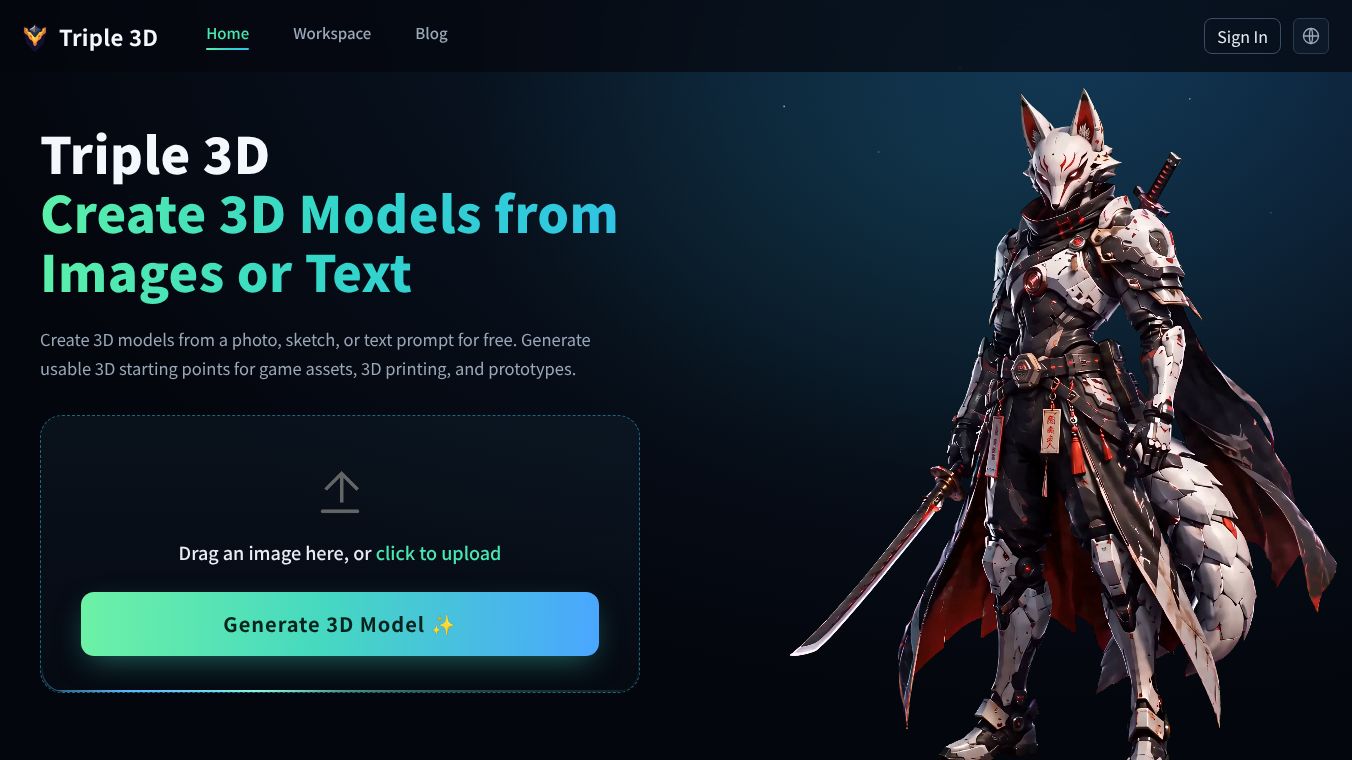





Triple 3D: Create Usable 3D Models from Images, Photos, or Text
Triple 3D is a free AI-powered platform designed to generate 3D models from images, photos, or text prompts. It serves as a powerful starting point for game developers, 3D printing enthusiasts, and creative professionals, allowing users to quickly transform visual references or descriptions into editable 3D assets.
Benefits
Triple 3D offers several key advantages for creators who need fast and practical results. The platform provides three primary workflows for generating 3D content. Users can upload a photo, concept image, product shot, sketch, or reference picture to create a 3D model with recognizable shape, depth, and texture. Another option allows users to turn real-world objects, pets, products, toys, or decorations into 3D starting points by converting clear photos into models that can be previewed, inspected, and refined. A third method lets users describe their desired creation using a text prompt. This is excellent for quickly exploring props, objects, creatures, characters, and printable ideas without needing a visual reference.
The platform emphasizes free generation for early-stage idea testing. This allows creators to generate multiple versions, compare results, and invest time only in the models that prove worth refining. Triple 3D is engineered to solve real-world 3D workflow problems, ensuring that generated models are practical rather than just visual previews. Key features include clear object shapes that preserve the main object's silhouette, volume, and proportions. The tool creates models with sharper visual details, clearer colors, and recognizable surface patterns. Users can also generate lightweight, stylized models optimized for game prototypes, mobile games, and background props. These low-poly options make models easier to preview and optimize in real-time engines. Generated models feature cleaner surfaces and fewer broken areas, providing a solid base for inspection, editing, and repair.
Use Cases
Triple 3D is versatile across various creative industries. In game development, users can rapidly prototype props, furniture, tools, vehicles, and fantasy or sci-fi items. Creators can create background assets and environment details that do not require hero-level topology. They can also explore style variations like cartoon, realistic, or stylized looks quickly. The tool focuses on polycount, texture clarity, asset scale, and engine export needs. It helps game makers create props, background objects, low-poly assets, environment pieces, and collectibles rapidly. Generated models serve as fast prototypes or base meshes for further cleanup, retopology, UV optimization, and engine integration in software like Unity or Unreal Engine.
For 3D printing, the platform helps users turn photos or prompts into printable concepts for decorations, figures, and custom objects. It creates STL-ready concepts for toys, keychains, and tabletop pieces. In product mockups, users can turn product images or rough ideas into 3D previews for e-commerce, marketing, design reviews, and client presentations. Character design is another strong use case. Users can generate stylized characters, pets, monsters, and mascots as a starting point for further rigging and animation.
Pricing
Triple 3D is a free platform for generating 3D models. The service allows users to generate multiple versions and compare results without cost. This free access is designed to support early-stage idea testing and brainstorming.
Vibes
Creators choose Triple 3D for its transparency and practical output. Unlike tools that only offer pretty previews, Triple 3D focuses on shape clarity and export options that fit into existing pipelines. It allows users to skip the blank canvas stage, generating a base model in minutes to accelerate brainstorming and prototyping. The platform supports iteration by allowing users to generate multiple versions from different inputs to compare silhouettes and textures before committing to a final direction.
Additional Information
Triple 3D is designed to integrate with popular software used by professionals. Users can download model files to continue editing in preferred software such as Blender, slicers, or game engines. The platform supports repair of topology, adjustment of UVs, optimization for engines, and preparation for slicing. It is built to work seamlessly within the workflows of Unity and Unreal Engine for game development and standard slicers for 3D printing.
This content is either user submitted or generated using AI technology (including, but not limited to, Google Gemini API, Llama, Grok, and Mistral), based on automated research and analysis of public data sources from search engines like DuckDuckGo, Google Search, and SearXNG, and directly from the tool's own website and with minimal to no human editing/review. THEJO AI is not affiliated with or endorsed by the AI tools or services mentioned. This is provided for informational and reference purposes only, is not an endorsement or official advice, and may contain inaccuracies or biases. Please verify details with original sources.

 No Info

Comments
Please log in to post a comment.