Tenure





Tenure: Persistent, Governable State for AI Systems
Introduction
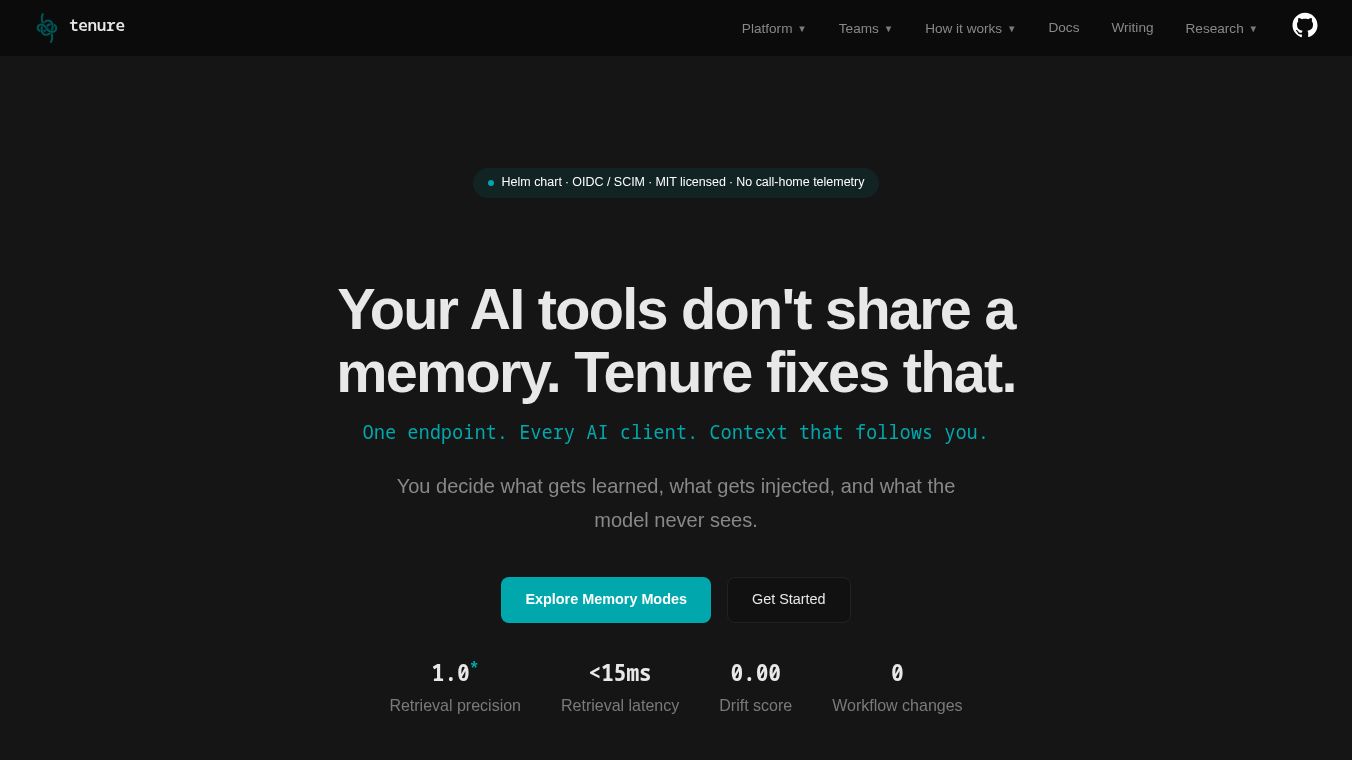
Tenure is a platform designed to manage the memory and state of AI systems. It sits between engineers and their AI tools to ensure that AI models have reliable, structured knowledge rather than just temporary context. While most AI tools forget information once a chat session ends or rely on fuzzy search methods, Tenure provides a system where every piece of information has a clear origin, version, and scope. This allows teams to build AI assistants that remember decisions accurately without mixing up data from different projects.
Benefits
Tenure offers several key advantages for teams using AI in their daily work. First, it eliminates memory drift. In other systems, old or irrelevant information can slowly mix with new data, causing the AI to give incorrect answers. Tenure scores zero on drift, meaning it keeps information clean and separate. Second, it provides perfect retrieval precision. The system retrieves exactly the information needed with less than 15 milliseconds of delay. This is much faster and more accurate than other memory tools that often return irrelevant data. Third, it gives users full control. Teams can observe their AI sessions to collect facts without changing how the AI behaves. Once they are ready, they can turn on the feature to let the AI use that curated knowledge. Finally, it ensures safety through hard boundaries. Information from one project never leaks into another, preventing cross-contamination of data.
Use Cases
Tenure is built for coding assistants and AI systems used by software engineers. It works across many popular tools including VS Code, Windsurf, Continue, and various mobile chat clients. A common use case is managing project-specific knowledge. For example, a team working on an API project can store decisions and facts in Tenure. When they start a new session, the AI only sees information related to that API. It does not see data from a different project or old versions of the code. Another use case is auditing AI decisions. Because Tenure logs every request and shows exactly which facts were used for every response, teams can trace back why the AI made a specific suggestion. This is useful for debugging issues or ensuring compliance. The system also works well for mobile users. Decisions made on a phone via a chat client are instantly available in the desktop IDE, keeping the team synchronized.
Pricing
Tenure is open source and available under the MIT license. This means it is free to use and modify. The platform is designed to run locally on a user's machine using Docker. It does not require an account or a subscription fee. Users can install it in about 30 seconds using a shell script or Helm package manager. Because it runs locally, teams do not need to pay for cloud hosting or worry about data privacy since all information stays on their own servers.
Vibes
Public reception for Tenure highlights its focus on precision and control. The platform addresses a major pain point in the AI industry: the lack of persistent state. Users appreciate that it solves the problem of context bleeding, where old topics interfere with new ones. The comparison of precision scores shows Tenure at 1.00, significantly higher than competitors like Mem0 or Zep. This metric suggests that Tenure is highly effective at finding the right information. The "observe before you commit" workflow is also well received. It allows teams to test the system safely before integrating it into their main workflow. This reduces risk and gives engineers confidence in the tool. The ability to retire old versions of decisions while keeping an audit trail is another feature that resonates with professional teams who need to maintain a clear history of their work.
Additional Information
Tenure is fully local and requires Docker to run. It uses a single endpoint at localhost:5757 to serve all AI clients. The platform supports OpenAI-compatible clients and can be registered with providers like Anthropic or OpenAI using a Bring Your Own Key approach. It includes features like OIDC for authentication and SCIM for user provisioning. The system is designed to be lightweight and fast, with retrieval latency under 15 milliseconds. Installation is straightforward and can be done via a simple command line script or Helm chart. The project is hosted on GitHub and is actively maintained by the Tenure team.
This content is either user submitted or generated using AI technology (including, but not limited to, Google Gemini API, Llama, Grok, and Mistral), based on automated research and analysis of public data sources from search engines like DuckDuckGo, Google Search, and SearXNG, and directly from the tool's own website and with minimal to no human editing/review. THEJO AI is not affiliated with or endorsed by the AI tools or services mentioned. This is provided for informational and reference purposes only, is not an endorsement or official advice, and may contain inaccuracies or biases. Please verify details with original sources.


Comments
Please log in to post a comment.