scritty





scritty: One Terminal for Every AI Agent
Research Context and Background
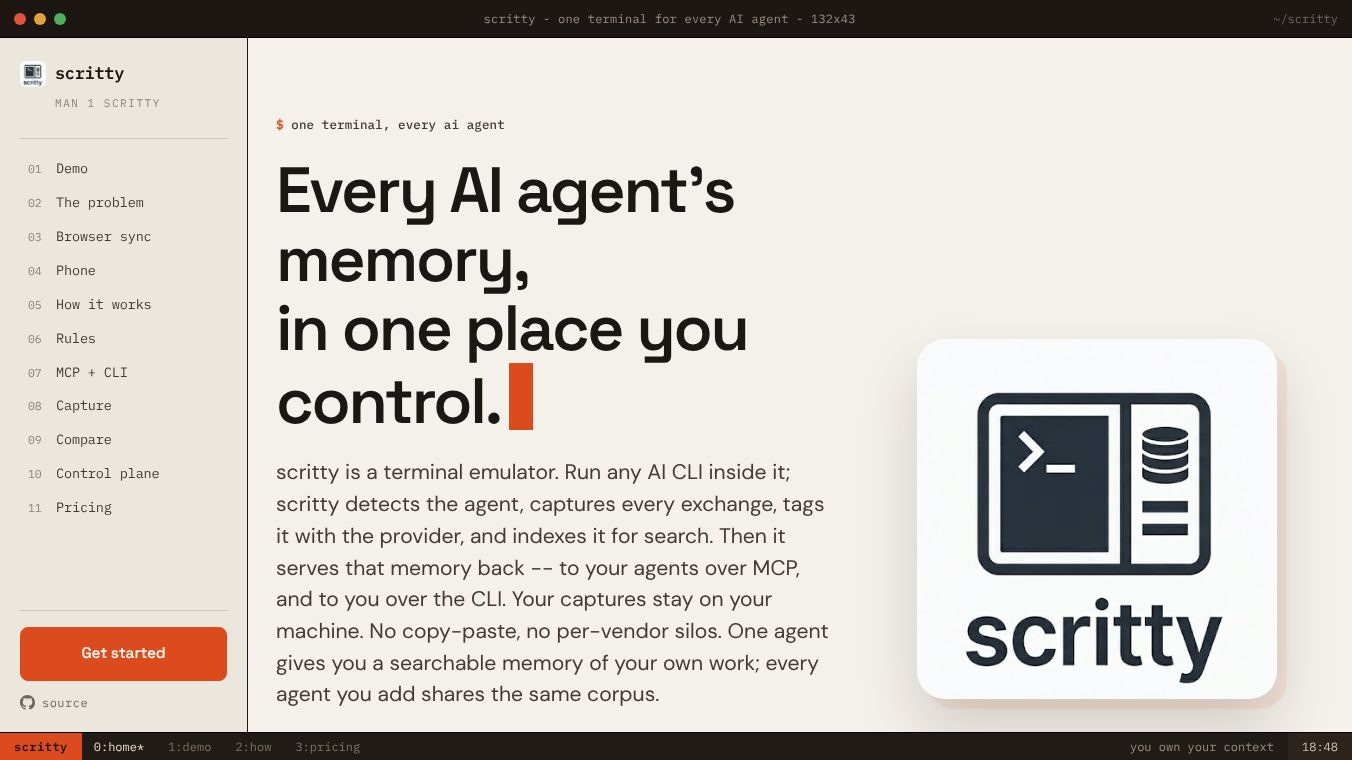
scritty is a terminal emulator built to solve a common problem for developers using AI tools. In a typical workflow, different AI agents like Claude Code or GitHub Copilot work in separate silos. Each vendor keeps its own logs, making it hard to search across all your work or share context between sessions. scritty changes this by capturing every AI command at the operating system level. It creates a single, searchable memory of all your AI interactions that stays on your machine. This unified memory helps both your AI agents and you find past decisions quickly without losing context.
Benefits
scritty offers several key advantages for developers who rely on AI tools. First, it is agent-agnostic, meaning it works with any AI CLI tool without needing special plugins or vendor cooperation. Second, it provides a unified corpus where all conversations from different agents live in one place. The system uses hybrid search that combines keyword matching with smart vector embeddings to find relevant past discussions instantly. Third, it offers a unique dual-view experience where you can type in a desktop terminal and see the same session live in a web browser. This allows you to access your work from any device on your network. Fourth, it enforces rules and instructions before messages reach an AI agent, ensuring consistency across all sessions. Finally, it prioritizes security and privacy by keeping all data local on your machine with optional encryption.
Use Cases
scritty is designed for developers and teams who use multiple AI coding assistants. It is ideal for individuals who want to search through all their past AI conversations to find solutions or context. Teams can use it to maintain a shared memory of project decisions across different agents and sessions. Developers who switch between different AI tools like Ollama or Antigravity will find it useful because scritty automatically detects and tags each interaction. It is also perfect for remote work scenarios where a developer starts a coding session on their desktop and continues it on their phone by scanning a QR code. Teams that need strict compliance can use the built-in rule enforcement to ensure every AI interaction follows specific guidelines.
Pricing
scritty uses a local-first architecture where data stays on your machine. Pricing is based on the volume of captured exchanges rather than the number of users. One exchange is defined as one prompt plus one reply. The Personal plan costs $19.99 per month and includes 10,000 exchange pairs. Overage costs $5 for every additional 10,000 pairs. The Team Pilot plan offers a free trial with 25,000 pairs or 35 days of use before converting to a paid tier. The Pro plan is $249.99 per month for 100,000 pairs and includes features like central federation and single sign-on. The Pro Plus plan costs $749.99 per month for 400,000 pairs and adds audit retention and dedicated support. The Enterprise plan starts at $2,500 per month for 1,000,000 base bands and offers advanced features like multi-org federation and hybrid deployment options.
Vibes
scritty is positioned as a powerful tool for developers who want full control over their AI workflow. By capturing data at the terminal boundary, it ensures that context remains on the user's machine and is accessible across all tools. This approach contrasts with other solutions that rely on vendor-specific logs or cloud-based services. The ability to search across every agent and session inline using a simple keyboard shortcut makes it a practical addition to a developer's daily toolkit. The emphasis on local storage and encryption appeals to users who prioritize data privacy and security.
Additional Information
scritty operates through three primary interfaces that share a single memory service. These include a terminal panel for inline search, an MCP server for exposing the corpus to local and remote agents, and a CLI for scriptable access to sessions. The system supports swapping vector backends like qdrant or pgvector behind a single interface, allowing for easy updates without losing data. This flexibility ensures that the tool can adapt to different technical requirements while maintaining a consistent user experience.
This content is either user submitted or generated using AI technology (including, but not limited to, Google Gemini API, Llama, Grok, and Mistral), based on automated research and analysis of public data sources from search engines like DuckDuckGo, Google Search, and SearXNG, and directly from the tool's own website and with minimal to no human editing/review. THEJO AI is not affiliated with or endorsed by the AI tools or services mentioned. This is provided for informational and reference purposes only, is not an endorsement or official advice, and may contain inaccuracies or biases. Please verify details with original sources.


Comments
Please log in to post a comment.