ScopeGuard — AI Code Governance
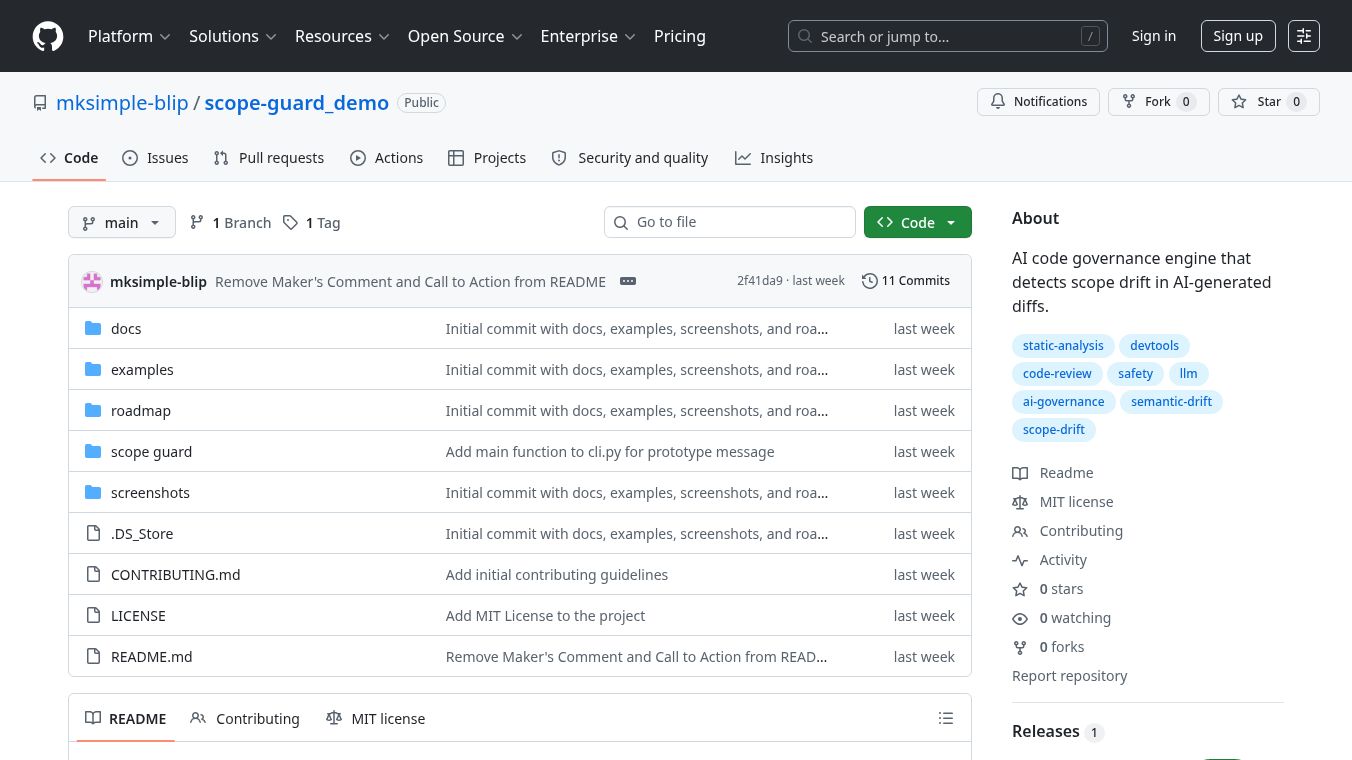





ScopeGuard: AI Code Governance Engine for Intent Alignment
Introduction
ScopeGuard is an AI code governance engine designed to detect scope drift in AI-generated code changes. As AI coding assistants become standard tools for developers, verifying that generated changes align with the original developer intent has become a critical challenge. ScopeGuard fills this gap by specifically analyzing intent-to-change alignment. It ensures that AI-generated code stays within the requested scope without introducing unexpected modifications.
Benefits
ScopeGuard offers several key advantages for teams using AI in their development workflow. It acts as an automated reviewer focused on intent alignment rather than replacing traditional code reviews. The tool detects five specific types of drift including scope expansion, structural changes, propagation across files, signature changes, and dependency introductions. It uses a severity model to evaluate detected drift and determine the appropriate action. This model ranges from allowing changes with no drift to blocking unsafe or destructive changes. The system provides explainable decisions so developers understand why a change was flagged. It is also model agnostic meaning it works with any AI coding assistant without being tied to a specific provider.
Use Cases
ScopeGuard is designed for engineers using any AI coding assistant and teams adopting AI-assisted development. It is particularly useful for CTOs requiring safety and auditability in their codebase. Companies with compliance or governance requirements can use it to ensure changes meet organizational standards. Anyone looking to prevent AI-generated regressions can benefit from its governance layer. The workflow is simple for developers to use. A developer writes a prompt in their AI coding tool and the AI generates code. ScopeGuard then analyzes the diff between the original and generated code. The drift engine evaluates the five drift types and the severity engine scores the risk. The enforcement engine returns a decision to allow, warn, require approval, or block the change. For example if a developer asks to improve error handling in a JSON encoder and the AI only makes changes to that file ScopeGuard allows the change. However if the AI refactors the entire header resolution pipeline and introduces new helper functions ScopeGuard flags this for review.
Pricing
Pricing details are not available for ScopeGuard at this time.
Vibes
Public reception and reviews are not available for ScopeGuard as it is currently in prototype stage. The project is hosted on GitHub under the repository mksimple-blip/scope-guard_demo.
Additional Information
ScopeGuard is currently in prototype stage. The current prototype successfully implements detection of scope structural propagation signature and dependency drift along with severity scoring and explainable decisions. Future iterations will include semantic drift analysis multi-file governance IDE integrations and model agnostic diff adapters. The project is not tied to any specific AI model and is designed to work with any AI coding assistant.
This content is either user submitted or generated using AI technology (including, but not limited to, Google Gemini API, Llama, Grok, and Mistral), based on automated research and analysis of public data sources from search engines like DuckDuckGo, Google Search, and SearXNG, and directly from the tool's own website and with minimal to no human editing/review. THEJO AI is not affiliated with or endorsed by the AI tools or services mentioned. This is provided for informational and reference purposes only, is not an endorsement or official advice, and may contain inaccuracies or biases. Please verify details with original sources.


Comments
Please log in to post a comment.