Retrace





Retrace: The Reliability Platform for AI Agents
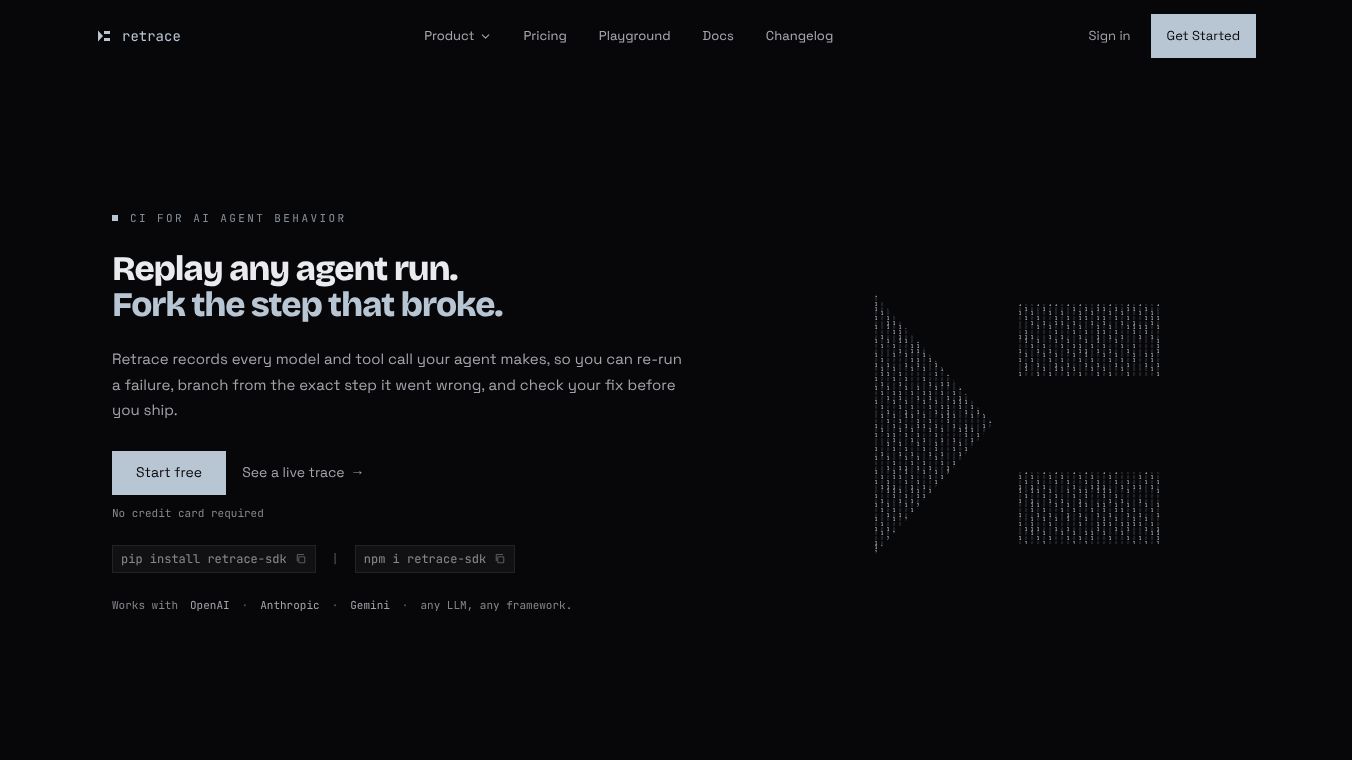
Retrace is a specialized tool built to help developers create, test, and launch AI agents with confidence. While many existing tools only show what went wrong after a failure, Retrace allows users to replay entire agent runs and fix issues before they reach production. It works with any large language model from providers like OpenAI, Anthropic, or Gemini, and it supports popular agent frameworks such as LangChain, CrewAI, and AutoGen. The platform is designed to turn every production failure into a permanent test case, ensuring that similar bugs are much harder to ship again.
Benefits
Retrace offers four main pillars to improve reliability:
- Detect: The system automatically spots problems like ungrounded claims, statistical drift, and multi-agent failures. It can flag issues where an AI makes claims without proper evidence.
- Enforce: It acts as a safety net by stopping runs immediately if they exceed budget limits, enter infinite loops, or hit step limits. This prevents small bugs from causing large unexpected cloud bills.
- Evaluate: Retrace integrates with continuous integration pipelines to block code merges if a regression is detected. It ensures that new changes do not break existing behavior compared to a known good baseline.
- Understand: The platform provides full visibility into how agents work. It tracks sessions, maps agent connections, manages memory, and keeps versions of prompts organized. This turns complex multi-agent failures into something transparent and easy to read.
Other key advantages include interactive debugging and proving fixes. Users can select any step in a trace, change the input or prompt, and replay the rest of the run to see the difference. The system also provides a verdict on whether a fix actually solves the problem without creating new issues. Developers can even describe a bug in plain language to jump straight to the failing run without searching through raw data.
Use Cases
Retrace is designed for teams building AI applications that need high reliability. It is useful in several scenarios:
- Debugging Complex Agents: When an AI agent fails in a complex workflow, developers can replay the run from the exact moment of failure. They can fork the trace, modify the logic, and see how the agent behaves differently.
- Preventing Cost Overruns: Teams can set guardrails to stop agents from running too long or using too many tokens. This is critical for preventing runaway costs in production environments.
- CI/CD Integration: Developers can add Retrace to their code deployment pipelines. If a new update causes a regression, the pipeline will automatically fail, preventing broken code from reaching users.
- Multi-Agent Systems: For projects using multiple AI agents working together, Retrace helps track how information flows between them and identifies where the system breaks down.
The setup is very fast, taking under two minutes. Users simply sign in with GitHub, add a few lines of code, and start seeing live traces. It supports both Python and TypeScript, making it accessible to a wide range of developers.
Pricing
Retrace uses a tiered pricing model that does not require a credit card to start.
- Free: This plan costs $0 per month. It includes 1,000 traces per month, 7 days of data retention, and support for one user. The fork and replay feature is available as a $5 per month add-on.
- Starter: Priced at $29 per month, this plan offers 10,000 traces per month, 30 days of retention, 100 fork replays per month, and 25 prove-the-fix runs per month.
- Pro: At $99 per month, users get 50,000 traces per month, 90 days of retention, unlimited fork replays, CI regression gates, and a sandbox environment for testing.
- Teams: This option costs $399 per month and includes 500,000 traces per month, 365 days of retention, support for up to 10 users, and team collaboration tools.
- Enterprise: Pricing is available upon request. This tier includes unlimited traces, custom retention periods, unlimited users, and dedicated sandbox environments.
Vibes
Retrace positions itself as a necessary upgrade for teams moving beyond basic AI tracing. By focusing on fixing issues before deployment, it addresses a major pain point for developers who struggle with unpredictable AI behavior. The ability to prove a fix works before shipping code gives teams a strong sense of control over their AI applications. Users appreciate the semantic search feature that lets them find bugs by describing them in natural language, which saves significant time during debugging sessions.
Additional Information
Retrace emphasizes strong security and data management. API keys are encrypted at rest and stored with only the last four characters visible. The platform uses TLS for data in transit and automatically redacts personally identifiable information. Data retention periods vary by plan, ranging from 7 days to 365 days, with custom options available for enterprise clients. The system also ensures tenant isolation so that different users cannot see each other's data.
This content is either user submitted or generated using AI technology (including, but not limited to, Google Gemini API, Llama, Grok, and Mistral), based on automated research and analysis of public data sources from search engines like DuckDuckGo, Google Search, and SearXNG, and directly from the tool's own website and with minimal to no human editing/review. THEJO AI is not affiliated with or endorsed by the AI tools or services mentioned. This is provided for informational and reference purposes only, is not an endorsement or official advice, and may contain inaccuracies or biases. Please verify details with original sources.


Comments
Please log in to post a comment.