PawFlow
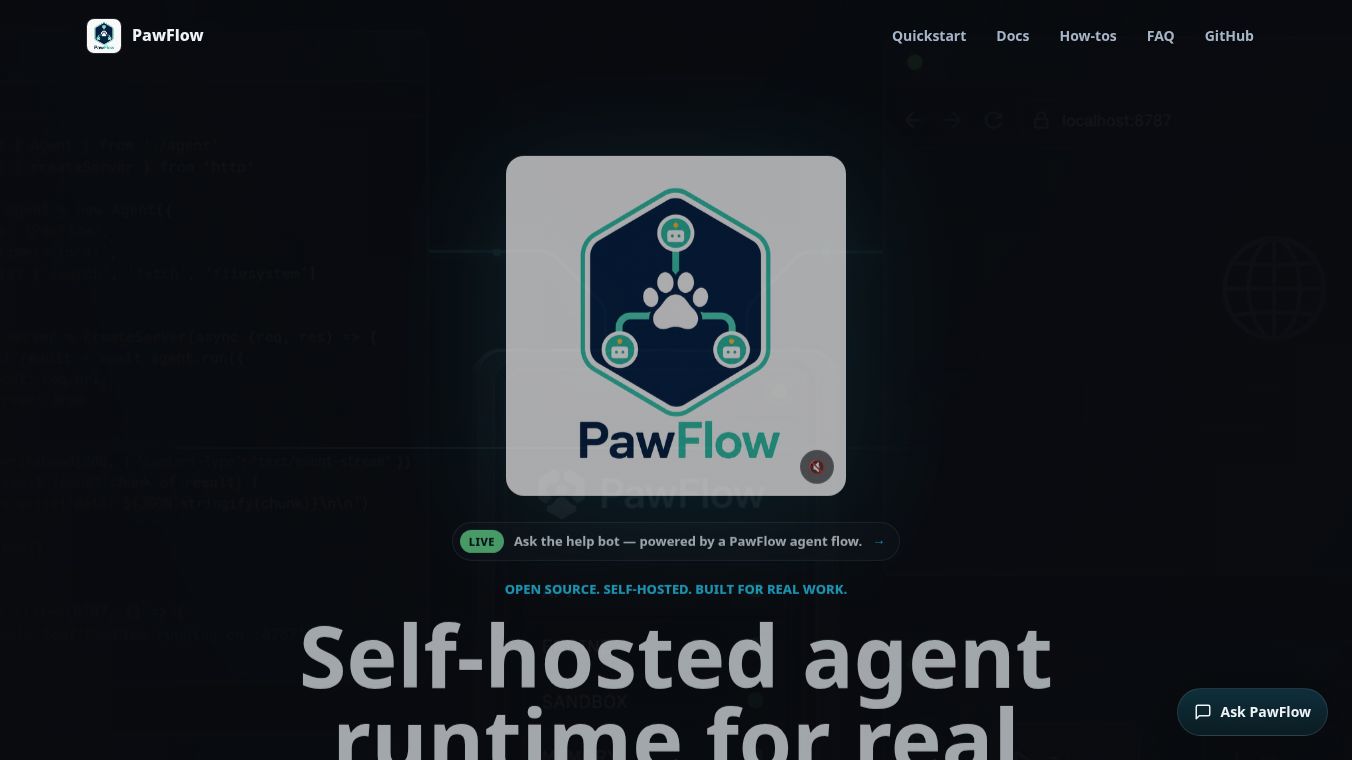





PawFlow: Self-Hosted Agent Runtime for Real Infrastructure
Overview
PawFlow is an open-source tool that lets users run AI agents on their own computers and local networks. Unlike many other AI tools that send your data to a company's cloud servers, PawFlow keeps everything on your machine. This means you stay in control of your files, your tools, and your workflows. The platform allows AI agents to interact with your desktop, browser, and local services without needing to move your data to a vendor-controlled environment. It is designed for people who want to use AI power while keeping their data private and secure.
Benefits
PawFlow offers several key advantages for users who need reliable and private AI automation.
- Full Control Over Data: Because it is self-hosted, your files and data never leave your network unless you choose to share them. This is ideal for businesses or individuals with strict privacy requirements.
- Flexible AI Providers: Users can choose from many different AI models. The system supports providers like Codex, Claude, Gemini, Anthropic, and OpenAI. You can even mix and match different models within the same conversation.
- Desktop and Browser Access: The tool can control your entire desktop or specific browser windows. Agents can see your screen, run commands in your terminal, and interact with web pages as if they were a human user.
- Reliable Automation: For tasks that need to happen on a schedule, PawFlow uses deterministic flows. These are structured plans that include retries and checkpoints, ensuring that important jobs finish correctly even if something goes wrong.
- Integrated Development Environment: Users get a built-in code editor that works right in the browser. They can also use a VS Code extension or a command-line tool to manage their projects and view what the AI is doing in real time.
- Strong Security: The platform includes encryption for your messages and tool inputs. It also has a private gateway that protects your network from outside attacks with rate limits and ban features.
Use Cases
PawFlow is built for real-world tasks that require direct access to local infrastructure.
- Agentic Coding: Developers can use coding agents to read, edit, and debug code in their local projects. The agents can run shell commands and manage project files without needing internet access to a central server.
- Multi-Agent Collaboration: Teams can assign different tasks to different AI agents. One agent might research data while another writes code, and they can all work within the same conversation context.
- Desktop and Browser Tasks: The tool can automate routine desktop activities. For example, an agent could fill out forms, check emails, or manage files on your computer by controlling your browser and desktop environment.
- Scheduled Automations: Businesses can set up automated workflows that run on a schedule. These flows can handle data processing, system checks, or AI-generated content creation at specific times.
Pricing
PawFlow is an open-source project. This means the core software is free to download and use. Users can host it on their own servers without paying licensing fees to the developers. However, users may need to cover their own costs for server hardware, internet bandwidth, and the AI model subscriptions they choose to use.
Vibes
As a self-hosted, open-source tool, PawFlow has not yet gathered a large number of public reviews or testimonials from the general public. The community around it is currently focused on developers and technical users who are testing its capabilities for local AI automation. Early feedback from the development team highlights its flexibility and the strength of its security features. Users who value privacy and data sovereignty tend to appreciate the ability to keep their AI operations entirely within their own infrastructure.
Additional Information
PawFlow is developed as an open-source project. This allows anyone to inspect the code, contribute to its development, or modify it to fit their specific needs. The architecture is designed to be modular, with clear separation between the client interfaces, the server, the relay system, and the workspace. This design makes it easier to integrate with other tools and customize the experience. The project aims to provide a robust foundation for running AI agents in environments where data privacy and local control are the top priorities.
This content is either user submitted or generated using AI technology (including, but not limited to, Google Gemini API, Llama, Grok, and Mistral), based on automated research and analysis of public data sources from search engines like DuckDuckGo, Google Search, and SearXNG, and directly from the tool's own website and with minimal to no human editing/review. THEJO AI is not affiliated with or endorsed by the AI tools or services mentioned. This is provided for informational and reference purposes only, is not an endorsement or official advice, and may contain inaccuracies or biases. Please verify details with original sources.

Comments
Please log in to post a comment.