Parastore
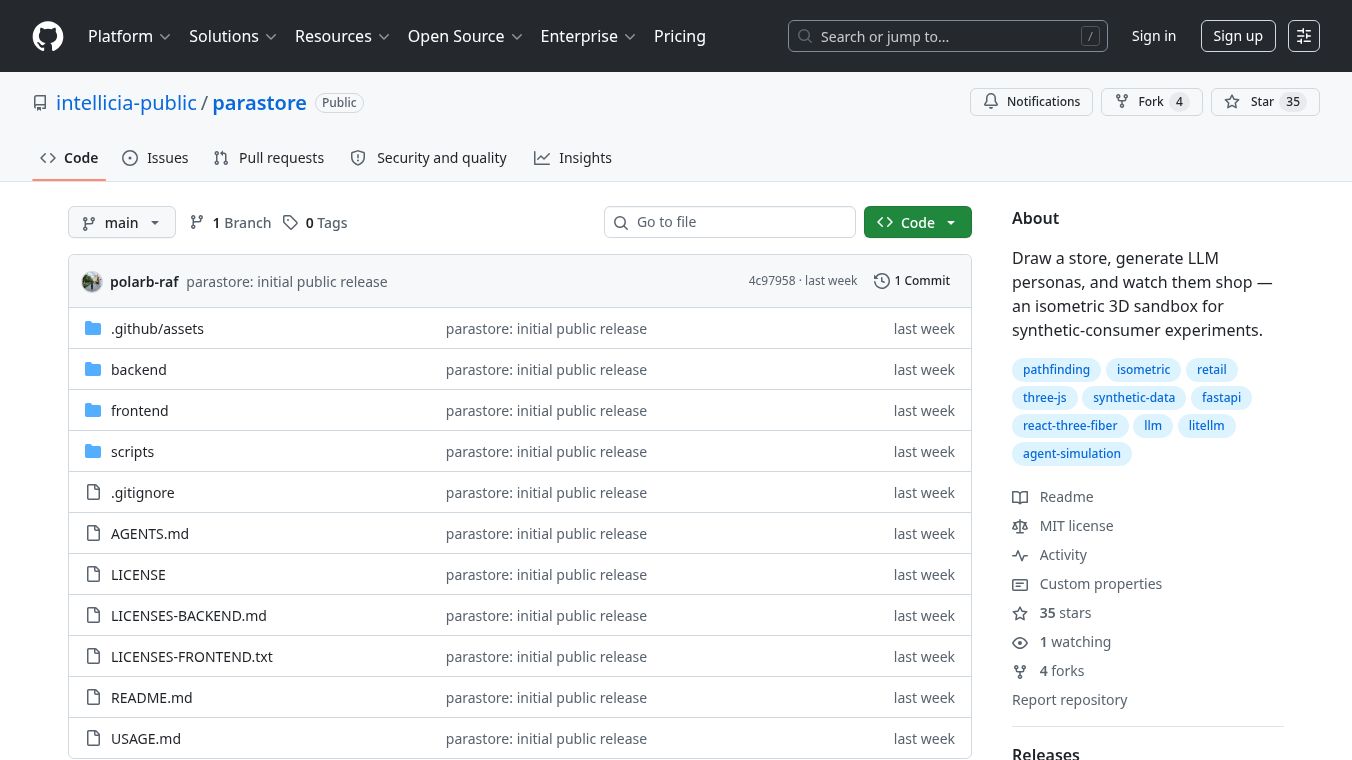





Parastore: Open-Source LLM-Powered Retail Simulation
Parastore is an open-source tool that creates a digital copy of a physical store. It uses artificial intelligence to act as shoppers and test how people might react to products, store layouts, and marketing messages. This platform helps businesses and researchers study consumer behavior without needing to wait for real customers to visit a store.
Benefits
- Realistic Testing:The tool simulates shoppers walking through aisles and making decisions based on their mood and budget. This allows teams to see how impulse buying happens, such as grabbing snacks near the checkout counter.
- High Accuracy:The system has been tested against real sales data and shows a very strong match, with a correlation score of 0.955. This means the results are trustworthy for planning purposes.
- Cost-Effective Research:Instead of running expensive surveys or waiting for foot traffic, companies can run thousands of simulated shopping trips quickly.
- Flexible Integration:The software is built with Python and React. This lets developers connect it to their own AI models or backends to customize the shopping experience.
- Open Source Access:The code is free to use under the MIT license. This allows anyone to study the technology and build upon it without paying licensing fees.
Use Cases
- Optimizing Store Layouts:Retailers can move shelves or change aisle arrangements to see if it improves how customers find products.
- Testing New Products:Brands can introduce a new item in the virtual store to gauge interest before a real launch.
- Refining Marketing Messages:Companies can try different ad copy or signage to understand which messages trigger more purchases.
- Analyzing Consumer Behavior:Researchers can study how different groups, such as students or families, shop based on their specific financial limits and emotional states.
Pricing (ONLY include if available)
The software itself is free because it is open source. However, running the simulation requires calling a Large Language Model many times for each shopper. This means users must pay for their own AI computing power and API costs. There are no fixed subscription fees mentioned for the open-source version.
Vibes (ONLY include if available)
Users who have tried the tool have found the concept surprisingly realistic. People describe the idea of agents physically walking through stores and making impulse buys as weirdly realistic. The project has gained attention on Product Hunt with 70 followers. It is well received by those working in retail optimization and artificial intelligence.
Additional Information (ONLY include if available)
Parastore was launched recently and is licensed under the MIT open-source agreement. The creators developed a proprietary engine that achieved the high accuracy scores, but the open-source version provides a simpler pipeline for testing. The project is hosted on GitHub and is aimed at democratizing access to agent-based behavioral simulation for builders and researchers.
This content is either user submitted or generated using AI technology (including, but not limited to, Google Gemini API, Llama, Grok, and Mistral), based on automated research and analysis of public data sources from search engines like DuckDuckGo, Google Search, and SearXNG, and directly from the tool's own website and with minimal to no human editing/review. THEJO AI is not affiliated with or endorsed by the AI tools or services mentioned. This is provided for informational and reference purposes only, is not an endorsement or official advice, and may contain inaccuracies or biases. Please verify details with original sources.


Comments
Please log in to post a comment.