PainSpotter
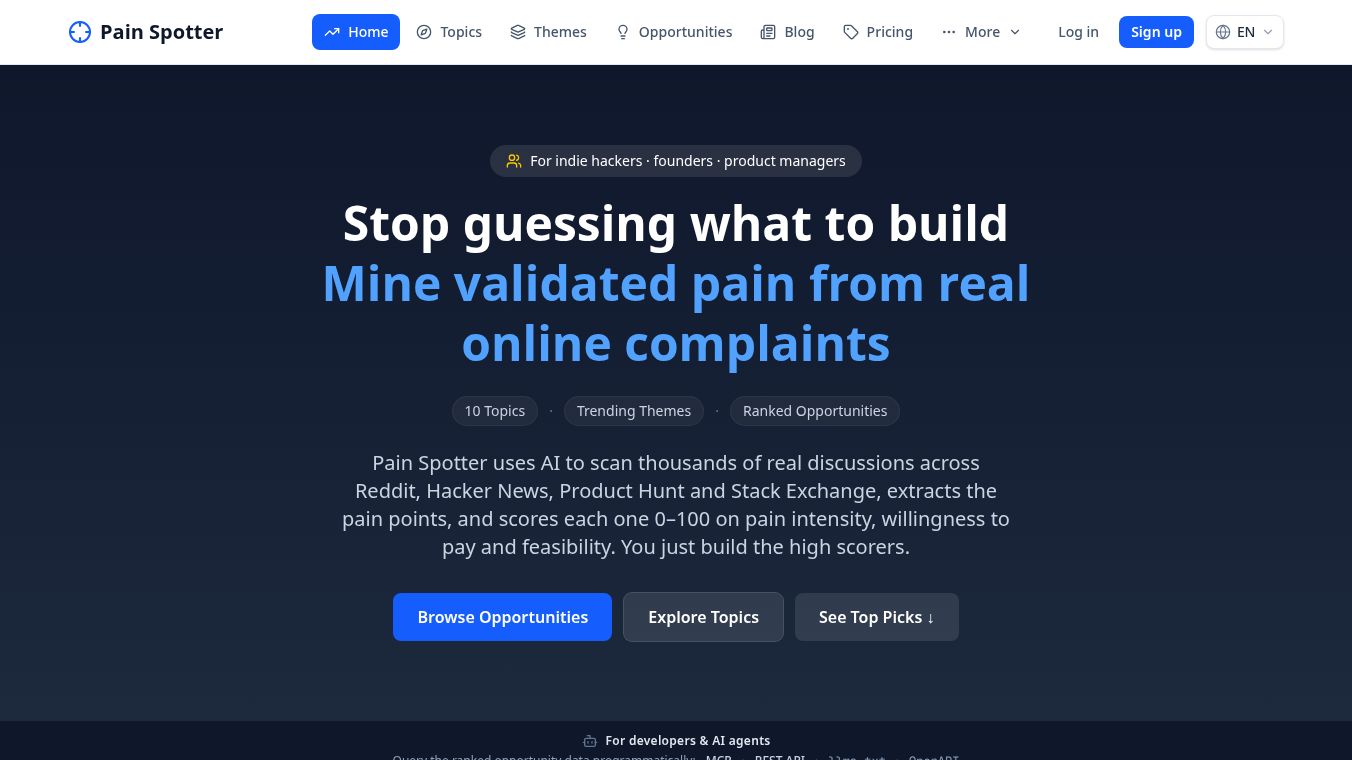





Pain Spotter: AI-Driven Opportunity Discovery for Builders
Research Context and Background
Pain Spotter is an AI-powered research tool designed for indie hackers, founders, product managers, and developers. It eliminates the guesswork of product development by continuously scanning thousands of real discussions across Reddit, Hacker News, Product Hunt, and Stack Exchange. Using Large Language Models, the tool extracts genuine user pain points and ranks them as actionable business opportunities on a 0 to 100 scale. Instead of manually reading threads to find ideas, Pain Spotter clusters the entire web of community chatter into comparable, validated opportunities. Users can then build products that solve problems people are already begging to have fixed.
Benefits
Pain Spotter offers several key advantages for anyone looking to build a new product. It provides access to a database of over 30,000 discovered opportunities. The platform analyzes thousands of discussions across five major platforms and sixty different channels. Users can jump straight into niches that match their specific skills using ten curated topic hubs. A weekly board highlights the fastest-growing pains across the web, often spotting trends two to four weeks before they appear on Hacker News. Every topic and theme hub includes a 350-word AI-generated brief, allowing users to understand the landscape in three minutes instead of three hours. For developers, opportunities can be pulled directly into an IDE via an MCP server or queried via a REST API. The tool also provides a composite score for each opportunity based on pain intensity, willingness to pay, technical feasibility, and long-term sustainability.
Use Cases
Pain Spotter serves a variety of users with different needs. Indie hackers and solo builders can use it to find the next side project starting from a validated problem. They can skip hundreds of hours of manual research because every idea comes with an MVP scope and landing-page copy. They can filter by ease-to-build to achieve weekend-sized wins. Founders can pick a lane based on real willingness-to-pay data rather than gut feel. They get quantitative scores, a Go-to-Market launch plan, and a reality check on why a project might fail. The tool includes a one-click generator to turn an opportunity into a report or product requirements document. Product managers and growth teams can track emerging pain in their niche before competitors. They can view cross-platform themes for a full landscape perspective and get instant AI summaries.
Pricing
Pain Spotter offers three pricing tiers to suit different needs. Anyone can browse the first 10 opportunities without an account using the free tier. The Pro Plan costs 20 dollars per month and unlocks the full ranked list, detailed pain narratives, MVP plans, and competitor analysis. This plan also includes REST API and MCP server access. The Business Plan costs 50 dollars per month and adds the Opportunity to Report and PRD generator. Billing is handled via Stripe with the ability to cancel anytime.
Vibes
The tool is built with privacy and accuracy in mind. All user identities are pseudonymized. Reddit usernames are irreversibly hashed before storage. No personal data is retained. The tool never republishes original posts verbatim. It only provides AI-rewritten summaries and aggregated insights. The platform adheres to GDPR standards and does not engage in cross-site tracking. Users appreciate that it clusters thousands of discussions into actionable themes and estimates the commercial viability of each. It provides an MVP scope for the first two weeks of build work. This allows builders to start from problems that are already validated by real users, significantly reducing the risk of building something nobody wants.
Additional Information
Pain Spotter is designed to help builders avoid the common pitfall of manually searching forums, which only surfaces individual posts and requires days of reading to find a pattern. The system transforms raw community data into a ranked opportunity in three steps. It collects public posts and comments via public APIs. LLMs analyze hundreds of comments per topic to identify pain points, detect payment signals, assess competitors, and evaluate technical feasibility. Each opportunity receives a composite score based on four axes. The platform analyzes discussions across five platforms and sixty channels to provide a comprehensive view of the market.
This content is either user submitted or generated using AI technology (including, but not limited to, Google Gemini API, Llama, Grok, and Mistral), based on automated research and analysis of public data sources from search engines like DuckDuckGo, Google Search, and SearXNG, and directly from the tool's own website and with minimal to no human editing/review. THEJO AI is not affiliated with or endorsed by the AI tools or services mentioned. This is provided for informational and reference purposes only, is not an endorsement or official advice, and may contain inaccuracies or biases. Please verify details with original sources.

Comments
Please log in to post a comment.