Paca
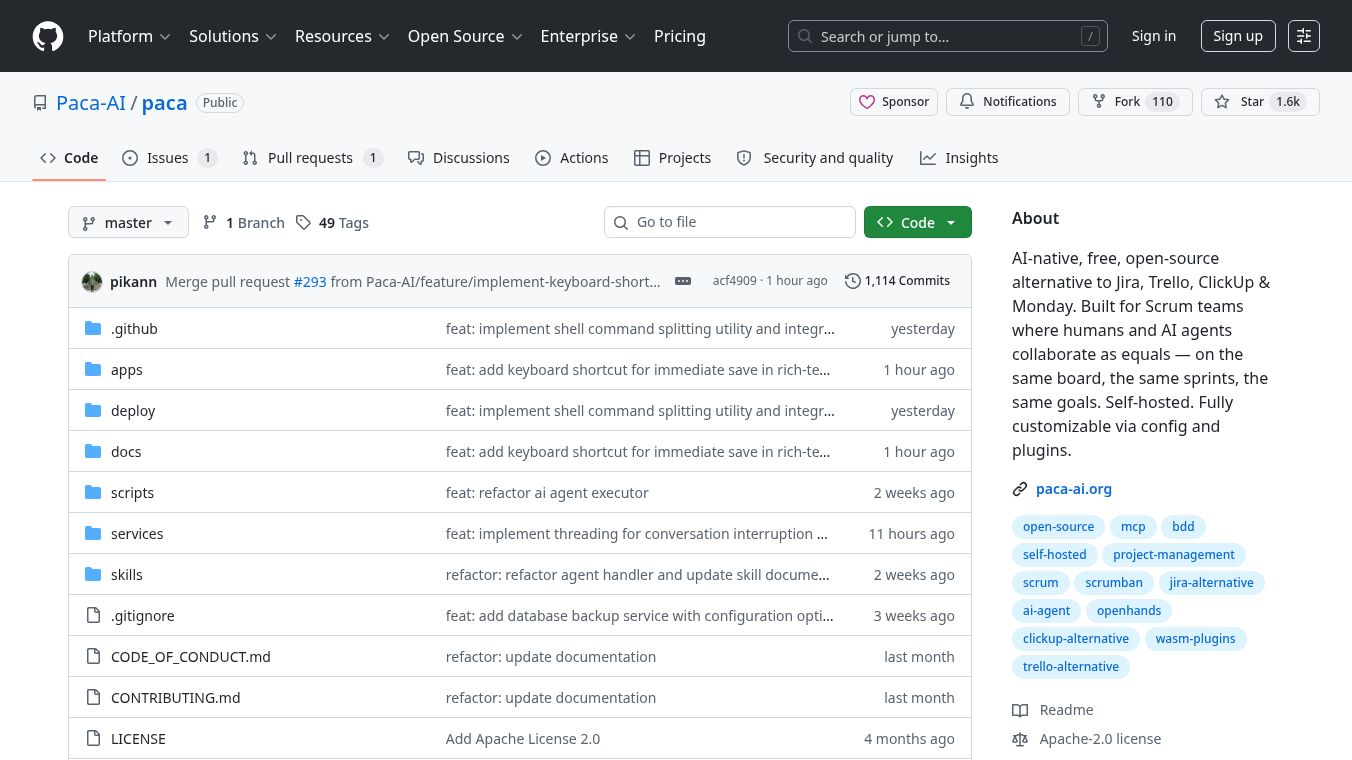





Paca: The AI-Native, Self-Hosted Project Management Platform
Overview
Paca is a free, open-source, and lightweight project management platform designed as a self-hosted alternative to tools like Jira, Trello, ClickUp, and Monday.com. Unlike traditional tools that treat AI as a peripheral add-on, Paca is built from the ground up for human-AI collaboration. It positions AI agents as first-class teammates within a Scrum team, allowing them to participate directly in sprint planning, task execution, and documentation alongside human developers.
Benefits
Paca offers several key advantages for teams looking to integrate AI into their workflow without the high costs of proprietary software. First, it treats AI agents as equal teammates rather than simple automation tools. These agents can join sprints, pick up tasks from the backlog, and update their status in real time. This approach moves beyond simple automation to genuine collaboration.
The platform includes a unified Scrumban board where humans and AI agents work side-by-side. There is no separate AI workspace; agents share the same backlog and contribute to the same goals. Users can chat with AI agents directly within the project interface to plan work or create tasks using plain English. Every field change displays a visual before-and-after diff, allowing users to revert changes with a single click to ensure data integrity.
Paca also supports BDD collaboration through a Gherkin scenario editor co-authored by Product Owners, Business Analysts, and AI agents. It maintains living architecture documents to keep AI agents contextually grounded in the project. The platform ships with an MCP server that allows any MCP-compatible AI client to connect directly to Paca's data layer. For users of Claude Code, Paca offers slash commands to manage tasks and sprints directly from the editor. The AI agents are powered by OpenHands, ensuring robust capabilities for code generation and testing. Finally, Paca features a secure plugin system where extensions run in a sandboxed environment, ensuring they cannot escape their declared permissions.
Use Cases
Paca is ideal for development teams who want full control over their data and infrastructure. Because it is self-hosted, teams can deploy it on their own Linux servers using Docker. This makes it perfect for organizations concerned about data privacy or those who prefer not to rely on vendor clouds.
The platform supports the P-A-C-A cycle, which mirrors both Scrum and the scientific method. Teams can use it to plan backlogs with AI help, act on live sprints where humans and agents execute tasks together, check work through automated verification by QA agents, and adapt based on sprint data. The unified board allows product owners and developers to see exactly what AI agents are doing in real time.
Teams can also use Paca to integrate with existing AI tools. For example, developers can use the MCP server to let their local AI assistants manage tasks or update sprints via natural language commands. The open-source nature of the platform allows for deep customization, meaning teams can extend only the features they need without paying for unused enterprise tiers.
Pricing
Paca is completely free forever. There are no hidden fees or per-seat costs. The platform is distributed under the Apache License 2.0, making it accessible to teams of any size without licensing restrictions.
Vibes
Paca represents a shift in project management from rigid, vendor-locked workflows to a flexible, collaborative environment. By offering a self-hosted, open-source solution with deep customization capabilities and seamless AI integration, Paca empowers teams to manage complex projects efficiently and transparently. The project name itself is a playful nod to the Japanese word for silly, reflecting the conviction that building a serious, free alternative to multi-billion-dollar tools might seem foolish but is a necessary step toward making human-AI collaboration accessible to every team.
Additional Information
Paca is built with a modular, microservices-based architecture. The frontend uses React and TanStack Start, while the API service is written in Go. Real-time updates are handled by Node.js and Socket.IO. The AI agent service runs on Python with FastAPI and the OpenHands SDK. The database is PostgreSQL, and caching is handled by Valkey.
Installation is straightforward. Users can run an interactive install script on any Linux server with Docker, or they can use Docker Compose for manual deployment. Upgrades are handled via a provided script that runs database migrations automatically on startup. The platform is designed to be lightweight, allowing teams to scale down services they do not need, such as the AI agent or external PostgreSQL, using Docker Compose flags.
This content is either user submitted or generated using AI technology (including, but not limited to, Google Gemini API, Llama, Grok, and Mistral), based on automated research and analysis of public data sources from search engines like DuckDuckGo, Google Search, and SearXNG, and directly from the tool's own website and with minimal to no human editing/review. THEJO AI is not affiliated with or endorsed by the AI tools or services mentioned. This is provided for informational and reference purposes only, is not an endorsement or official advice, and may contain inaccuracies or biases. Please verify details with original sources.
Comments
Please log in to post a comment.