Optifeed Radar
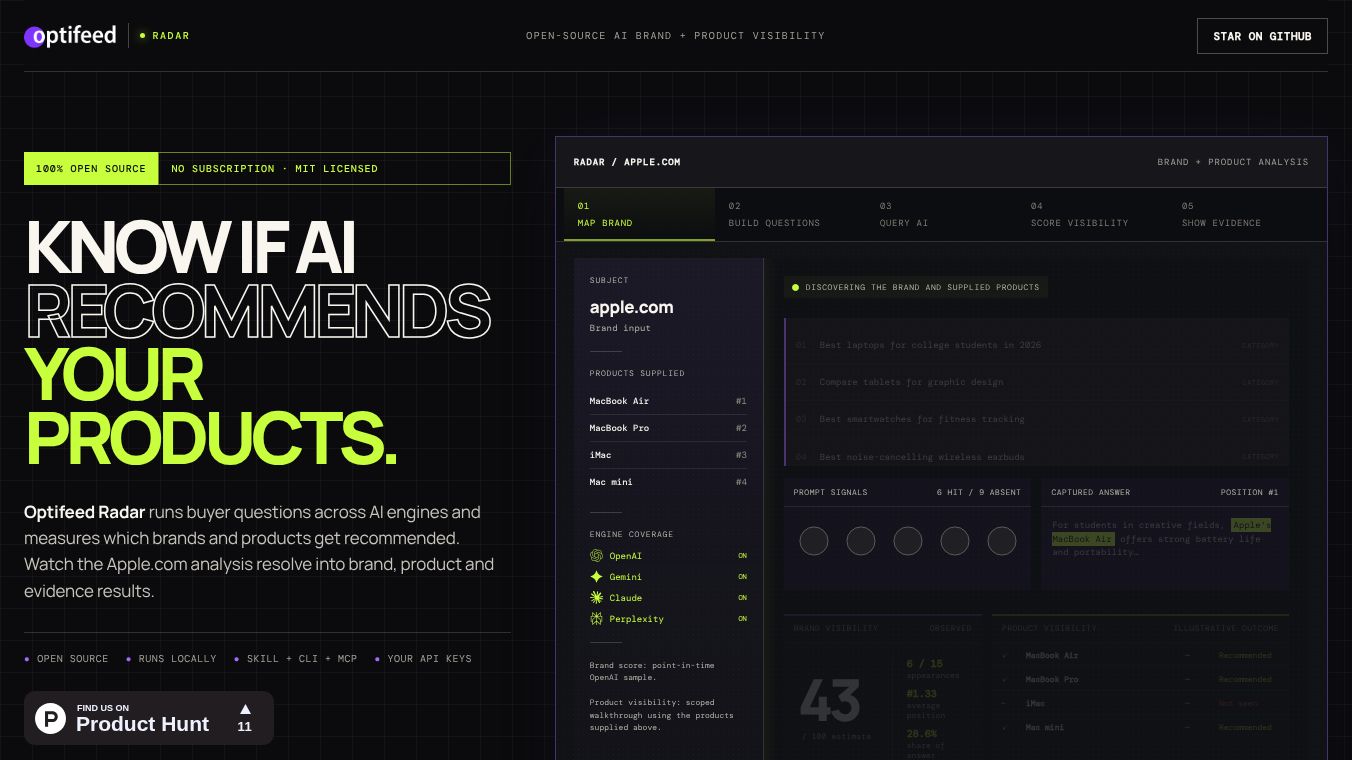





Optifeed Radar: Open-Source AI Visibility Measurement
Overview
Optifeed Radar is a 100% open-source tool designed to help brands and products determine if AI engines recommend their offerings. Unlike subscription-based services, Optifeed Radar runs locally on your machine, ensuring that your API keys remain secure and all data stays on your disk. The tool automates the process of generating buyer questions, querying AI engines, and analyzing the results to measure brand and product visibility.
Benefits
Optifeed Radar offers several key advantages for users who want to track their presence in AI responses. First, it provides a secure environment because it runs entirely on your local machine. This means your sensitive API keys and data never leave your computer. Second, the tool offers complete transparency. Every detected appearance or absence of a brand is backed by the original prompt and the raw AI answer. This eliminates hidden evidence and allows users to inspect exactly what happened. Third, it creates point-in-time snapshots. Since AI answers can change, Radar saves repeatable records so users can see exactly how their visibility changes over time. Finally, it is versatile and can be used as a skill for AI agents, a command line tool, or through a model context protocol for autonomous agent operations.
Use Cases
Optifeed Radar can be utilized in three primary ways depending on user preference. The easiest starting point is using it as an agent skill for compatible AI agents like Codex, Claude Code, and Cursor. This method begins with a free audit and only initiates paid engine calls when requested. For users who prefer direct control, the tool can be run from a single command on their machine. This method calls configured providers directly and stores all prompts, captured answers, and reports locally. Another option is using the Model Context Protocol to give AI agents the ability to check visibility, compare competitors, and open the evidence behind results on their own. For example, a brand could use the tool to analyze a query like "Best laptops for college students" to see if their products appear in the top recommendations and understand why the AI made those choices.
Pricing
Optifeed Radar is a 100% open-source tool with an MIT license. This means there are no subscription fees or hidden costs for using the software itself. The tool runs locally on your machine, which removes the need for cloud-based data storage fees. While the tool can make calls to paid AI engines, these costs are only incurred when the user explicitly requests them during the analysis process. The initial audit and setup are free, making it an accessible option for brands of all sizes.
Vibes
Optifeed Radar is well-regarded for its commitment to transparency and security. Users appreciate that it does not rely on third-party subscriptions or cloud-based data storage. The ability to see raw evidence behind every score builds trust in the results. The tool has been demonstrated to effectively map brand and product analysis, revealing specific details like brand visibility scores and which products are recommended versus those that are ignored. Its open-source nature allows for flexibility and community support, which is a strong point for technical users who value control over their data.
Additional Information
Optifeed Radar is built on an open-source foundation with an MIT license. This licensing model ensures that the code is freely available for anyone to use, modify, and distribute. The tool is designed to work with various AI agents and protocols, showing its adaptability in the evolving landscape of AI integration. By combining open-source flexibility with robust local execution, it empowers users to understand their brand perception without relying on proprietary platforms.
This content is either user submitted or generated using AI technology (including, but not limited to, Google Gemini API, Llama, Grok, and Mistral), based on automated research and analysis of public data sources from search engines like DuckDuckGo, Google Search, and SearXNG, and directly from the tool's own website and with minimal to no human editing/review. THEJO AI is not affiliated with or endorsed by the AI tools or services mentioned. This is provided for informational and reference purposes only, is not an endorsement or official advice, and may contain inaccuracies or biases. Please verify details with original sources.

Comments
Please log in to post a comment.