OpenSourceAI.tech





Top 10 Open-Source AI Tools You Need to Know in 2026
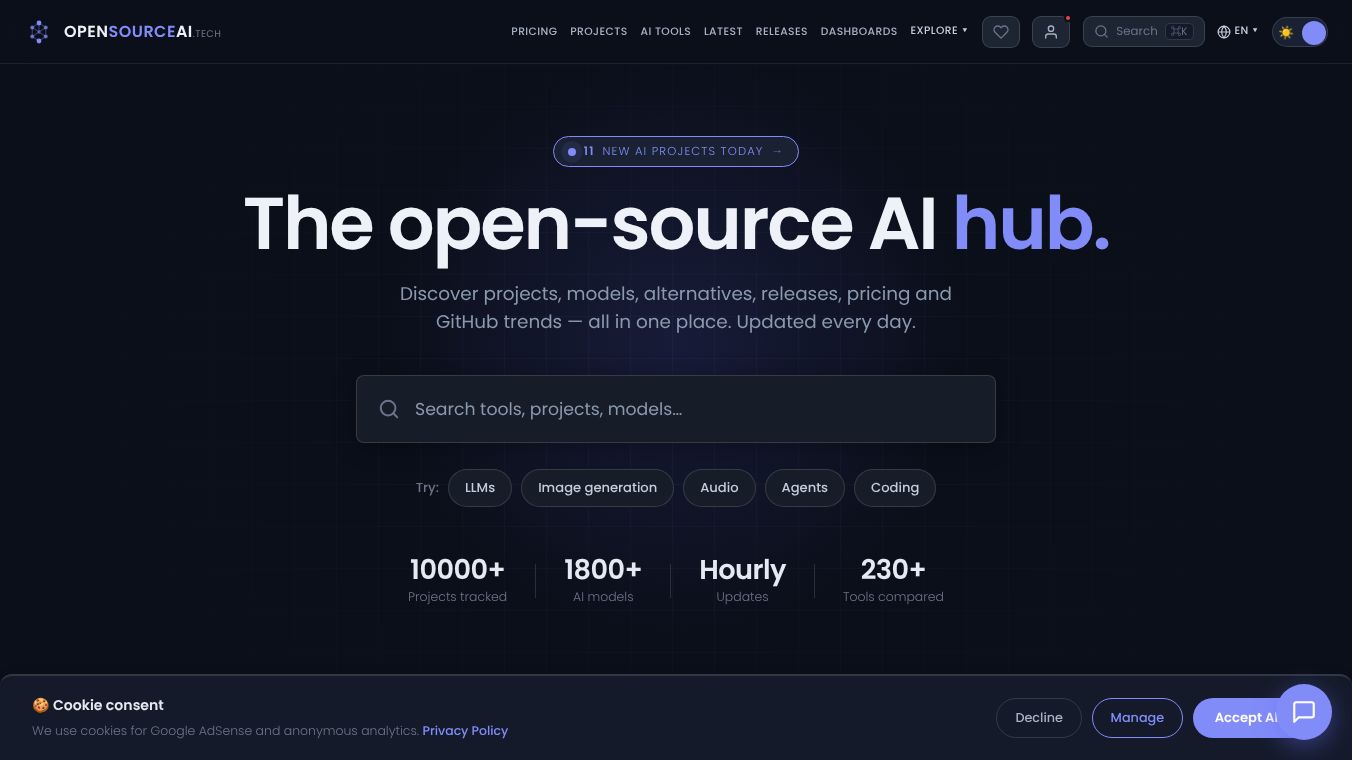
Proprietary AI is often expensive, restrictive, and opaque. In contrast, the open-source AI ecosystem has evolved into an extraordinary landscape offering tools that rival—and often surpass—commercial alternatives at zero cost, with full transparency and the ability to run on your own hardware. This guide details the 10 essential open-source AI tools every developer, creator, and curious mind should know in 2026.
Criteria for Selection
For this list, a tool must meet the following criteria to be considered "open-source AI":*Publicly Available Source Code:Fully accessible for inspection and modification.*Permissive License:Must use licenses such as MIT, Apache 2.0, or GPL.*Free Usage:No token billing or hidden costs.*Active Maintenance:Tools must be actively updated and supported.*Verification:All tools were tested in May 2026.
1. Ollama: The Universal LLM Runner
Category:LLM RunnerLicense:MITSkill Level:Beginner
Ollama has fundamentally changed how developers interact with large language models (LLMs). Previously, running an LLM locally required navigating a complex maze of Python dependencies, CUDA drivers, and model conversion scripts. Ollama collapses this complexity into a single terminal command:ollama run llama3.
In 2026, Ollama supports over 80 models, including Llama 4, Mistral, Gemma, Qwen, DeepSeek R1, and Phi-4. It exposes a local REST API compatible with the OpenAI format, meaning any tool built for OpenAI (such as LangChain, Open WebUI, Dify, and the Continue extension for VS Code) works out of the box with your local model.
Key Features:*Zero Configuration:Install and run in under 2 minutes.*OpenAI-Compatible API:Drop-in replacement for existing integrations.*Hardware Flexibility:Supports quantized models (GGUF) that run on CPU without a GPU.*Daily Updates:New models are added within hours of release.
Installation:
# macOS / Linuxcurl-fsSLhttps://ollama.com/install.sh|sh# Run Llama 3 (8B parameters, ~4GB download)ollamarunllama3# Run DeepSeek R1 reasoning modelollamarundeepseek-r1# List all available modelsollamalist2. ComfyUI: Visual Workflow Builder for Image Generation
Category:Image GenerationLicense:GPL-3.0Skill Level:IntermediateHardware:NVIDIA / AMD / Apple GPU Recommended
ComfyUI is the most powerful open-source interface for Stable Diffusion and FLUX. Unlike simpler UIs, it exposes the entire generation pipeline as a visual node graph. Users connect samplers, models, VAEs, LoRAs, ControlNets, and conditioning nodes in any configuration they desire. This complexity unlocks capabilities unavailable elsewhere, such as multi-pass generation, image-to-video workflows, custom model merging, and reproducible pipelines shareable as JSON files.
With the rise of FLUX in 2025-2026, ComfyUI has become the default environment for serious AI artists. The community publishes thousands of ready-to-use workflows.
Key Features:*Model Support:Supports FLUX, SD 1.5, SDXL, SD3.5, and custom models.*Reproducibility:Shareable workflows as JSON files.*Ecosystem:Massive extension ecosystem via ComfyUI-Manager.*Privacy:Runs locally with no cloud upload of images.
3. OpenAI Whisper: Gold Standard Speech Recognition
Category:Speech-to-TextLicense:MITSkill Level:BeginnerLanguages:99 Supported
Released by OpenAI under the MIT license, Whisper remains the gold standard for offline speech-to-text in 2026. It handles accented speech, technical jargon, multiple speakers, and background noise with remarkable accuracy, often outperforming expensive commercial APIs.
Key Features:*Commercial Freedom:MIT license allows free use in commercial projects.*Privacy:No data is sent to the cloud; 100% local transcription.*Scalability:Multiple model sizes available, from tiny (39MB) to large-v3 (3GB).*Output Formats:Supports SRT subtitles, VTT, and JSON timestamps.
Installation:
pipinstallopenai-whisper# Transcribe an audio filewhisperaudio.mp3--languageEnglish# Use large model for maximum accuracywhisperinterview.wav--modellarge-v3--output_formatsrt4. LangChain: The Backbone of LLM Applications
Category:LLM FrameworkLicense:MITSkill Level:DeveloperLanguages:Python / JS
LangChain is the standard framework for building LLM-powered applications, often described as the "jQuery of LLM development." It provides abstractions for chaining prompts, connecting to vector databases (for RAG), building agents with tools, and managing memory across multi-turn conversations.
A key advantage is its vendor-agnosticism; it works with any LLM backend. Developers can switch between OpenAI, Claude, Gemini, or a local Ollama instance by changing a single line of code. This flexibility is crucial for production applications where model availability and costs fluctuate.
Key Features:*Universal Compatibility:Works with OpenAI, Anthropic, Ollama, HuggingFace, and more.*Integrations:Built-in support for 200+ vector stores, document loaders, and APIs.*Monitoring:LangSmith for debugging and monitoring chains.*Complex Workflows:LangGraph for complex stateful agent workflows.
5. Stable Diffusion WebUI (AUTOMATIC1111): The Swiss Army Knife
Category:Image GenerationLicense:AGPL-3.0Skill Level:BeginnerHardware:4GB+ VRAM Recommended
With over 145,000 GitHub stars, AUTOMATIC1111's Stable Diffusion WebUI is one of the most starred AI repositories in history. It offers a comprehensive, no-code browser interface for text-to-image, image-to-image, inpainting, outpainting, high-res fix, and batch generation—all running locally.
If ComfyUI is the power tool for experts, AUTOMATIC1111 is the Swiss Army knife for everyone else. Its extension ecosystem is enormous, covering everything from face restoration (CodeFormer) to creative upscaling (RealESRGAN) to ControlNet for pose-guided generation.
Key Features:*Model Support:Supports SD 1.5, SDXL, SD3.5, and most community models.*Extensions:500+ extensions available via the built-in manager.*Fine-Tuning:LoRA, hypernetwork, and embedding support.*Hardware:Runs on NVIDIA, AMD (ROCm), and Apple Silicon.
Note: AGPL-3.0 tools require care in commercial deployment; any modifications must be open-sourced if the software is distributed.
6. Open WebUI: Self-Hosted Chat Interface
Category:Chat InterfaceLicense:MITSkill Level:BeginnerInstall:Docker / pip
Open WebUI is a beautiful, self-hosted ChatGPT-like interface designed for local models. It connects to a local Ollama instance to provide a polished chat experience with conversation history, model switching, RAG document upload, image generation, voice input, and user management—all contained within a single Docker container.
It is the fastest way to share local AI access with non-technical teammates. By spinning up Open WebUI on a local server, teams can access a ChatGPT-quality experience for free, ensuring data never leaves the building.
Key Features:*Deployment:One Docker command to deploy a full ChatGPT-equivalent.*Security:Multi-user support with role-based access control.*RAG:Upload PDFs, docs, and ask questions about them.*Multimodal:Voice input/output and image generation capabilities.
Installation:
dockerrun-d-p3000:8080\--add-host=host.docker.internal:host-gateway\-vopen-webui:/app/backend/data\--nameopen-webui\ghcr.io/open-webui/open-webui:main# Visit: http://localhost:30007. DeepSeek R1: The Reasoning Model
Category:LLM ModelLicense:MITModel Sizes:1.5B – 671BSkill Level:Beginner
When DeepSeek released R1 in January 2025 under an MIT license, it sent shockwaves through the industry. A Chinese research lab produced a reasoning model that matched OpenAI o1 on key benchmarks, trained at a fraction of the cost and given away for free. This proved that frontier AI is not the exclusive domain of multi-billion-dollar companies.
DeepSeek R1 uses chain-of-thought reasoning and is particularly strong at math, coding, and logical problem-solving. Distilled versions (1.5B to 70B parameters) can be run locally via Ollama on consumer hardware, while the full 671B model is accessible via their API at extremely competitive prices.
Key Features:*Commercial Freedom:Full MIT license.*Performance:Exceptional reasoning, coding, and math performance.*Transparency:Transparent training methodology published in a research paper.*Accessibility:Distilled versions run locally; full model available via API.
8. Dify: No-Code AI App Platform
Category:App PlatformLicense:Apache 2.0Skill Level:No-codeDeploy:Self-host / Cloud
Dify is the fastest path from "I want an AI app" to a deployed, working product. It is an open-source platform for building LLM applications featuring a visual workflow editor, RAG pipelines, agent tools, and one-click deployment. Users can have a working chatbot connected to their documents in 20 minutes.
What separates Dify from simpler no-code tools is its depth: it supports multi-step agent workflows, custom tool integrations via API, monitoring dashboards, and A/B testing between models. Organizations worldwide use it to build internal knowledge bases, customer support bots, and AI-powered content pipelines.
Key Features:*Visual Editor:No coding required to build complex apps.*Compatibility:Works with 50+ LLMs: OpenAI, Anthropic, Ollama, and more.*RAG:Built-in vector database for RAG pipelines.*Integration:API endpoint auto-generated for easy integration anywhere.
9. CrewAI: Multi-Agent Orchestration
Category:Agent FrameworkLicense:MITSkill Level:DeveloperLanguage:Python
The next frontier of AI is not smarter single models, but teams of specialized agents working together. CrewAI makes this accessible. Users define a crew of agents (e.g., Researcher, Writer, Editor, Analyst), assign them roles and goals, give them tools (web search, code execution, file I/O), and watch them collaborate to complete complex multi-step tasks.
Built on top of LangChain and designed for production use, CrewAI is the most intuitive multi-agent framework available. It is particularly powerful for content generation pipelines, automated research workflows, and software development assistance.
Key Features:*Architecture:Role-based agent architecture that is intuitive to design.*Backend Flexibility:Works with any LLM backend, including local Ollama models.*Tools:Built-in tools for web search, code execution, and file read/write.*Execution Modes:Supports sequential and hierarchical task execution.
10. AnythingLLM: Private Desktop AI
Category:RAG Desktop AppLicense:MITSkill Level:BeginnerInstall:Desktop App
AnythingLLM is the most complete all-in-one solution for private, local AI. It is a desktop application (Mac, Windows, Linux) that bundles a full RAG pipeline: upload any PDF, Word doc, website, YouTube video, or CSV, and have a conversation with it using your choice of local or cloud LLM. No data leaves your machine unless you choose a cloud model.
It supports Ollama, LM Studio, LocalAI, and all major cloud APIs out of the box. The built-in agent mode can execute code, browse the web, and manage files—all from a clean chat interface that non-technical users can operate without any command-line knowledge.
Key Features:*Ease of Use:One-click desktop installer; no Docker or terminal required.*Document Support:Supports 15+ document types.*Database:Built-in vector DB; no external setup needed.*Workspaces:Multi-workspace with separate document collections.
Quick Comparison Table
| Tool | Category | License | GPU Needed | Skill Level |
|---|---|---|---|---|
| Ollama | LLM Runner | MIT | No | Beginner |
| ComfyUI | Image Gen | GPL-3.0 | Recommended | Intermediate |
| Whisper | Speech-to-Text | MIT | No | Beginner |
| LangChain | LLM Framework | MIT | No | Developer |
| SD WebUI | Image Gen | AGPL-3.0 | Recommended | Beginner |
| Open WebUI | Chat Interface | MIT | No | Beginner |
| DeepSeek R1 | LLM Model | MIT | For large sizes | Beginner |
| Dify | App Platform | Apache 2.0 | No | No-code |
| CrewAI | Agent Framework | MIT | No | Developer |
| AnythingLLM | RAG Desktop | MIT | No | Beginner |
Frequently Asked Questions
What is the best open-source AI tool for beginners?
Start withOllamaandOpen WebUI. Ollama installs in two minutes, and Open WebUI provides a polished ChatGPT-equivalent interface. You can be chatting with a free, local Llama model within 10 minutes.
Can I use these tools commercially?
Most of them, yes. MIT and Apache 2.0 licensed tools (Ollama, Whisper, LangChain, Open WebUI, DeepSeek R1, Dify, CrewAI, AnythingLLM) can be used in commercial products. AGPL-3.0 tools like AUTOMATIC1111's WebUI require more care—any modifications must be open-sourced if you distribute the software. Always verify the current license before commercial deployment.
Do I need an expensive computer to run these tools?
Not for most of them. Ollama, Open WebUI, LangChain, Dify, CrewAI, and AnythingLLM all work well on a standard laptop with no GPU. For image generation (ComfyUI, AUTOMATIC1111), a GPU with at least 6GB VRAM is recommended but not strictly required. Smaller quantized models can run on CPU, just more slowly.
How do open-source LLMs compare to ChatGPT in 2026?
The gap has closed dramatically. Models like DeepSeek R1, Llama 4, and Qwen 3 match or exceed GPT-4 on many benchmarks. For everyday tasks—writing, coding, summarizing, answering questions—a good local model running on Ollama is genuinely competitive with ChatGPT, at zero marginal cost per query.
🚀 Where to go from here:Start with Ollama + Open WebUI for chat, AnythingLLM for document Q&A, and Whisper for transcription. These three cover 90% of everyday AI use cases and run on any modern laptop for free.
This content is either user submitted or generated using AI technology (including, but not limited to, Google Gemini API, Llama, Grok, and Mistral), based on automated research and analysis of public data sources from search engines like DuckDuckGo, Google Search, and SearXNG, and directly from the tool's own website and with minimal to no human editing/review. THEJO AI is not affiliated with or endorsed by the AI tools or services mentioned. This is provided for informational and reference purposes only, is not an endorsement or official advice, and may contain inaccuracies or biases. Please verify details with original sources.

Comments
Please log in to post a comment.