OpenSeek





OpenSeek: A Terminal-Based, Multi-Provider Coding Agent
Overview
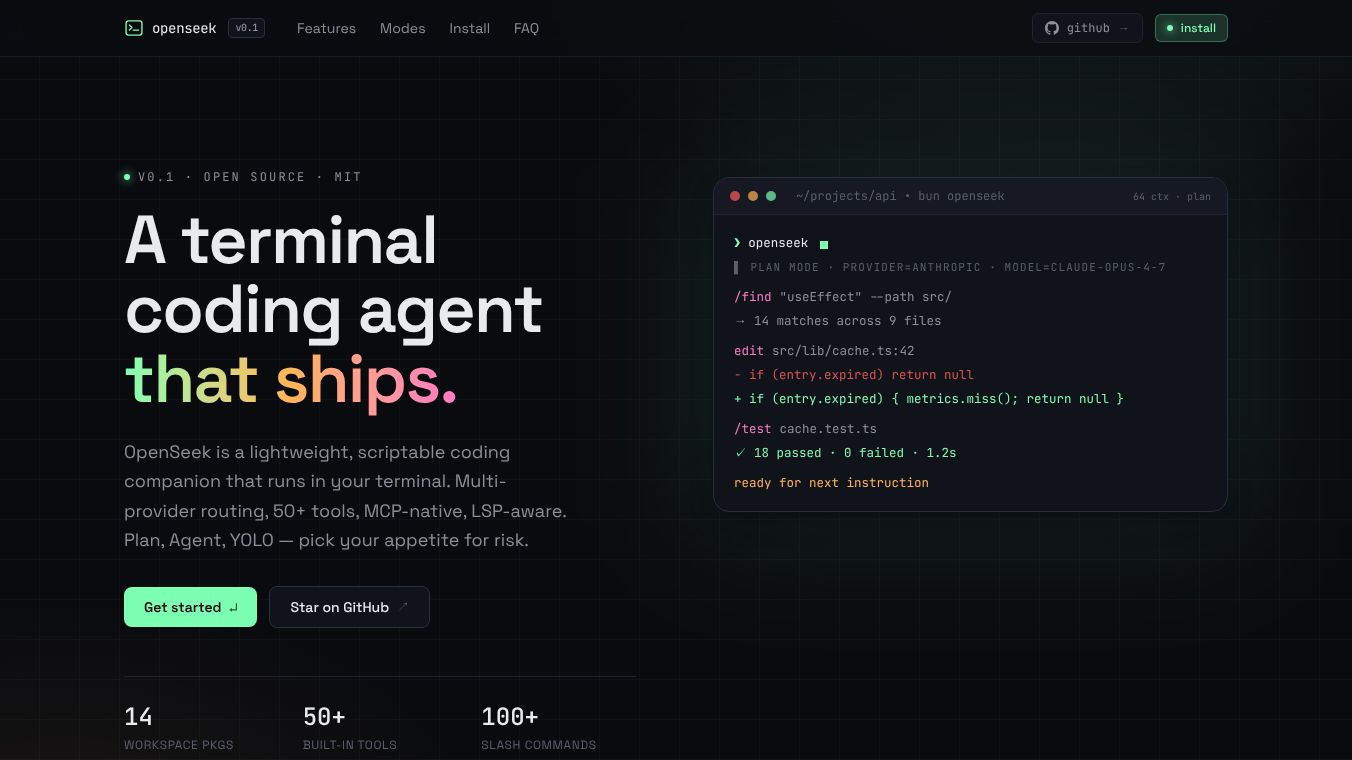
OpenSeek is a lightweight, open-source coding companion designed to run directly in the terminal. It functions as a plumbing layer rather than a proprietary product surface, eliminating the need for sign-in flows, cloud round-trips, or vendor lock-in. Built for engineers who live in the terminal, OpenSeek allows users to plan, execute, and ship code changes with full control over the underlying AI models and tools.
Benefits
OpenSeek offers several key advantages for developers who value flexibility and privacy. First, it is provider-neutral by design. Unlike other agents that rely on a central SaaS runtime, OpenSeek runs entirely on the user's machine. Your code, file edits, and shell commands never pass through OpenSeek's servers; they go directly to the Large Language Model endpoint of your choice. This architecture ensures privacy, flexibility, and the ability to mix and match different AI backends within a single session.
The tool supports routing across five major backends, allowing users to swap models per task or per session without rewriting code. These backends include Anthropic, OpenAI, AWS Bedrock, Google Vertex, and Azure. This flexibility enables strategies such as using a cheaper model for planning and a frontier model for execution, or running local models for offline work.
OpenSeek comes with an extensive toolset featuring 50+ built-in tools and 100+ slash commands. These cover the full lifecycle of software development, including file edits, shell execution, search, fetching, refactoring, running tests, git operations, and browser automation. The agent is also a first-class Model Context Protocol client, allowing users to plug in their own servers, data, and skills seamlessly.
Another major benefit is the integration of Language Server Protocol feedback directly into the agent loop. Diagnostics, hovers, and references are piped straight to the agent, ensuring it understands the project context exactly as the user's IDE does. Users can also choose from three operational modes to control the level of autonomy. The Plan mode is read-only and ideal for reasoning. The Agent mode allows the user to retain veto power over file writes. The YOLO mode auto-approves everything, which is best suited for CI runs or rapid iteration.
Use Cases
OpenSeek is designed for developers who prefer working in the terminal and want full control over their coding environment. It is suitable for anyone looking to avoid vendor lock-in or central runtimes. The tool can be used for various tasks such as searching for code patterns, editing files, running tests, and committing changes to a repository.
The headless runtime feature makes OpenSeek suitable for Docker containers, GitHub Actions, and custom schedulers. Users can run it as a service, stream tokens to CI/CD pipelines, editors, or bots, and pipe goals in to receive structured event streams out. This makes it a powerful tool for automated workflows and continuous integration.
Developers who want to mix and match different AI backends within a single session will find OpenSeek particularly useful. For example, a developer might use a local model for initial planning and a cloud-based model for complex execution tasks. The ability to switch modes on the fly allows users to adapt to their current workflow needs, whether they need careful review of changes or rapid automation.
Pricing
OpenSeek is released under the MIT License. This means it is free to use, fork, ship, embed, or sell products built on top of it. The only request from the maintainers is that users share what they build. There are no hidden costs or subscription fees associated with the software itself.
Vibes
As an open-source project, OpenSeek has not yet accumulated a large volume of public reviews or testimonials. However, the community response to its philosophy of provider neutrality and local execution has been positive among developers who are concerned about data privacy and vendor lock-in. The project aims to empower developers to stop renting their coding agents and instead run them locally with full control.
Additional Information
OpenSeek is built on Bun, a runtime that offers superior startup time, native TypeScript support, and a streamlined workspace runner. This technical foundation helps avoid the need for numerous plugins and ensures a smooth user experience. The project is actively maintained and supports multiple operating systems including macOS, Linux, and WSL2. The maintainers encourage users to share their builds and contributions to the community.
This content is either user submitted or generated using AI technology (including, but not limited to, Google Gemini API, Llama, Grok, and Mistral), based on automated research and analysis of public data sources from search engines like DuckDuckGo, Google Search, and SearXNG, and directly from the tool's own website and with minimal to no human editing/review. THEJO AI is not affiliated with or endorsed by the AI tools or services mentioned. This is provided for informational and reference purposes only, is not an endorsement or official advice, and may contain inaccuracies or biases. Please verify details with original sources.

Comments
Please log in to post a comment.