Octen Model Gateway
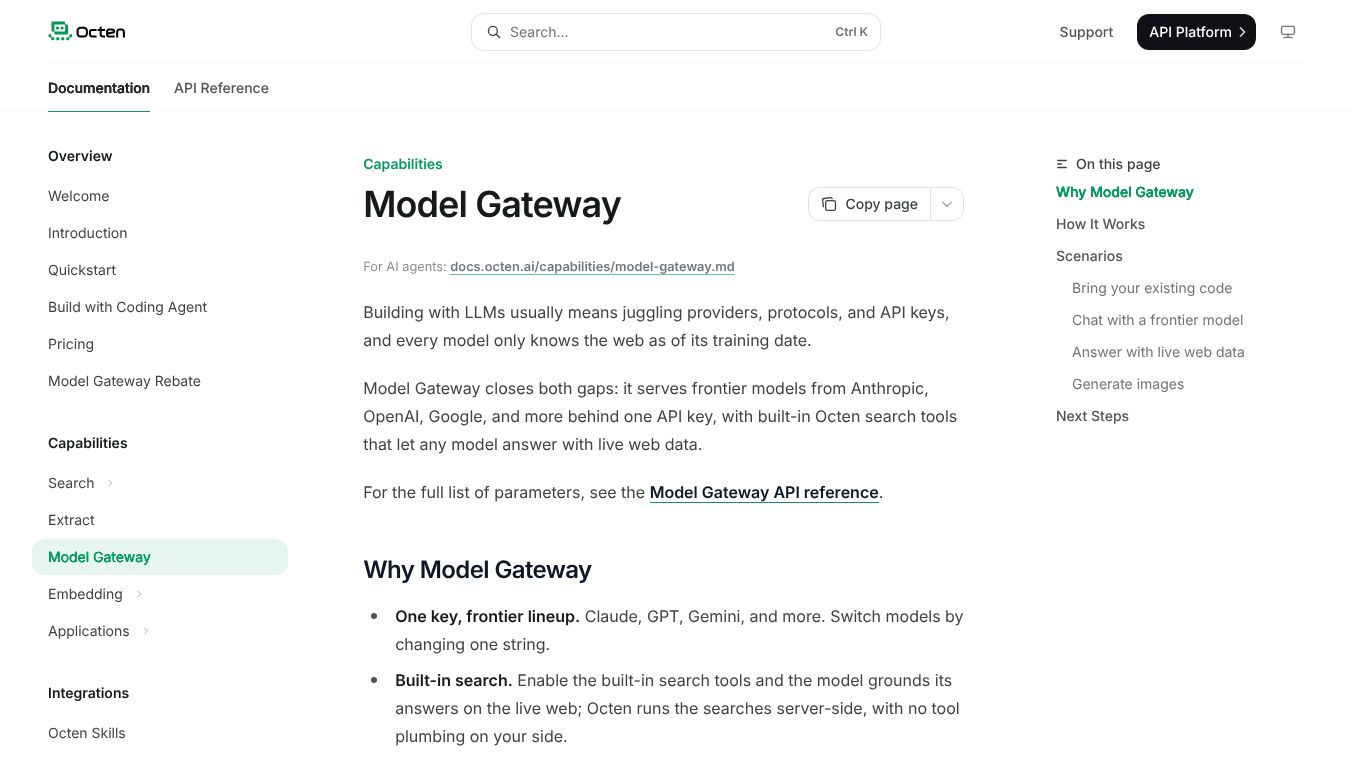





Introducing Octen Model Gateway: The Infrastructure for the Agent Era
Traditional search systems have been designed for humans, not AI. For the past twenty years, search engines have optimized for a user who types a query, scrolls through a list of blue links, and opens a few pages to find what they need. This process is built for human attention and human speed.
Even today's "Deep Research" agents largely follow this same pattern. They search, read, search again, and repeat the cycle one step at a time. The result is a slow, sequential process where gathering information can take seconds, minutes, or even hours, depending on the scope of the task. AI, however, does not need to work this way.
Benefits
Octen is built specifically for AI systems. Instead of mimicking a human browsing experience, it gives agents direct, high-speed access to the information they need. When search systems throttle requests or force agents to wait for results, they limit what AI can actually do, causing intelligence to slow when access to information does.
Octen was built around a different research model. Instead of moving through information step by step, agents can issue hundreds or even thousands of queries at once. What used to require a long chain of searches and page loads can now be completed in a few high-concurrency rounds, delivering the relevant context directly to the model.
To support the next generation of agents, Octen rebuilt the search stack around three priorities that matter most for AI workloads:
- Massive Concurrency: Octen supports more than 1,000,000 queries per second on a single account, allowing agents to explore an entire topic space almost instantly.
- Low Latency: With a P50 latency of 62 milliseconds, information retrieval happens fast enough to feel immediate for downstream models.
- Real-Time Indexing: News and data can appear in the index within 5 minutes of publication, allowing models to work with information as it emerges rather than relying on stale context.
Use Cases
Broad search changes the equation for how much information a model can realistically evaluate during a task. When an agent can launch thousands of queries simultaneously, it gains a much wider view of the landscape in the same amount of time.
This shift opens the door to new capabilities. Agents can monitor global markets, follow breaking news, and synthesize signals from thousands of sources before a traditional research workflow would even finish its first page of results. Octen is designed to serve as the high-bandwidth layer connecting models to the ever-changing world around them.
The goal is simple: build the underlying system that lets agents move at machine speed. As Kuan (Colin) Zou, Founder & CEO of Octen AI, notes, the builders who come next will decide what that makes possible.
Pricing
Pricing details are not available in the provided article.
Vibes
Public reception and specific reviews are not available in the provided article.
Additional Information
Additional information regarding funding, partnerships, or achievements is not available in the provided article.
This content is either user submitted or generated using AI technology (including, but not limited to, Google Gemini API, Llama, Grok, and Mistral), based on automated research and analysis of public data sources from search engines like DuckDuckGo, Google Search, and SearXNG, and directly from the tool's own website and with minimal to no human editing/review. THEJO AI is not affiliated with or endorsed by the AI tools or services mentioned. This is provided for informational and reference purposes only, is not an endorsement or official advice, and may contain inaccuracies or biases. Please verify details with original sources.
Comments
Please log in to post a comment.