MuseVideoAI
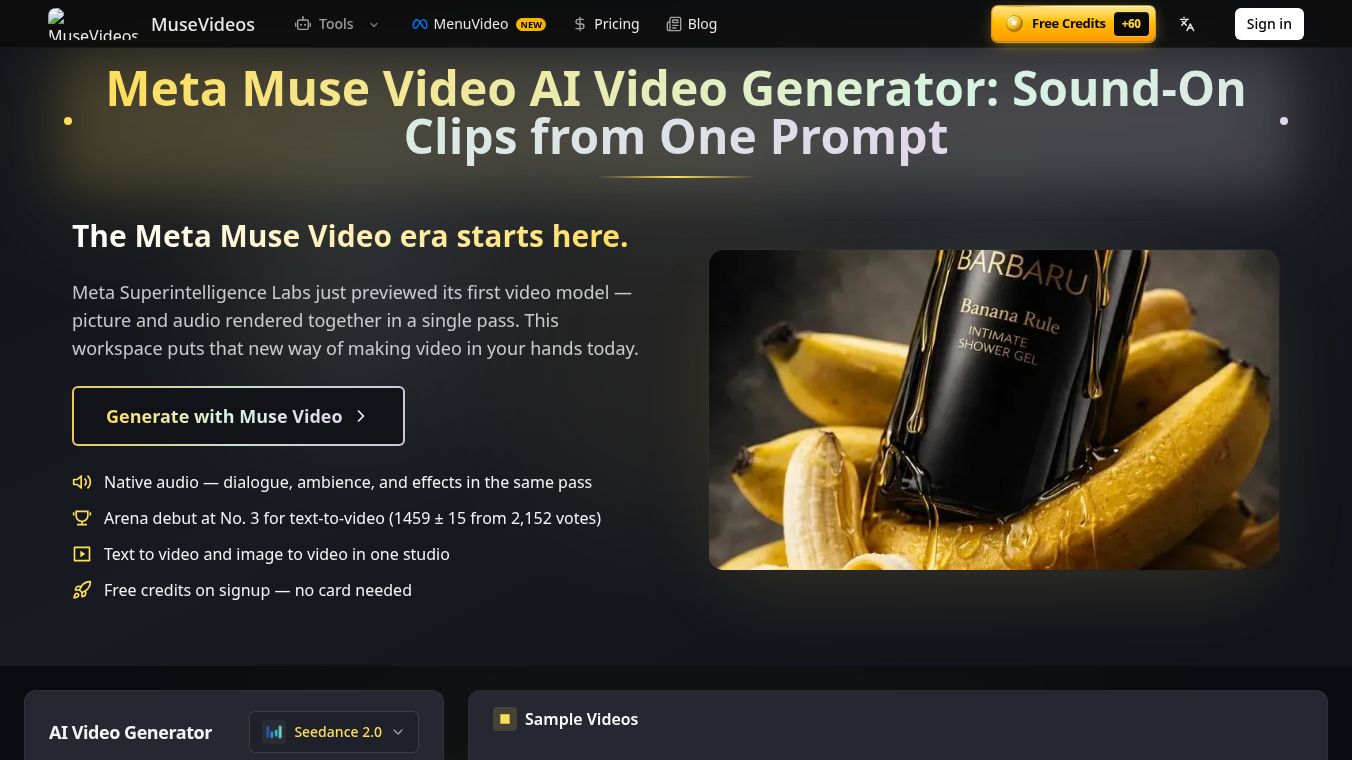





Meta Muse Video AI: The Era of Sound-On Clips from One Prompt
Introduction
Meta Superintelligence Labs has officially previewed its first video generation model, Muse Video, marking the beginning of a new era in AI content creation. Previewed on July 7, 2026, alongside its sibling model Muse Image, Muse Video represents a significant shift by rendering both picture and audio in a single pass. This integrated approach eliminates the traditional need for post-production sound design, allowing creators to generate synchronized sound-on clips directly from a text prompt.
Benefits
Unlike most existing video models that produce silent clips requiring a separate audio layer, Muse Video composes dialogue, ambience, and sound effects simultaneously with the visual frames. This audio-native architecture offers several distinct advantages:
- Single-Pass Generation:Visuals and synchronized sound are rendered together, removing an entire post-production step.
- Grounded Physics & Identity:The model supports grounded physics and maintains reusable character identity across clips, ensuring consistency in serial content.
- Clip Remixing:Users can feed an existing clip back into the system to steer it toward a new direction rather than starting from scratch.
- Versatile Inputs:The workspace supports text-to-video, image-to-video, and the animation of existing clips.
In the community-voted Text-to-Video Arena, Muse Video debuted at No. 3 with a preliminary score of 1459 across 2,152 votes. This score placed it ahead of several established engines. The model excels in prompt adherence, visual fidelity, and temporal consistency.
Use Cases
The Muse Video workspace is designed to be accessible, running entirely in the browser without the need for timelines, sound libraries, or editing suites. The workflow is streamlined into four steps:
- Describe the Scene:Users write a plain-language prompt detailing the subject, motion, mood, and desired sounds. Alternatively, users can upload a still image to animate.
- Pick Engine and Frame:Creators can choose between Muse Video or other engines in the roster such as Veo, Kling, or Wan. Users set the aspect ratio for vertical shorts or widescreen cinematic shots and choose the resolution.
- Generate:With a single click, the system renders the shot. The resulting clip includes composed audio, which is automatically filed to the user's cloud library.
- Download and Publish:Users export a clean MP4 ready for platforms like TikTok, Reels, YouTube, or client decks. Paid plans offer watermark-free downloads with full commercial rights.
The integration of native audio is changing workflows for various types of content creators:
- Short-Form Creators:Can reduce their pipeline from multiple tools to a single prompt box, generating sound-on ad variants instantly.
- Performance Marketers:Benefit from rapid iteration, comparing engine outputs on the same prompt before standups.
- Course Producers & Indie Directors:Can create narrated explainer clips without a separate voice-over pass, as timing aligns naturally because the voice renders with the picture. Producers can also use roughed-in sound design for better mood board reactions.
Pricing
Muse Video is currently in a preview-only phase. It is not yet available via public API, though access is expected to open soon. Users receive free credits upon signup and daily check-in credits. Video render costs vary based on the engine, resolution, and duration. One-time credit packs and subscriptions are available for purchase. Paid plans include watermark-free downloads with full commercial rights suitable for ads, client work, and monetized channels. Free renders carry a watermark. Output formats include clean MP4 files in various aspect ratios such as 9:16, 1:1, and 16:9 with resolutions ranging from HD up to 4K, depending on the selected engine.
Vibes
While specific user testimonials are not detailed in the available information, the public reception highlights Muse Video's strong performance. The model quickly established itself in the competitive landscape of AI video generation by ranking third in community votes. The community is tracking metrics regarding audio-video synchronization in complex scenarios and fast physical motion as the model evolves. The overall sentiment suggests a powerful tool that is poised to redefine the standards for AI-assisted video production.
Additional Information
Meta Muse Video represents a significant leap forward in AI video generation by treating audio as a native component of the generation process rather than an afterthought. By combining high visual fidelity with synchronized sound and a user-friendly workspace, it offers creators a powerful tool to produce professional-grade, sound-on video content efficiently. As the model matures and API access expands, it is expected to continue evolving based on community feedback and technical improvements.
This content is either user submitted or generated using AI technology (including, but not limited to, Google Gemini API, Llama, Grok, and Mistral), based on automated research and analysis of public data sources from search engines like DuckDuckGo, Google Search, and SearXNG, and directly from the tool's own website and with minimal to no human editing/review. THEJO AI is not affiliated with or endorsed by the AI tools or services mentioned. This is provided for informational and reference purposes only, is not an endorsement or official advice, and may contain inaccuracies or biases. Please verify details with original sources.


Comments
Please log in to post a comment.