Mistikguard
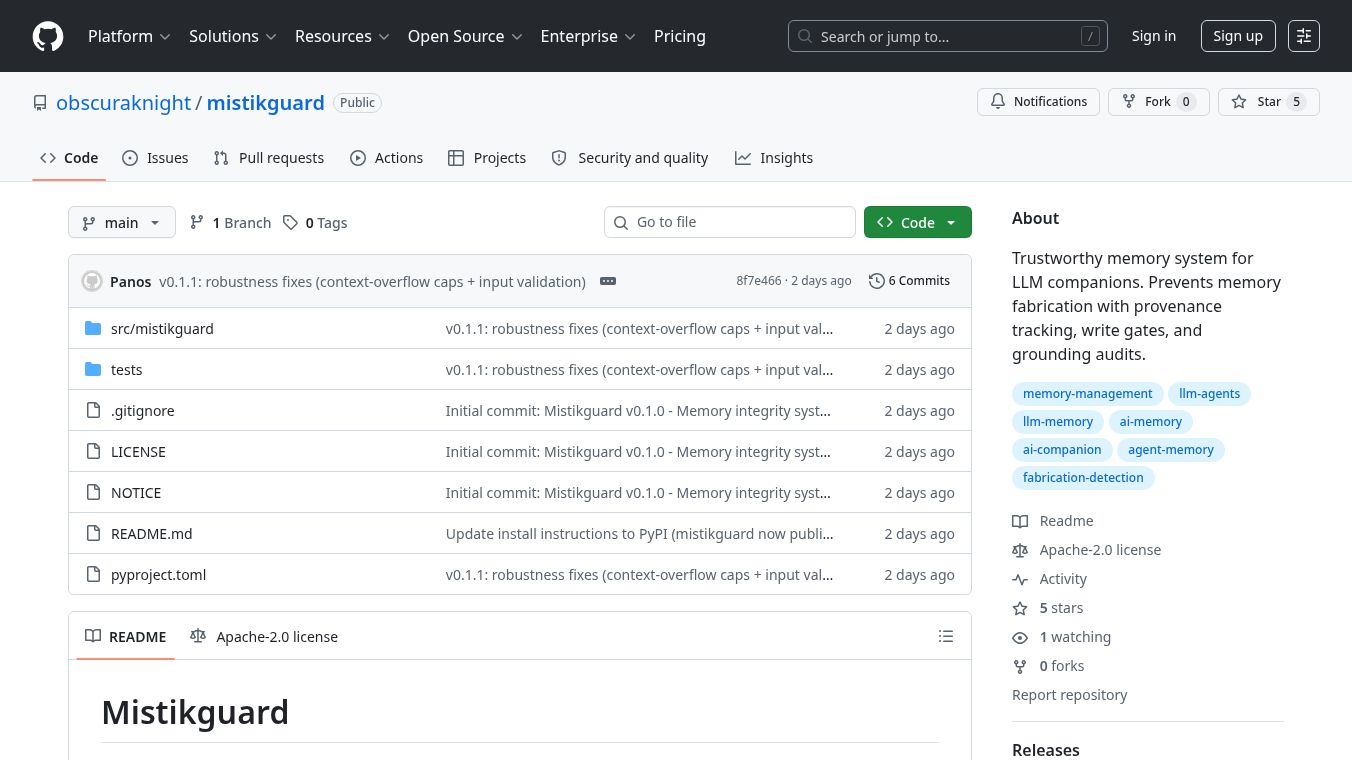





Mistikguard: Ensuring Memory Integrity for LLM Companions
Research Context and Background
Mistikguard is a lightweight software library designed to solve a specific problem in artificial intelligence. It helps prevent Large Language Models from creating false memories about a user and treating them as real facts. When an AI companion talks to a person, it often summarizes conversations and stores details about that person. Mistikguard acts as a safety layer to ensure that only true information becomes permanent in the system's memory. It follows a simple rule: the AI can suggest facts, but Mistikguard decides which ones are allowed to be saved.
Benefits
Mistikguard offers several key advantages for developers building AI companion applications. First, it stops false information from becoming permanent. Without this tool, a single mistake by the AI could be saved as a fact and repeated forever. Mistikguard ensures that corrections made by a user are respected and that old mistakes cannot be quietly brought back. Second, it tracks where every piece of information comes from. It clearly marks facts that the user confirmed as true against facts that the AI guessed. This distinction helps the system stay honest. Third, it includes a safety check that reviews the AI's responses. If the AI claims to remember something that was never said, Mistikguard flags it for review. This keeps the human user in control of their digital history.
Use Cases
Mistikguard is primarily used by developers creating long-term AI companion apps. These are applications where an AI remembers details about a user over time, such as a personal assistant or a chatbot that learns about your life. The tool is useful whenever an AI needs to store facts about a person without losing accuracy. For example, if a user tells an AI their favorite color, Mistikguard ensures that color is saved correctly. If the AI later guesses a wrong detail, Mistikguard prevents that guess from being saved as truth. It is also used to audit conversations. Developers can run the tool to check if an AI response contains claims that do not match the stored memory. This is helpful for building trustworthy systems where users need to know the AI is not making things up.
Pricing
Mistikguard is available as an open-source library under the Apache License 2.0. Developers can install it for free using the pip package manager. The core version has no external dependencies, meaning it works without needing other paid software. There is an optional extension that includes a client for the OpenAI API to power the judgment features, which can be installed separately.
Vibes
As an open-source project in its alpha stage, Mistikguard has not yet received widespread public reviews or testimonials. However, the developers have shared performance data from internal testing. In a benchmark test with 44 cases, the tool achieved a perfect precision score of 1.000. This means it never falsely accused a true statement of being fake. It also had a high recall score of 0.909, meaning it caught most of the false statements. The community response suggests that developers in the AI space are interested in tools that prioritize memory integrity and user authority over convenience.
Additional Information
Mistikguard is currently in the alpha version, labeled as 0.1.0. This means the core features are tested and working, but the API might change in future updates. The project was originally created as part of a larger local-first AI companion called Mistik. It is designed to be transparent about its limits. The developers clearly state that the tool does not stop the AI from making a mistake in the first place. It only prevents that mistake from becoming a permanent, defended fact in the memory store. The project also warns about security risks, noting that because it uses AI to make decisions, it could be vulnerable to prompt injection attacks if not used carefully in public systems.
This content is either user submitted or generated using AI technology (including, but not limited to, Google Gemini API, Llama, Grok, and Mistral), based on automated research and analysis of public data sources from search engines like DuckDuckGo, Google Search, and SearXNG, and directly from the tool's own website and with minimal to no human editing/review. THEJO AI is not affiliated with or endorsed by the AI tools or services mentioned. This is provided for informational and reference purposes only, is not an endorsement or official advice, and may contain inaccuracies or biases. Please verify details with original sources.



 No Info

Comments
Please log in to post a comment.