MiniMax H3
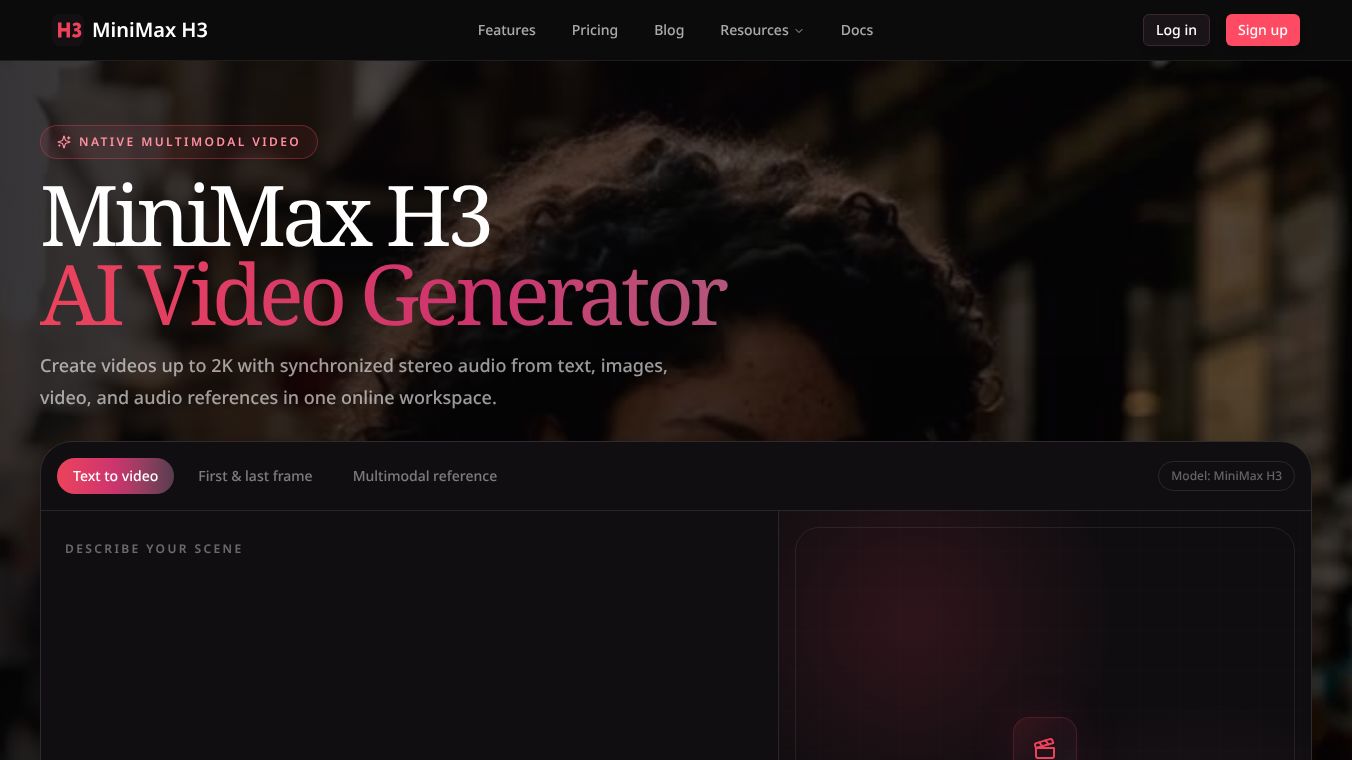





MiniMax H3: A General-Purpose Multimodal Generation Model
MiniMax has officially launched MiniMax H3, a general-purpose full-modal generation model designed to unify the understanding and generation of text, images, video, and audio. Unlike previous specialized models, H3 is built to handle complex, real-world creative tasks by deeply understanding the relationships between different modalities.
Benefits
H3 offers several key advantages that make it a powerful tool for content creators. It supports the unified understanding of text, images, video, and audio. The model can generate native dual-channel audio-visual content with a maximum resolution of 2K and a duration of 15 seconds. One of its standout features is its ability to process prompts that reference multiple inputs simultaneously. For example, a user can instruct the model to use the camera movement from one video, have a character from an image sing, and reference audio from a third source. H3 automatically understands the relationships between these inputs to generate the target video.
The model excels in scenarios requiring the fusion of complex information across modalities, such as generating movie trailers, game UIs, dynamic news reports, and advertisements. It also demonstrates strong capabilities in adhering to complex instructions, including text-to-brand information presentation and video-to-video motion transfer. In terms of performance, H3 defaults to 2K resolution. At this resolution, its cost per second is less than one-third of mainstream models. At 768P, it costs half of mainstream 720P models. The model offers the best price-performance ratio in the industry, achieved through architectural optimizations and efficient tokenization.
Use Cases
H3 is designed for commercial-grade content creation across various industries. In the film and media sector, it can be used to generate movie trailers. For the gaming industry, it helps create game UIs and assets. The news industry can use it to produce dynamic news reports. Marketing teams can leverage the model to create advertisements and commercials. Designers can use it to assist in product design and UI/UX development.
Pricing
The model offers the best price-performance ratio in the industry. At 2K resolution, its cost per second is less than one-third of mainstream models. At 768P, it costs half of mainstream 720P models.
Vibes
MiniMax H3 marks a transition from generating simple videos to participating in the full content production process, treating language as a scalable computing system for multimodal interaction.
Additional Information
H3 was developed with the philosophy of serving tasks through architecture, prioritizing simplicity, universality, and high efficiency over specialized sub-modules. The model utilizes a Contextual Omni Representation approach to achieve broad instruction understanding. It features an H3-VAE that significantly optimizes architectural efficiency and offers a compression ratio that brings a 4x benefit in sequence length. The H3-Omni Transformer adopts a unified architecture designed for task generalization, resulting in a nearly 30% improvement in training throughput.
For 2K resolution outputs, H3 uses In-Context Regeneration. The base model generates a lower-resolution result and then re-generates the high-resolution output in-context. This approach reuses the base model's generation capabilities and allows for the restoration of fine details that traditional super-resolution methods often miss.
The training strategy focuses on early integration of various data types and tasks with appropriate ratios to ensure the model possesses broad multimodal context understanding and generation capabilities from the pre-training stage. While H3 is a significant leap forward, MiniMax acknowledges areas for future improvement, including enhancing the model's ability to understand complex multimodal contexts, increasing model size, and pursuing higher resolutions and finer image quality. Plans are in place to open-source the model weights in the near future to foster community development and accelerate domestic chip adaptation.
This content is either user submitted or generated using AI technology (including, but not limited to, Google Gemini API, Llama, Grok, and Mistral), based on automated research and analysis of public data sources from search engines like DuckDuckGo, Google Search, and SearXNG, and directly from the tool's own website and with minimal to no human editing/review. THEJO AI is not affiliated with or endorsed by the AI tools or services mentioned. This is provided for informational and reference purposes only, is not an endorsement or official advice, and may contain inaccuracies or biases. Please verify details with original sources.

Comments
Please log in to post a comment.