Marginal
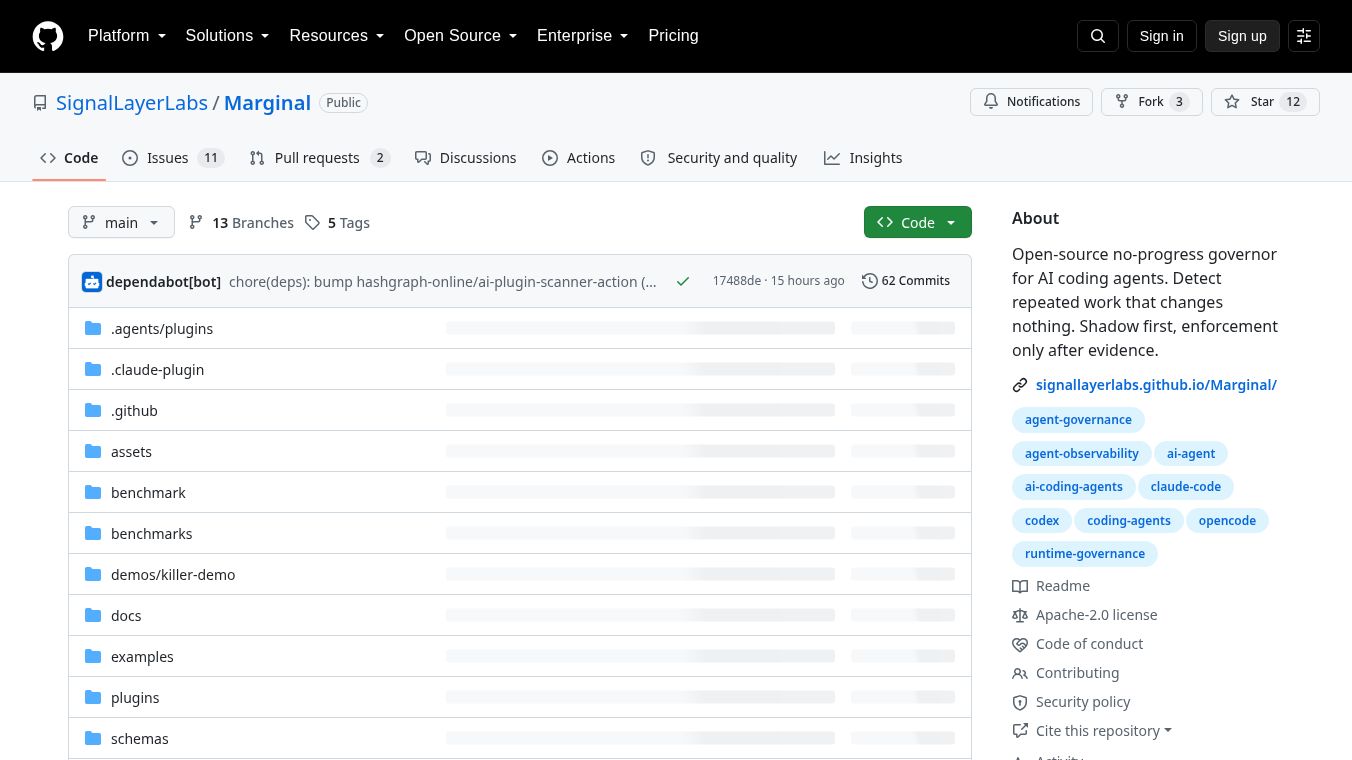





Marginal: A Tool for Efficient Data Processing
Introduction
Marginal is an open-source tool designed to help developers and data scientists process large datasets more efficiently. It is built by SignalLayerLabs and is available on GitHub. The tool focuses on reducing the computational cost of training machine learning models by using a technique called marginal sampling. This method allows users to work with smaller, more representative subsets of data without losing important information. Marginal is particularly useful for tasks that require significant computing power, such as training deep learning models or analyzing massive datasets. By optimizing how data is sampled, Marginal helps save time and resources while maintaining high accuracy in results.
Benefits
Marginal offers several key advantages for users working with data. First, it reduces the need for expensive computing resources. Traditional methods often require processing entire datasets, which can be slow and costly. Marginal solves this by selecting only the most relevant data points, making the process faster and cheaper. Second, it improves efficiency without sacrificing accuracy. The tool ensures that the selected data still represents the full dataset well, so models trained on this smaller set perform just as well as those trained on the whole. Third, Marginal is easy to integrate into existing workflows. It is built as a Python library, meaning developers can add it to their projects with minimal effort. Finally, being open-source, Marginal allows users to inspect, modify, and improve the code, fostering transparency and collaboration within the community.
Use Cases
Marginal is suitable for a variety of scenarios where data efficiency matters. One common use case is training machine learning models on large datasets. For example, a company working with millions of customer records can use Marginal to train models quickly without needing a supercomputer. Another application is in research settings where scientists need to analyze vast amounts of experimental data but have limited computing budgets. Marginal helps them focus on the most critical data points, speeding up the analysis process. It is also useful for tasks like hyperparameter tuning, where multiple model configurations need to be tested. By reducing the data size for each test, Marginal makes this process much faster. Additionally, it can be applied to any project involving deep learning, such as image recognition, natural language processing, or predictive analytics.
Pricing
Marginal is completely free to use. It is an open-source project hosted on GitHub, which means anyone can download, install, and use it without paying any fees. There are no hidden costs or subscription plans. Users only need to have Python installed on their systems to get started. This makes Marginal accessible to individuals, small teams, and large organizations alike.
Vibes
As Marginal is a relatively new open-source tool, there are limited public reviews or testimonials available at this time. However, the project has gained attention within the developer community for its innovative approach to data sampling. Early adopters and contributors on GitHub have praised its simplicity and effectiveness. Some users have noted that it significantly reduced their training times for deep learning models. While there are no formal testimonials yet, the positive engagement from the open-source community suggests that Marginal is well-received by those who have tried it.
Additional Information
Marginal was created by SignalLayerLabs, a group focused on advancing machine learning techniques. The project is hosted on GitHub under the repository name SignalLayerLabs/Marginal. It is licensed under the MIT License, which allows users to freely use, modify, and distribute the software. The tool is actively maintained, with updates and improvements being made regularly by the development team. There are no known partnerships or funding sources publicly disclosed at this time, but the project relies on community contributions and support. The open-source nature of Marginal encourages collaboration, and developers are welcome to submit issues, pull requests, or feature suggestions to help improve the tool.
This content is either user submitted or generated using AI technology (including, but not limited to, Google Gemini API, Llama, Grok, and Mistral), based on automated research and analysis of public data sources from search engines like DuckDuckGo, Google Search, and SearXNG, and directly from the tool's own website and with minimal to no human editing/review. THEJO AI is not affiliated with or endorsed by the AI tools or services mentioned. This is provided for informational and reference purposes only, is not an endorsement or official advice, and may contain inaccuracies or biases. Please verify details with original sources.



Comments
Please log in to post a comment.