Kleev
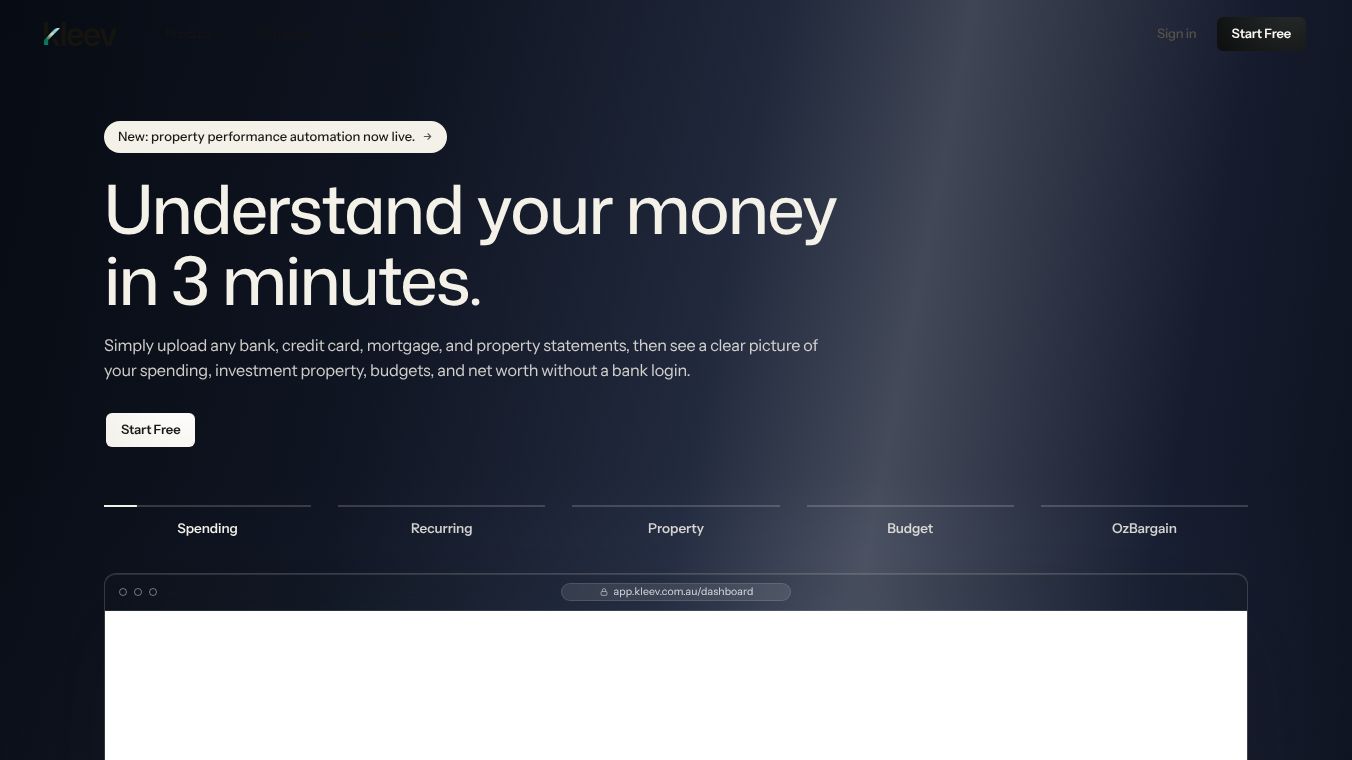





Kleev: Your Personal AI Financial CFO
Introduction
Kleev is a financial management platform designed to help individuals take control of their money. It acts like a personal Chief Financial Officer (CFO) by providing deep insights into spending, habits, investments, and long-term goals. Unlike many banking apps that require you to log in with your bank credentials, Kleev works differently. Users simply upload financial statements in CSV format from any Australian bank or card. The platform processes this data securely within the user's browser, ensuring that sensitive login details are never shared.
Benefits
Kleev offers several key advantages for managing personal finances. First, it provides a comprehensive view of a user's financial life. It breaks down income, expenses, and net cashflow into clear categories like dining out, transport, utilities, and subscriptions. The tool also projects future cashflows based on user-defined inflation assumptions, helping people plan ahead.
Second, Kleev excels at modeling investment properties. Users can create detailed scenarios for rental income, council rates, insurance, and maintenance costs. This allows them to see net cashflow projections over multiple years, such as from fiscal year 2024 to 2030.
Third, the platform includes an AI-powered feature called Kleev AI. This tool runs in the background to explain financial data in plain English. Users can ask natural language questions, such as what happens to their cashflow when a fixed loan rate ends or how to save for a house deposit by a specific date. The AI analyzes the data to suggest specific actions, like reducing spending on dining out to reach a savings goal. It also detects trends and surprises before they impact financial health.
Security is another major benefit. Kleev uses a read-only design philosophy. It never asks for banking credentials, which eliminates the risk of credential theft. Data is encrypted during transmission and while stored. The platform runs on Australian infrastructure, and the raw data remains secure. Users can also delete their account and all records instantly with one click.
Use Cases
Kleev is ideal for individuals who want to optimize their wealth without the complexity of traditional dashboards. It is particularly useful for people who want to model their financial future and make informed decisions.
One common use case is budgeting and goal setting. Users can create and adjust budgets based on historical data. They can use scenario modeling to answer what-if questions. For example, a user can see how a change in fixed-rate loans affects their cashflow or calculate exactly how much they need to save to reach a house deposit goal by a certain date.
Another use case is tracking assets and debts over time. This helps users monitor their net worth growth. The platform supports offline data entry as well, allowing users to manually enter data for assets not covered by banks, such as vehicles or offline investments.
Kleev is also great for those who prefer privacy. Since it does not require bank logins, it is a safe choice for people concerned about data security. The ability to upload CSV files from any Australian bank makes it compatible with a wide range of financial institutions.
Pricing
Kleev operates on a freemium model. There is a free version available for basic needs. Paid plans start from A$3.39 per week if paid annually or A$3.99 per week if paid monthly. These paid plans provide access to features like unlimited transactions, AI credits, and advanced reporting tools.
Vibes
While specific customer reviews are not detailed in the provided information, the platform has received positive attention for its unique approach to financial management. Users appreciate the focus on privacy and the ability to avoid sharing sensitive banking credentials. The AI-driven insights have been noted as a significant advantage over rule-based systems used by competitors. The platform is often compared favorably to tools like WeMoney, Frollo, and YNAB for its advanced scenario modeling and lack of advertisements.
Additional Information
Kleev distinguishes itself from competitors by focusing specifically on the Australian financial context. It includes features tailored for local needs, such as ATO-shaped property tax schedules and EOFY deductions. The platform is built on Supabase and utilizes Anthropic's Claude for AI analysis. Both providers hold rigorous security certifications, including SOC 2 Type II, ISO 27001, and ISO/IEC 42001. This ensures a high standard of data protection and reliability. The platform also reads over 120 Australian bank and card formats, making it highly compatible with local financial institutions.
This content is either user submitted or generated using AI technology (including, but not limited to, Google Gemini API, Llama, Grok, and Mistral), based on automated research and analysis of public data sources from search engines like DuckDuckGo, Google Search, and SearXNG, and directly from the tool's own website and with minimal to no human editing/review. THEJO AI is not affiliated with or endorsed by the AI tools or services mentioned. This is provided for informational and reference purposes only, is not an endorsement or official advice, and may contain inaccuracies or biases. Please verify details with original sources.




Comments
Please log in to post a comment.