Headroom
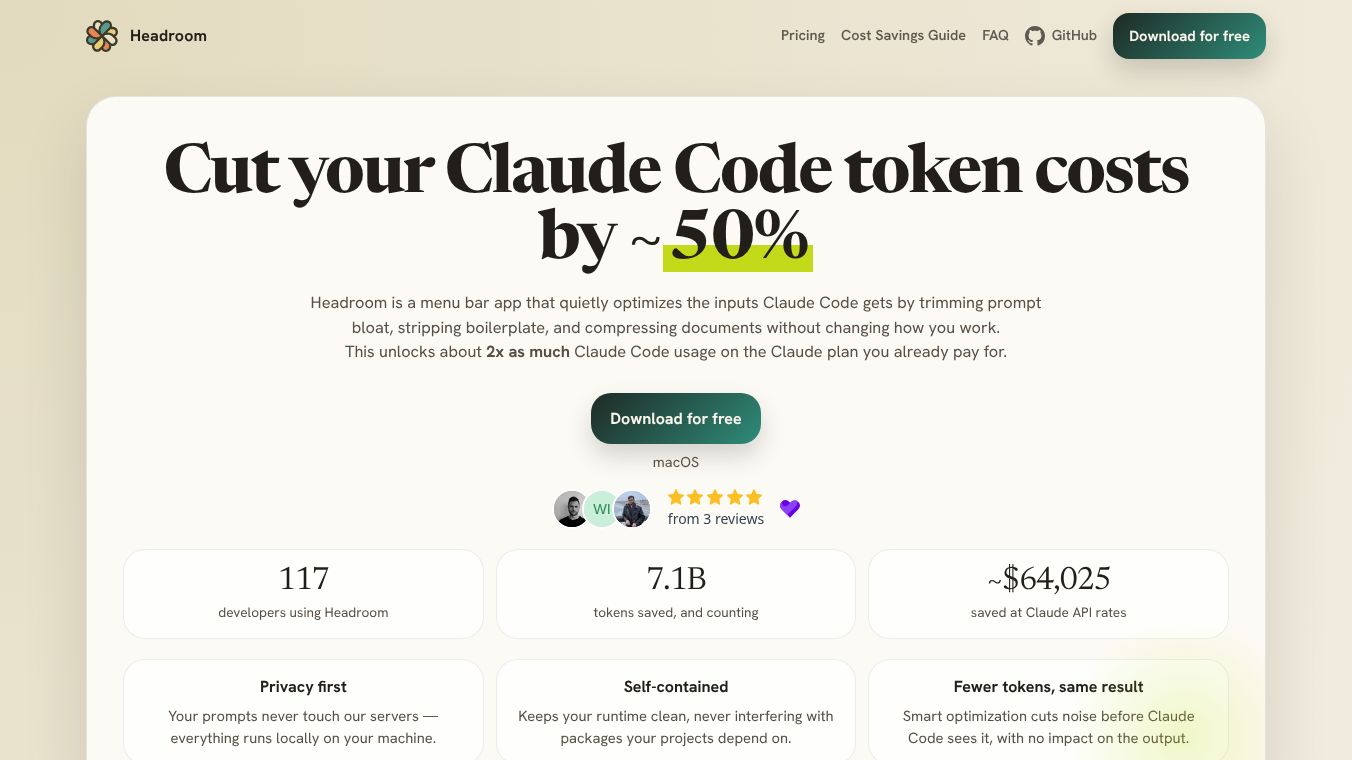





Headroom: Slash LLM Token Costs by 90% Instantly
Introduction
Your AI agents are currently wasting a lot of money on token usage. Every time they run a database query or process a log file, they send huge amounts of unnecessary data to the AI model. This burns through your budget and slows down responses. Headroom is a smart tool designed to fix this problem instantly. It works as a transparent layer that sits between your AI agents and the AI providers like OpenAI or Anthropic. It intelligently removes redundant data while keeping all the important information the model needs to give accurate answers. The result is a massive reduction in token usage without requiring you to change any of your existing code.
Benefits
Headroom offers several powerful advantages for developers and teams using AI agents. First, it provides lossless compression. This means it never throws away data permanently. It compresses the content aggressively, stores the original version, and tells the AI model exactly what was removed so it can fetch full details if needed. Second, it uses intelligent content detection. The tool automatically recognizes different types of data like JSON arrays, code, logs, or database results and applies the best compression method for each type. Third, it optimizes caching. By stabilizing message prefixes, it helps unlock significant discounts from providers that offer lower prices for cached prompts. Fourth, it includes a failure learning system. The tool analyzes past conversations to find errors and automatically writes corrections into memory files so future sessions start smarter. Finally, it is universally compatible. It works with any programming language, tool, or framework and can be set up in under five minutes using just an environment variable.
Use Cases
Headroom is perfect for many different scenarios where AI agents process large amounts of data. One major use case is SRE incident debugging. When engineers debug complex issues, they often send thousands of tokens filled with redundant timestamps and severity fields. Headroom can reduce this by over 90% while keeping the critical error information intact. Another use case is code search and exploration. When an agent searches through hundreds of code results, Headroom compresses the repetitive code into a much smaller format that the model can understand quickly. It is also excellent for RAG pipelines. These systems often retrieve large chunks of documents with redundant metadata. Headroom can compress this data by 73% while maintaining answer quality. For autonomous agents that run for hours, Headroom identifies repetitive reasoning patterns and compresses them, allowing agents to run longer and think deeper at half the cost.
Pricing
Headroom is open source and available under the Apache 2.0 license. This means you can use it for free without paying per token or per request. The tool is production-ready and actively maintained by the community. You can install it using pip with the command pip install "headroom-ai[all]". There are no hidden fees or subscription tiers. The cost savings come entirely from the reduction in tokens you send to AI providers like OpenAI or Anthropic. Since these providers charge per million tokens, using Headroom can save you hundreds or even thousands of dollars annually depending on your usage volume.
Vibes
Developers and engineers are responding very positively to Headroom because it solves a real and painful problem. The tool is praised for its ability to cut token costs by up to 92% while maintaining perfect accuracy. Benchmarks show that it achieves an 87.6% token reduction on math and reasoning tasks without losing any correctness. Users appreciate that it requires zero code changes to set up via a proxy server. The built-in evaluation framework allows teams to run smoke tests quickly to ensure accuracy before deploying to production. Many users note that the tool feels like a paradigm shift in how AI agents handle context. It is seen as essential for teams running complex agent sessions that previously blew through their monthly budgets. The community values its transparency and the fact that it works seamlessly with popular frameworks like LangChain and LiteLLM.
Additional Information
Headroom is an open-source project licensed under Apache 2.0. It is actively maintained and production-ready for immediate use. The project supports over 100 AI models via LiteLLM, including OpenAI, Anthropic, and Google models. It includes comprehensive documentation and examples for various setup methods including proxy mode, Python integration, and framework-specific integrations. The tool is designed to be secure and includes features to exclude sensitive data like PII from compression. It also provides audit logs for compliance needs. The repository is hosted publicly and encourages community contributions. The team behind Headroom focuses on making AI agent development more cost-effective and efficient for everyone.
This content is either user submitted or generated using AI technology (including, but not limited to, Google Gemini API, Llama, Grok, and Mistral), based on automated research and analysis of public data sources from search engines like DuckDuckGo, Google Search, and SearXNG, and directly from the tool's own website and with minimal to no human editing/review. THEJO AI is not affiliated with or endorsed by the AI tools or services mentioned. This is provided for informational and reference purposes only, is not an endorsement or official advice, and may contain inaccuracies or biases. Please verify details with original sources.







Comments
Please log in to post a comment.