HasteKit
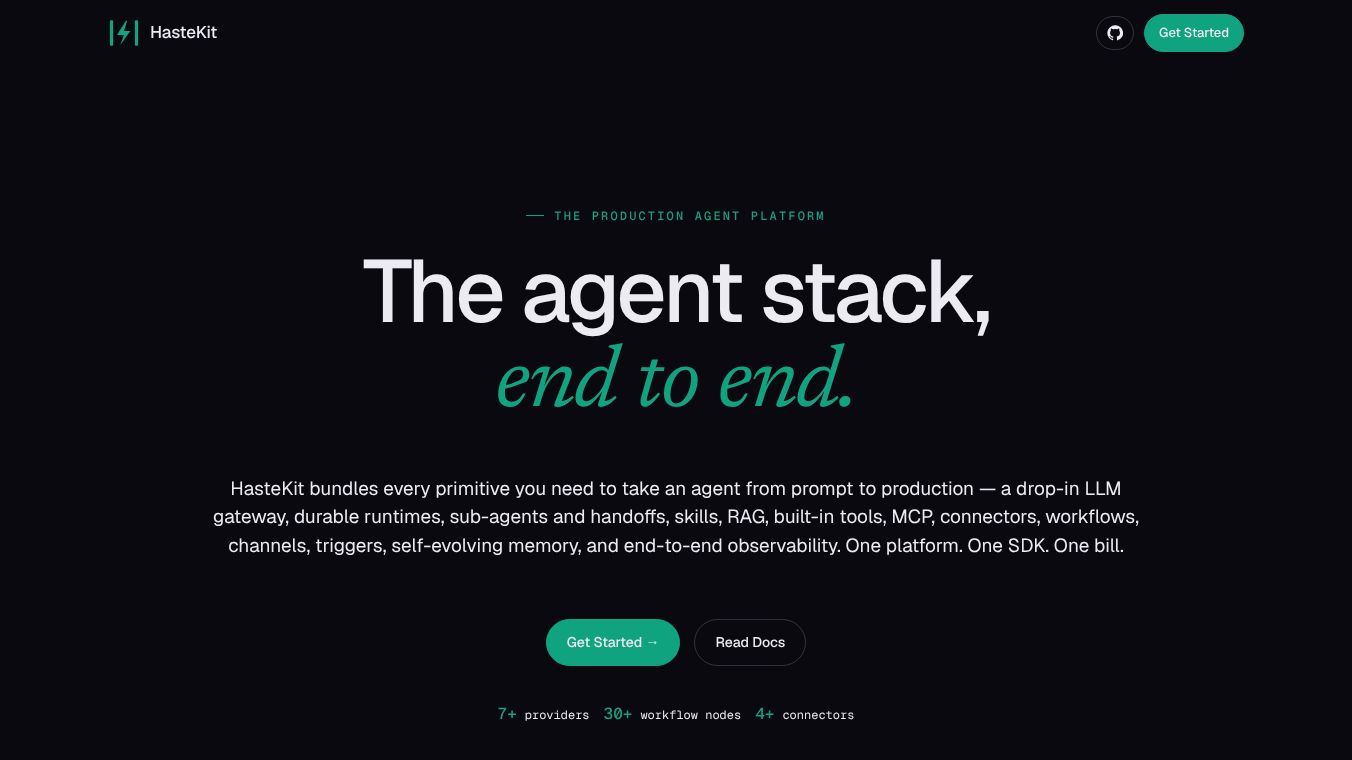





The Production Agent Platform: HasteKit
HasteKit is a complete platform built to help developers move AI agents from simple ideas to fully working systems. It brings together every tool needed for building and running these agents in one place. This includes the code libraries, billing systems, and the infrastructure required to keep agents running smoothly in production environments. The goal is to make the entire process easier and faster for teams of all sizes.
Benefits
HasteKit offers several key advantages for anyone building AI agents. First, it acts as a drop-in replacement for the OpenAI API. Developers can use a single virtual key to connect to seven or more different AI providers without rewriting their code. This helps avoid being locked into one specific company. The platform also tracks costs and sets limits on how many requests a project can make. This prevents unexpected bills and helps manage resources better.
Another major benefit is the ability to tune agents without changing the code. Users can adjust settings like the model type, context history, and output formats from a central dashboard. The system also supports versioning, which means teams can save different versions of an agent and switch between them easily. This is crucial for testing and safety. If an agent makes a mistake, developers can roll back to a previous version instantly.
The platform handles long-running tasks with durability. Agents run on systems like Temporal or Restate that save their progress at every step. If a server crashes or restarts, the agent can pick up exactly where it left off. This ensures that important work is never lost. Additionally, HasteKit supports complex teams of agents. It allows different agents to work together, share information, and hand off tasks to specialists. This creates more powerful and flexible systems than a single agent could handle alone.
Skills are reusable pieces of code that agents can use. These skills come with clear documentation and can be shared across different projects. The platform also includes built-in tools for generating images, running code, and managing tasks. For data, it supports Retrieval-Augmented Generation, which lets agents access external knowledge bases and cite their sources. This makes the information they provide more accurate and trustworthy.
Integration is also a strong point. HasteKit connects easily with popular services like Gmail, Slack, Jira, and GitHub. It uses secure authentication so user data stays safe. Developers can also add custom tools using OpenAPI specs or Model Context Protocol servers. Human oversight is built in, allowing people to approve specific actions before the agent takes them. This adds an extra layer of safety for critical operations.
Use Cases
HasteKit is designed for developers and teams who want to build reliable AI agents for real-world applications. It is ideal for companies that need to deploy agents quickly without managing complex infrastructure. The platform supports various use cases across different industries.
One common use case is customer support. Agents can be connected to Slack or Telegram to handle user inquiries. They can use the built-in tools to check calendars, send emails, or look up information in a knowledge base. The system can be set to trigger automatically when a new message arrives or on a scheduled time. This allows businesses to provide 24/7 support without hiring more staff.
Another application is internal automation. Teams can build agents to manage workflows like code reviews, ticket updates, or data analysis. The durable execution feature ensures that long processes, such as generating reports or processing large datasets, do not fail if a server restarts. The multi-agent orchestration allows different agents to specialize in different parts of a workflow, improving efficiency and accuracy.
Developers can also use HasteKit to create specialized tools for specific tasks. For example, a team might build an agent that monitors GitHub for new pull requests and automatically comments on them. Another agent could manage project timelines by integrating with Jira and sending updates to the team. The platform makes it easy to combine these agents into a cohesive system that handles multiple responsibilities.
The self-evolving memory feature is useful for agents that need to remember past interactions. An agent that manages a user account can keep a record of preferences and past issues. This allows it to provide more personalized service over time. The memory updates automatically as new information becomes available, ensuring the agent always has the latest context.
Pricing
HasteKit uses a unified billing structure that tracks costs per request and per project. The platform allows users to set rate limits to control spending. While specific pricing tiers are not detailed in the available information, the system is designed to provide clear visibility into costs. This helps teams budget effectively and avoid unexpected charges. Developers can monitor costs in real time through the observability tools provided by the platform.
Vibes
The platform is designed to be user-friendly and powerful at the same time. Users can ship their first agent in minutes by bringing their own API keys and configuring settings through the dashboard. The community and developers appreciate the flexibility of the multi-provider support and the ease of integration with existing tools. The ability to version agents and recover from crashes is seen as a major advantage for production environments. Overall, the reception suggests that HasteKit is a practical solution for teams looking to scale their AI agent operations.
Additional Information
HasteKit is built on a robust stack that includes support for Temporal and Restate for durable execution. It integrates with OpenTelemetry for comprehensive tracing and monitoring. The platform supports various programming languages and environments, including bash, Python, and Node. It also includes connectors for major services and supports both scheduled and event-driven triggers. The development team focuses on providing a complete solution that covers everything from initial prompts to full-scale deployment.
This content is either user submitted or generated using AI technology (including, but not limited to, Google Gemini API, Llama, Grok, and Mistral), based on automated research and analysis of public data sources from search engines like DuckDuckGo, Google Search, and SearXNG, and directly from the tool's own website and with minimal to no human editing/review. THEJO AI is not affiliated with or endorsed by the AI tools or services mentioned. This is provided for informational and reference purposes only, is not an endorsement or official advice, and may contain inaccuracies or biases. Please verify details with original sources.




Comments
Please log in to post a comment.