FeatLens





What is FeatLens
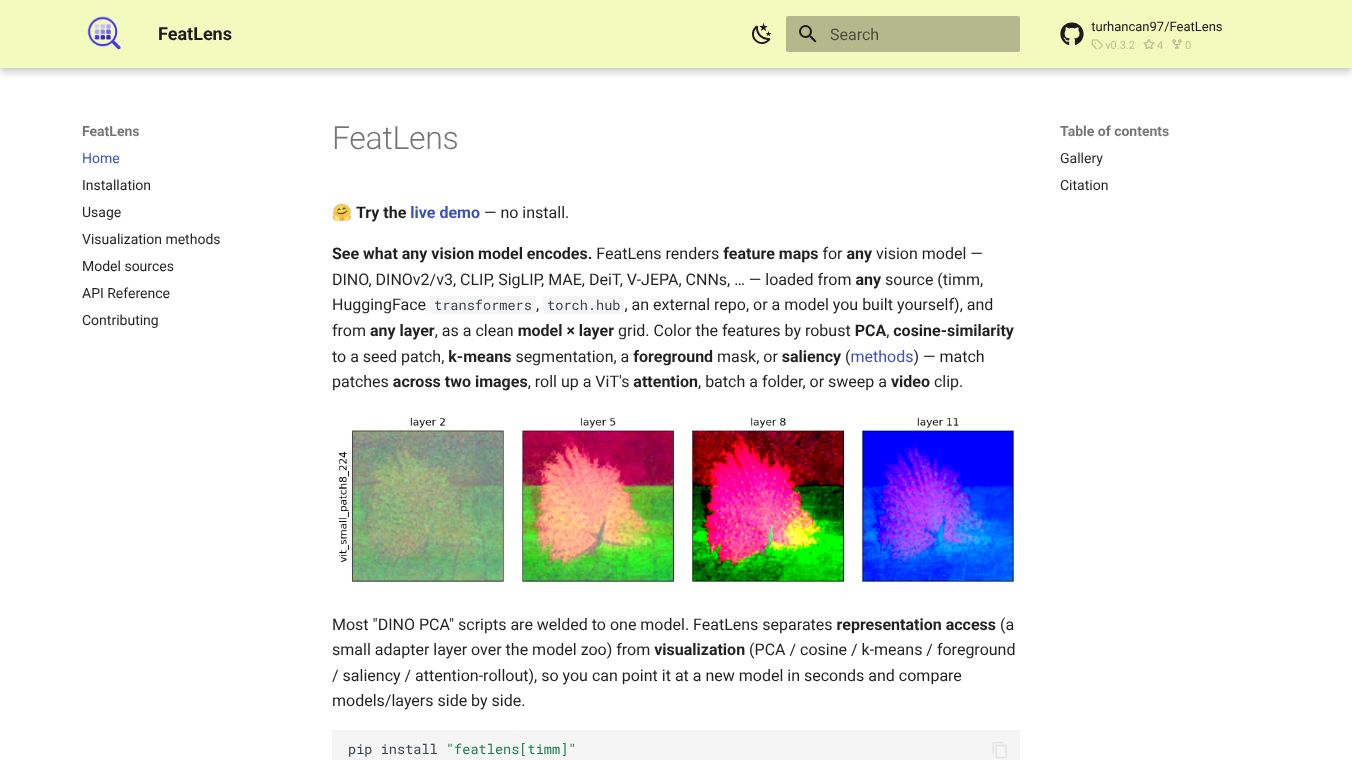
FeatLens is an open-source Python library that helps researchers and developers visualize the inner workings of vision models. It is designed to work with many different types of models, including vision transformers, CNNs, and other architectures. The tool allows users to see how these models process images by showing feature maps at any layer. This makes it easier to understand what a model is learning and how it makes decisions.
Benefits
FeatLens offers several powerful benefits for anyone working with computer vision models. First, it provides a clean interface that separates loading a model from visualizing its data. This means users can easily switch between different models without changing their visualization code. Second, it supports a wide variety of popular models from sources like HuggingFace and timm. Users can also create custom adapters for models that are not yet built into the library.
The tool includes multiple methods to interpret feature maps. It can use Principal Component Analysis to project features into color, calculate cosine similarity to find matching parts in images, or use K-Means clustering to group similar features. It also offers a foreground mask to separate objects from backgrounds and a saliency view to show where the model is paying attention. These tools help users gain deep insights into model behavior.
Another major benefit is the ability to compare models side by side. Users can generate grids that show how different models process the same image at the same layer. This helps reveal differences in training objectives and architectural choices. The library also supports video analysis, allowing users to render feature maps as animated GIFs or filmstrips to study temporal changes.
Use Cases
FeatLens is useful for a range of tasks in computer vision research and development. Researchers can use it to debug models by seeing exactly where and how errors occur during processing. It is also ideal for educational purposes, as it makes complex neural network concepts visible and understandable.
Developers can use the tool to compare different pre-trained models to choose the best one for their specific project. The model comparison feature helps identify which architecture performs better for certain types of images or tasks. For example, one model might be better at recognizing smooth textures while another excels at detailed edges.
The cross-image correspondence feature is particularly useful for finding matching parts across different images. This can help in tasks like image retrieval or semantic segmentation. Users can seed a patch in one image and find the same semantic part in another image, even if the images look very different, such as a photo versus a watercolor painting.
For video analysis, FeatLens allows users to process entire clips and visualize how features change over time. This is valuable for understanding temporal dynamics in video data. The batch processing capability also enables users to analyze entire folders of images quickly, generating a montage of results for efficient review.
Pricing
FeatLens is completely free to use. It is an open-source project available on GitHub under a permissive license. Users can install it using pip and access all its features without any cost. There are no hidden fees or premium tiers.
Vibes
The community response to FeatLens has been positive. As an open-source tool, it has gained traction among researchers who need flexible visualization options. The library is cited in academic papers, indicating its value in the research community. Users appreciate its model-agnostic design, which allows them to experiment with many different architectures without being locked into a single framework. The active development and welcoming contribution guidelines suggest a healthy and growing ecosystem around the project.
Additional Information
FeatLens was created by Turhan Can Kargin and is hosted on GitHub. The project is maintained as open source, meaning anyone can contribute to its development. Users are encouraged to submit code, report bugs, or suggest new features. The library follows standard testing practices, requiring tests for new behavior and verification for new models before they are merged.
If you use FeatLens in your research or projects, you should cite the software. The citation information is available in the project documentation. The tool is continuously updated to support new models and visualization techniques, ensuring it stays relevant as the field of computer vision evolves.
This content is either user submitted or generated using AI technology (including, but not limited to, Google Gemini API, Llama, Grok, and Mistral), based on automated research and analysis of public data sources from search engines like DuckDuckGo, Google Search, and SearXNG, and directly from the tool's own website and with minimal to no human editing/review. THEJO AI is not affiliated with or endorsed by the AI tools or services mentioned. This is provided for informational and reference purposes only, is not an endorsement or official advice, and may contain inaccuracies or biases. Please verify details with original sources.
Other Interesting AI Tools

Comments
Please log in to post a comment.