Element Node
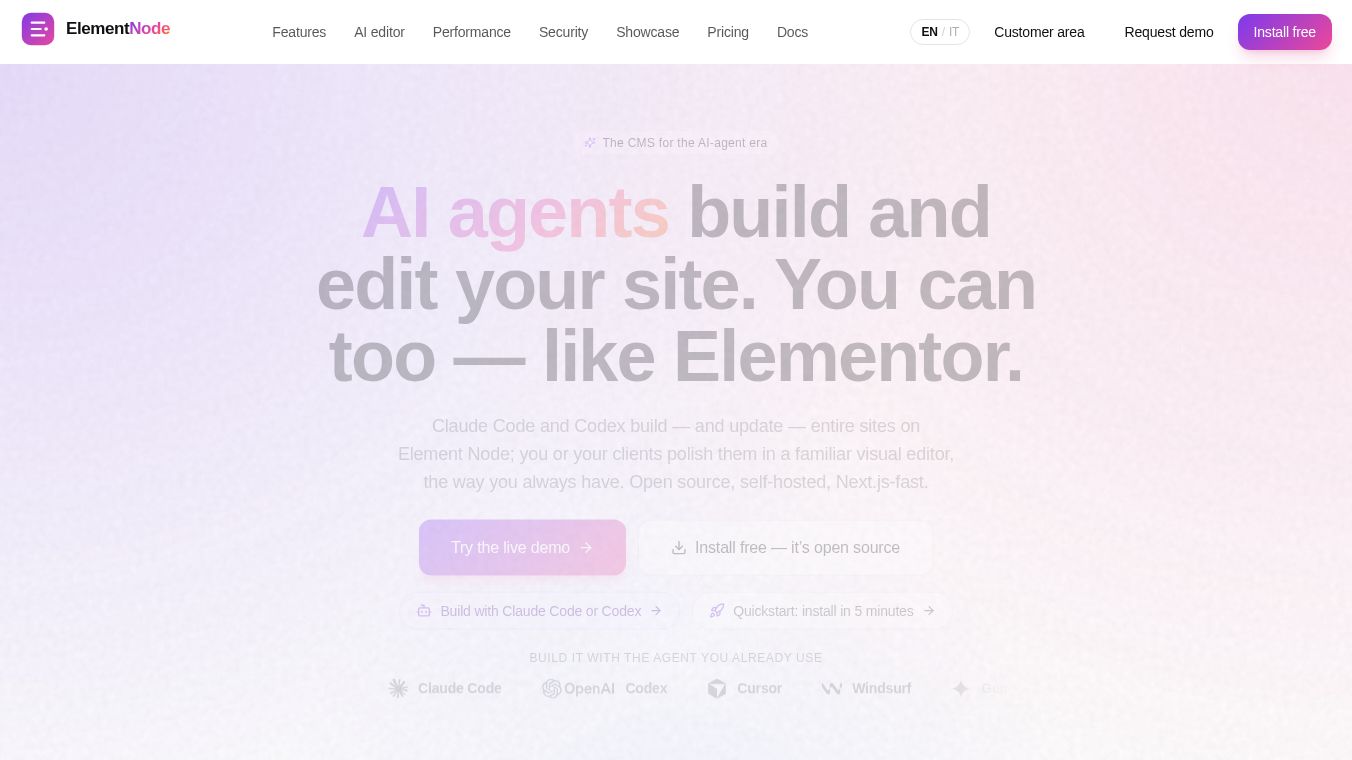





Element Node: The AI-Native CMS Built for the Agent Era
Overview
Element Node is an open-source content management system designed for the age of AI agents. It is built on a high-performance Next.js stack and combines AI-driven site generation with a familiar visual editing experience. Unlike traditional CMS platforms, Element Node allows AI agents to build and edit entire sites while enabling users to refine the work in a drag-and-drop visual editor similar to Elementor.
Benefits
Element Node offers several key advantages over traditional platforms like WordPress.
AI Generation with Human Control: Users can describe their business in plain English, and the AI generates a complete homepage. The system ensures that prompts result in pages that conform strictly to the CMS structure. The AI does not create uneditable code blocks. Instead, it makes real changes to the widget tree, such as creating sections or swapping images. Every change is hand-editable and undoable.
Superior Performance: Element Node is engineered for speed. It achieves a Lighthouse score of 95 or higher by default. This is possible through server-side rendering, smart caching, and image optimization. Benchmarks show that Element Node loads significantly faster than WordPress with Elementor PRO. For example, the time to first byte is 95ms for Element Node compared to 1,240ms for WordPress. The bundle size is also much smaller at 88kB versus 720kB.
Security by Design: Security is built into the architecture rather than relying on plugins. The platform is built entirely on Node.js, which eliminates many legacy PHP vulnerabilities. There are no exposed admin panels or web-writable PHP files. It uses robust authentication with JWT-signed sessions and implements secure password hashing. Security headers are enabled by default.
Visual Editing Experience: The platform features a 3-panel visual editor that mimics the smooth drag-and-drop experience of Elementor PRO. It includes 51 widgets out of the box, such as Hero sections, Sliders, Forms, and Galleries. Users can instantly switch between Desktop, Tablet, and Mobile views with per-breakpoint overrides.
Use Cases
Element Node is ideal for businesses and developers who want to build high-performance websites without the legacy constraints of traditional CMS systems.
- AI-Driven Development: Developers can use AI agents like Claude Code to generate site structures. The official skill for AI agents ensures that generated pages are structurally sound and editable.
- Small to Medium Businesses: Companies looking for a fast and secure website can use Element Node to create professional sites without the bloat of plugins.
- Self-Hosted Environments: The CMS can be deployed anywhere, including Plesk, VPS, or Docker environments. It is suitable for users who want full control over their hosting.
- Multi-User Teams: The platform supports Admin, Editor, Author, and Viewer roles, making it suitable for teams that need collaborative editing capabilities.
Pricing
Element Node is free and open-source on GitHub. Users can try the live demo or download the CMS to deploy on their server in approximately 10 minutes. For paid plans, users can download the latest packaged version directly from the CMS panel, which includes a ready-made command for their AI agent.
Vibes
As an open-source project, Element Node has not yet gathered a large volume of public reviews or testimonials. However, the project has received attention for its innovative approach to combining AI generation with visual editing. The benchmark results comparing it to WordPress have been highlighted as a significant achievement in performance optimization.
Additional Information
Element Node represents a shift in CMS architecture, moving from a plugin-heavy, PHP-based model to a lightweight, AI-ready, Node.js-based platform. It is built on a Next.js stack and uses React Server Components for the visual editor. The project is available on GitHub and can be deployed in various environments. The development team focuses on maintaining a clean codebase and ensuring compatibility with modern AI tools.
This content is either user submitted or generated using AI technology (including, but not limited to, Google Gemini API, Llama, Grok, and Mistral), based on automated research and analysis of public data sources from search engines like DuckDuckGo, Google Search, and SearXNG, and directly from the tool's own website and with minimal to no human editing/review. THEJO AI is not affiliated with or endorsed by the AI tools or services mentioned. This is provided for informational and reference purposes only, is not an endorsement or official advice, and may contain inaccuracies or biases. Please verify details with original sources.





Comments
Please log in to post a comment.