Deepseek Harness Workbench





DeepSeek Harness Workbench
Introduction
DeepSeek Harness Workbench is a flexible platform built by DeepSeek AI to help developers create custom coding agents. It is not an AI model itself but a tool that connects large language models to files, terminals, and other software tools. Think of it as a workshop where you can build your own AI assistants tailored to specific coding tasks. The system uses a plugin-based architecture called Cordis, which allows different parts of the agent to be swapped or upgraded easily. It is currently in a developer preview stage, meaning it is still being tested and may change in the future.
Benefits
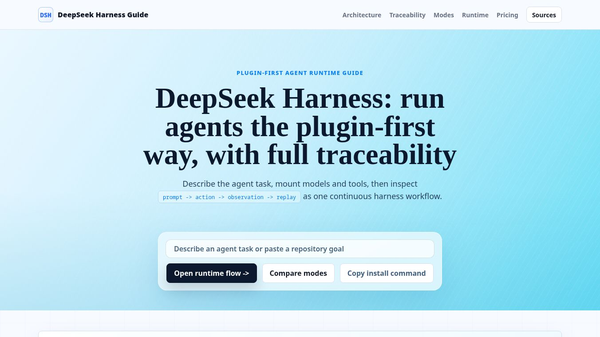
The main advantage of DeepSeek Harness Workbench is its modularity. Instead of using a fixed coding assistant, users can build agents with specific capabilities. Key benefits include:
- Custom Control:Developers can define exactly what tools and permissions an agent has. This includes access to files, shell commands, and search functions.
- Flexible Model Support:The platform works with various AI models, not just DeepSeek. Users can connect to providers like Anthropic or OpenAI if they choose.
- Transparent Workflow:The system logs every action an agent takes. This makes it easy to review history, replay sessions, or debug issues.
- Multiple Agent Modes:Users can choose from different presets like Standard, Minimal, or Creator mode. Each mode offers a different balance of power and safety.
- Open Source:The project is released under the MIT license, allowing anyone to inspect the code or build upon it.
Use Cases
DeepSeek Harness Workbench is designed for developers and researchers who need more control over AI agents. Common use cases include:
- Building Custom Coding Assistants:Teams can create agents that specialize in specific programming languages or project types.
- Research and Testing:Researchers can compare how different settings, tools, or models affect an agent's performance on coding tasks.
- Plugin Development:Developers can write new tools or adapters to extend the capabilities of the harness.
- Learning and Experimentation:The Creator mode allows users to experiment with how AI agents think and act by writing code that runs inside the agent loop.
- Local Development:The tool provides a local web interface for testing agents without needing to set up complex cloud infrastructure.
Pricing
DeepSeek Harness Workbench is free to use. It is an open-source project available on GitHub under the MIT license. However, using the platform requires an API key from a supported AI model provider, such as DeepSeek. Users will need to pay for the API calls they make to the underlying models, but the harness software itself has no cost.
Vibes
As the project is in developer preview, there are no official public reviews or testimonials yet. The community is currently testing the tool to find bugs and suggest improvements. Early feedback from developers suggests that the modular design is powerful but requires careful configuration. Some users note that the Creator mode carries significant risks because it allows the AI to write code that runs directly in the system. Overall, the reception is positive among those interested in building custom AI agents, but it is not yet recommended for critical production systems.
Additional Information
DeepSeek Harness Workbench is maintained by DeepSeek AI. The official repository is located at deepseek-ai/deepseek-harness. The project is still in a developer preview phase, which means APIs and configurations may change without notice. Users are advised to pin specific package versions to ensure their setups remain stable. The platform includes a local web interface that runs on port 3080 by default, but this does not mean the AI model runs locally. All model requests are sent to remote APIs unless a custom provider is configured. There is also an unofficial project with a similar name, but this guide focuses only on the official DeepSeek AI version.
This content is either user submitted or generated using AI technology (including, but not limited to, Google Gemini API, Llama, Grok, and Mistral), based on automated research and analysis of public data sources from search engines like DuckDuckGo, Google Search, and SearXNG, and directly from the tool's own website and with minimal to no human editing/review. THEJO AI is not affiliated with or endorsed by the AI tools or services mentioned. This is provided for informational and reference purposes only, is not an endorsement or official advice, and may contain inaccuracies or biases. Please verify details with original sources.

Comments
Please log in to post a comment.