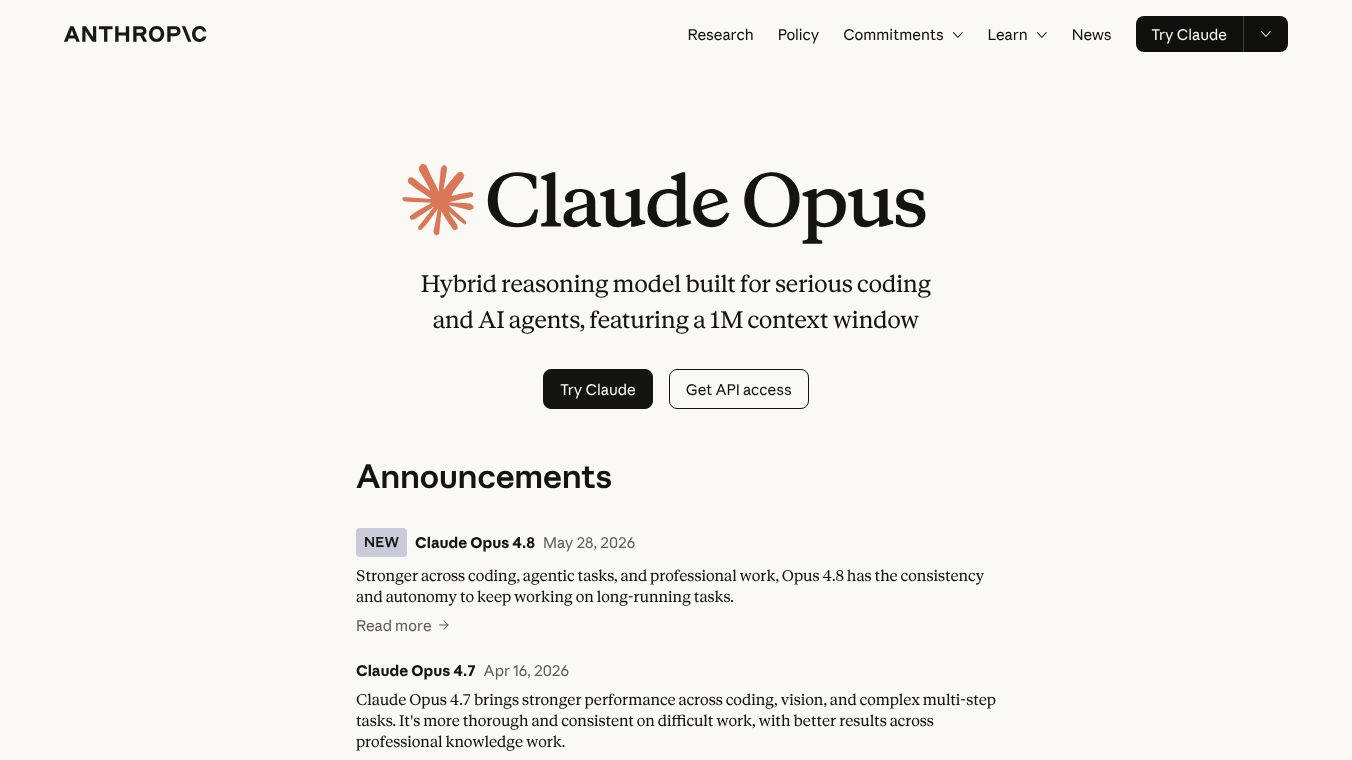





What is Claude Opus 4.8
Anthropic released Claude Opus 4.8 on May 28, 2026. This is the latest version in the Opus series of artificial intelligence models. It arrived quickly, just 41 days after the previous version. The tool is available on the Claude website, in Claude Code for developers, and through an API for businesses. It can handle very long documents with a 1 million token context window.
Benefits
Claude Opus 4.8 offers several major improvements over its predecessor. The model is designed to be more honest and accurate. It is four times less likely to miss errors in its own code. It also flags uncertainty more often and avoids making claims it cannot support. This helps users trust the output more.
Developers can now choose effort levels directly on the interface. This allows users to balance cost against the depth of the answer. The tool calling system is significantly more efficient. It requires fewer steps to complete complex tasks. On internal benchmarks, it was the only model to finish every coding case at the same cost as a competitor.
A new feature called Fast Mode makes the model run about 2.5 times faster. It costs less per token and keeps users on the full powerful model instead of switching to a smaller one. Another feature called Dynamic Workflows allows teams to run hundreds of subagents in parallel. This is useful for large codebase migrations and refactoring projects.
Use Cases
This model is ideal for agentic coding tasks. It excels at writing and debugging software. It also performs well in knowledge work tasks that require deep reasoning. Financial analysts can use it for complex data analysis. The 1 million token context is perfect for reviewing massive legal documents or entire books.
Developers can use the updated API to manage system instructions more easily within conversations. Teams can utilize Dynamic Workflows to handle large scale software updates without manual intervention. The Fast Mode is great for users who need quick responses but still want the intelligence of the full model.
Pricing (ONLY include if available)
The pricing remains the same as the previous version. Users pay five dollars per million input tokens and twenty-five dollars per million output tokens. Fast Mode costs ten dollars per million input tokens and fifty dollars per million output tokens. The 1 million token context variant uses the standard pricing rates.
Vibes (ONLY include if available)
Users who focus on coding and knowledge work are encouraged to switch immediately. The improvements in these areas are the largest. Those who rely heavily on terminal commands might wait because a competitor still leads in that specific area. People who are very cost sensitive and have simple tasks might stay on the older version since the gains there are minimal.
Additional Information (ONLY include if available)
The model leads six out of seven internal benchmarks. It shows significant gains in coding and reasoning tasks. The release marks the fastest update speed for the Opus series. It includes a 1 million token context option for handling large data sets. The Dynamic Workflows feature is currently available as a research preview for Enterprise, Team, and Max plans.
This content is either user submitted or generated using AI technology (including, but not limited to, Google Gemini API, Llama, Grok, and Mistral), based on automated research and analysis of public data sources from search engines like DuckDuckGo, Google Search, and SearXNG, and directly from the tool's own website and with minimal to no human editing/review. THEJO AI is not affiliated with or endorsed by the AI tools or services mentioned. This is provided for informational and reference purposes only, is not an endorsement or official advice, and may contain inaccuracies or biases. Please verify details with original sources.






Comments
Please log in to post a comment.