Brain Memory





Research context and background
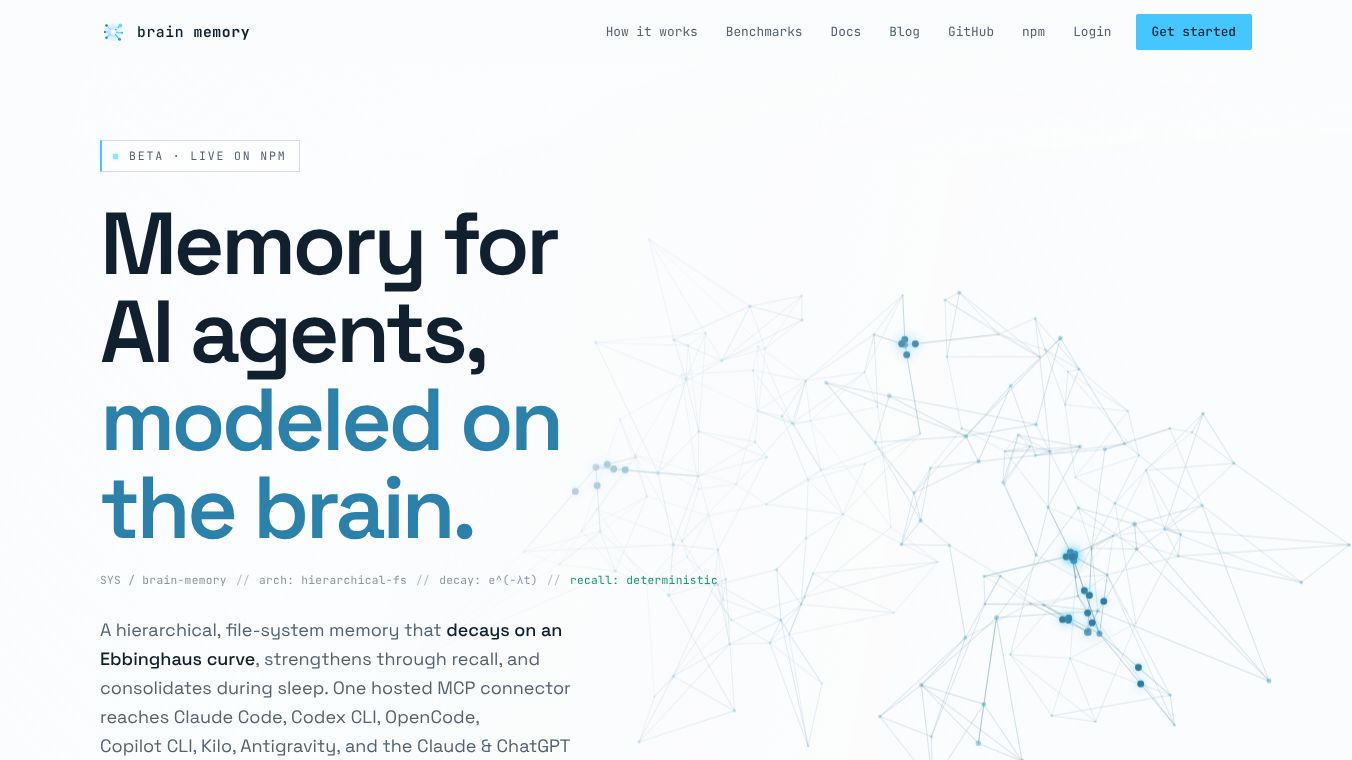
Brain Memory is a new tool designed to help AI agents remember things better. It works like a human brain by organizing information in a way that is easy to find and understand. Instead of using standard storage methods that can be confusing, it uses a system based on how our brains actually work. This makes it easier for different AI tools to share knowledge and learn from past experiences.
Benefits
Brain Memory offers several key advantages over traditional memory systems. First, it uses a clear directory tree structure. This means users can browse their memory using standard file explorers instead of dealing with a black box system. Second, it handles different types of information differently. It separates memories into episodic, semantic, and procedural types. Each type has its own rules for how long it lasts and how it is stored. This helps the system keep important information while letting less relevant details fade away naturally. Third, it is very efficient with tokens. Tests show it uses significantly fewer tokens than other methods while still finding the right information. This saves money and speeds up processing. Finally, it includes a nightly maintenance cycle that automatically organizes and cleans up memory to keep everything running smoothly.
Use Cases
Brain Memory is built for language agents and developers who want their AI tools to remember things over time. It works with many popular platforms including Claude Code, Codex CLI, OpenCode, Copilot CLI, Kilo, and Antigravity. Developers can use it to create AI assistants that remember project details across multiple sessions. It is also useful for coding tasks where an agent needs to recall specific skills or past decisions without getting confused by too much information. The tool supports both local use on a computer and cloud storage options like Google Drive or Dropbox. This makes it flexible for teams that need to share memory across different devices or users.
Pricing
The article does not provide specific pricing details for Brain Memory. It mentions a free native plugin available for local use and a hosted connector for remote access. Users can install it globally using npm commands.
Vibes
The article does not include specific user reviews or testimonials. However, it presents strong benchmark results showing high performance in various tests. The system achieved a 100% pass rate in noisy project scenarios where other methods failed completely. It also demonstrated excellent resistance to hallucinations and confusion. These results suggest that the tool is reliable and effective for long-term memory tasks.
Additional Information
Brain Memory is based on established academic research in neuroscience and cognitive science. It uses models from CoALA for memory types and follows Ebbinghaus forgetting curves for decay rates. The development team has tested the system against multiple evaluation benchmarks including LongMemEval and MemoryAgentBench. The project emphasizes local-first compatibility to avoid vendor lock-in and gives users full control over their data.
This content is either user submitted or generated using AI technology (including, but not limited to, Google Gemini API, Llama, Grok, and Mistral), based on automated research and analysis of public data sources from search engines like DuckDuckGo, Google Search, and SearXNG, and directly from the tool's own website and with minimal to no human editing/review. THEJO AI is not affiliated with or endorsed by the AI tools or services mentioned. This is provided for informational and reference purposes only, is not an endorsement or official advice, and may contain inaccuracies or biases. Please verify details with original sources.



Comments
Please log in to post a comment.