Basedash AI Sources
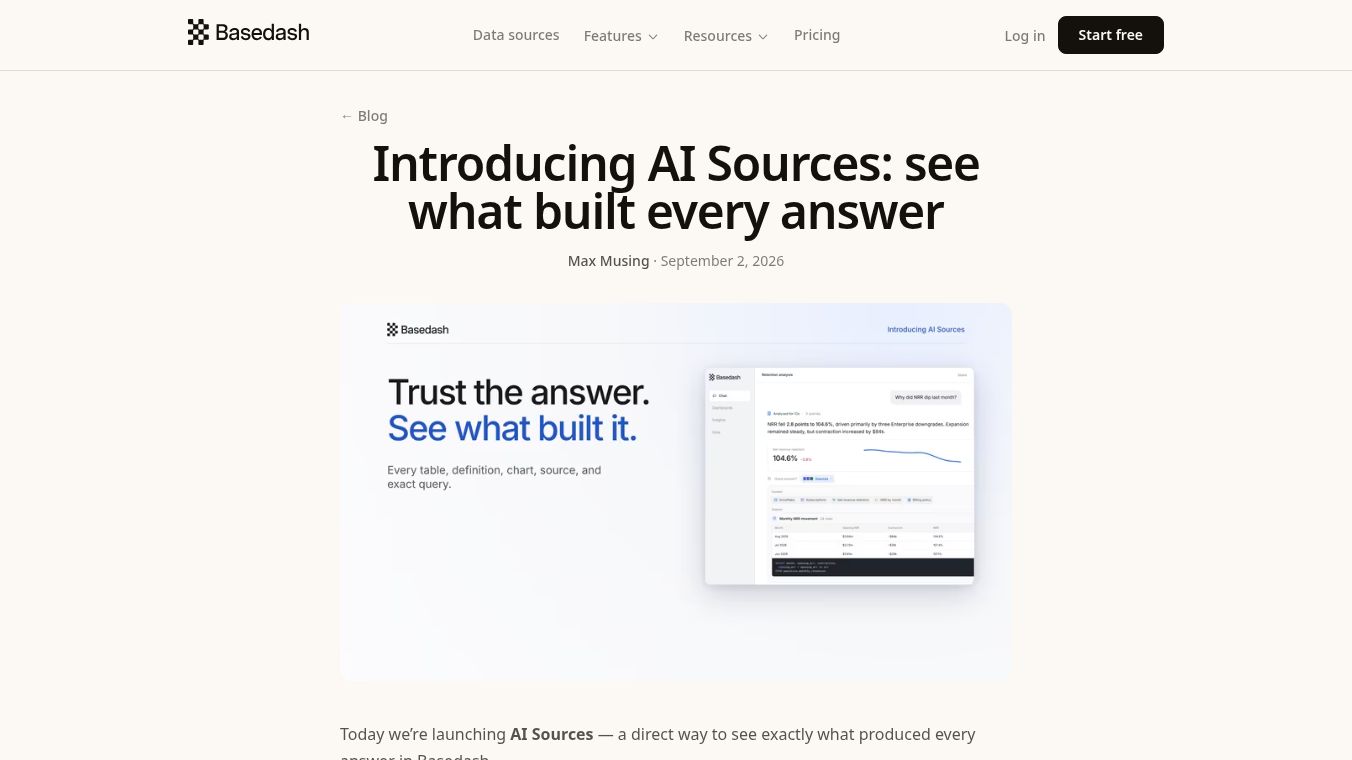





Basedash AI Sources: What It Is and How It Helps
Basedash is an AI-native business intelligence platform designed to help teams analyze data without needing to write complex code. It allows users to ask questions in plain English and instantly get answers, charts, or dashboards. The tool connects to various databases and software tools to provide a unified view of business data. Its main goal is to let non-technical users explore analytics while keeping data accurate and secure.
Benefits
Basedash offers several key advantages for teams that need fast and reliable data insights.
- Natural Language Queries: Users can ask questions like "How is our monthly recurring revenue trending?" or "Which customers are at risk of leaving?" in simple English. The platform understands these prompts and returns the correct data immediately.
- Instant Dashboard Creation: Instead of building charts one by one, users can describe what they want to see. For example, they can say "Create a dashboard showing our core growth metrics," and Basedash will generate the full dashboard in minutes.
- Data Accuracy and Trust: The platform uses a semantic layer to ensure that every answer comes from trusted, pre-defined metrics. This prevents the AI from making things up or hallucinating incorrect data. Every result shows the underlying SQL code so users can verify the logic.
- Wide Integration Support: Basedash connects to over 750 different data sources, including popular databases like Snowflake and BigQuery, as well as SaaS tools like Salesforce, HubSpot, and Stripe. This means teams can pull data from their entire stack into one place.
- Enterprise Security: The tool is built for large organizations with strict security needs. It offers SOC 2 Type II compliance, data encryption, and role-based access controls. It also allows companies to host the software on their own servers if needed.
Use Cases
Basedash is useful for many different teams within an organization who need to make data-driven decisions quickly.
- Revenue Teams: Sales and finance professionals can track metrics like monthly recurring revenue, customer acquisition costs, and churn risks without waiting for data analysts.
- Product Managers: These users can analyze user retention rates, feature usage, and conversion funnels to understand how customers interact with the product.
- Marketing Teams: Marketers can identify which campaigns are driving the most leads and measure the return on investment for different channels.
- Engineering Teams: Developers can monitor error rates across different app versions or SDKs to quickly spot and fix technical issues.
- General Business Users: Any employee can explore data to answer ad-hoc questions, reducing the need to constantly request reports from specialized data teams.
Pricing
Basedash offers a 14-day free trial that does not require a credit card. Specific pricing plans for ongoing use are not detailed in the available information, but the platform is designed to scale for teams of all sizes.
Vibes
While there are no specific customer reviews or testimonials included in the provided article, the platform has received positive attention for its approach to data analytics. Industry observers note that it solves common problems found in traditional BI tools, such as slow setup times and reliance on SQL skills. The focus on governed metrics and SQL transparency has been highlighted as a major strength, ensuring that AI-generated insights remain trustworthy and auditable.
Additional Information
Basedash has achieved SOC 2 Type II audit status, which is a significant milestone for enterprise security. The company emphasizes that customer data is never used to train their AI models, protecting user privacy. They also offer both cloud and self-hosted deployment options, giving companies flexibility in how they manage their data infrastructure. The platform aims to replace the need for manual data handoffs between engineering and business teams by covering the entire data stack in one product.
This content is either user submitted or generated using AI technology (including, but not limited to, Google Gemini API, Llama, Grok, and Mistral), based on automated research and analysis of public data sources from search engines like DuckDuckGo, Google Search, and SearXNG, and directly from the tool's own website and with minimal to no human editing/review. THEJO AI is not affiliated with or endorsed by the AI tools or services mentioned. This is provided for informational and reference purposes only, is not an endorsement or official advice, and may contain inaccuracies or biases. Please verify details with original sources.


Comments
Please log in to post a comment.