AI Visibility Score






Understanding and Improving Your AI Visibility Score
What is an AI Visibility Score?
An AI Visibility Score is a diagnostic tool that measures how often and how accurately generative AI systems like ChatGPT, Claude, Gemini, and Perplexity mention a specific business when answering buyer questions. Unlike traditional SEO metrics that focus on ranking in a list of search results, this score assesses what an AI system actually says in a synthesized answer. It checks which sources the AI cites and whether the facts stated about the business are correct. The score evaluates four main areas: how often the business is named, which sources the AI prefers instead, who the competitors are that get mentioned, and if basic facts like hours or location are accurate.
Benefits
The main benefit of using an AI Visibility Score is that it helps businesses see if they are actually visible to the AI tools that many buyers now use for research. Studies show that even credible and established companies can be completely ignored by AI systems if their online presence is not optimized for these new platforms. This tool reveals the gap between being good at traditional search engine optimization and being visible to AI. By identifying this gap, businesses can ensure their name appears in AI-generated answers rather than being left out. It also helps verify that basic information is correct, preventing potential misinformation from spreading about the company.
Use Cases
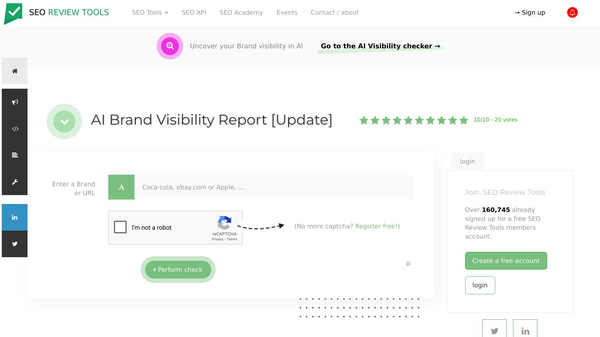
This tool is useful for any business that wants to ensure potential customers can find them through AI chat interfaces. It is particularly helpful for firms in sectors like accountancy, law, fintech, and coaching where buyers often ask specific questions to AI models. The process involves running live queries against four major AI models using real questions a prospective client would type. The results show the exact answers provided by each model, allowing the business to see how different engines perceive them. Companies can use this to check their mention rate, citation rate, share of voice, and misinformation check. It is also used to guide strategies for Generative Engine Optimization and Answer Engine Optimization to improve future visibility.
Pricing
The tool offers different options for monitoring and improvement. A comprehensive free report is available that runs live checks against the four major AI models. This includes the mention rate, citation rate, share of voice, and a misinformation check. It also provides a 30-day plan based on specific gaps found. For ongoing tracking, subscriptions are available at a cost of 6.99 pounds per month. For businesses needing immediate help, a Fix service is offered for a one-off fee of 495 pounds. This service closes identified gaps within seven days by writing organization schemas, creating an llms.txt file, correcting the about paragraph, and updating profiles. It ends with a re-check to show before and after results.
Vibes
Public reception highlights the importance of this metric as search behavior shifts. Research involving 15 real UK firms showed a consistent pattern where one firm often dominated AI mentions while several other credible businesses were never mentioned once. This has created a sense of urgency among business owners who realize that ranking first on Google is no longer sufficient. The tool is seen as a necessary step to stay relevant in a market where buyers start their research via chat interfaces. The availability of a free diagnostic has been well received as it allows businesses to get immediate insight without a large upfront cost.
Additional Information
The AI Visibility Score is calculated by running live queries against four major AI models: ChatGPT from OpenAI, Claude from Anthropic, Gemini from Google, and Perplexity. The process involves asking eight real questions that cover both branded and unbranded queries. The tool displays the verbatim answers provided by each model for direct comparison. Research indicates that four specific factors significantly impact visibility: external mentions on other websites, consistency of information across all profiles, quotable content with direct answers and numbers, and crawler accessibility. To improve accessibility, businesses are encouraged to configure robots.txt to permit access, serve text in HTML, and consider using an llms.txt file which provides a curated map of important pages. This file is distinct from robots.txt and helps AI systems navigate the site more effectively.
This content is either user submitted or generated using AI technology (including, but not limited to, Google Gemini API, Llama, Grok, and Mistral), based on automated research and analysis of public data sources from search engines like DuckDuckGo, Google Search, and SearXNG, and directly from the tool's own website and with minimal to no human editing/review. THEJO AI is not affiliated with or endorsed by the AI tools or services mentioned. This is provided for informational and reference purposes only, is not an endorsement or official advice, and may contain inaccuracies or biases. Please verify details with original sources.
Comments
Please log in to post a comment.