AI Resume Builder by DevelopersMatrix
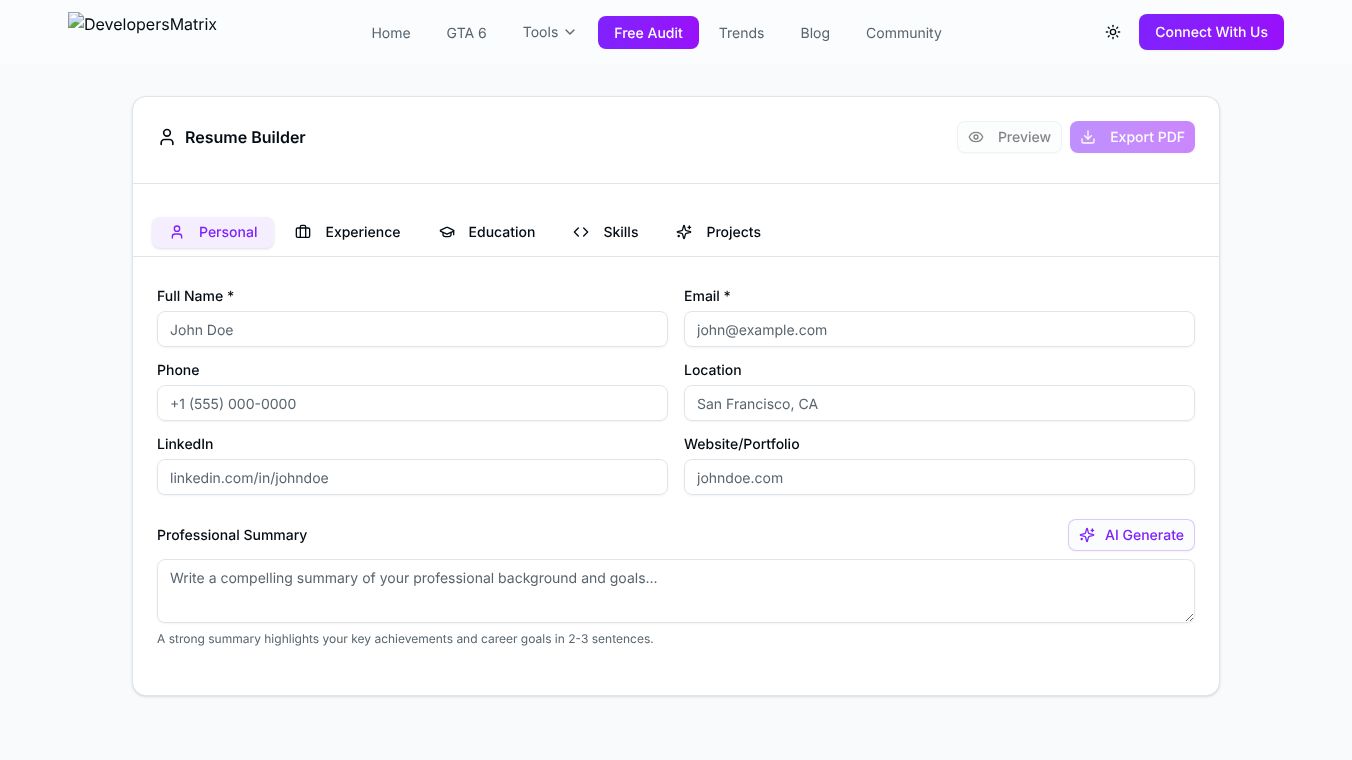





The Ultimate Guide to Developer Resumes in 2026: ATS Optimization and Best Practices
Introduction
The landscape of software hiring has shifted dramatically by 2026. With over 75% of companies utilizing AI-driven Applicant Tracking Systems (ATS) and roughly 90% of Fortune 500 firms employing contextual AI screening, generic resume strategies are obsolete. Most resumes never reach a human recruiter because they fail automated screening. To succeed, developers must adopt a Skills-First layout, ensure strict ATS compatibility, and quantify every achievement.
Benefits
The single most critical factor is ensuring your resume can be parsed correctly. Avoiding images, text boxes, graphics, and multi-column layouts prevents up to 30% of resumes from being misread or rejected. Recruiters scan for tech stacks in approximately 6.8 seconds. Grouping skills by category such as Frontend, Backend, DevOps, and Cloud allows hiring managers to find relevant information in under 3 seconds. ATS systems rely on exact phrasing. Mirroring the terminology used in the job posting ensures your skills are recognized. Generic statements like Built a dashboard are insufficient. In 2026, resumes with quantified achievements are 40% more likely to pass screening and receive callbacks. The formula for success is Action Verb plus Task plus Metric plus Outcome. For example, instead of saying Responsible for API development, you should write Designed RESTful APIs handling 12M daily requests with 99.97% uptime. Mentioning AI tools requires nuance. Listing ChatGPT as a skill can appear superficial. Instead, demonstrate technical depth by highlighting specific implementations like Built a RAG pipeline with LangChain or Fine-tuned a Llama model for production. For junior and mid-level developers, a one-page resume is the gold standard. Every line must justify its existence. Senior engineers with 10+ years of experience may stretch to two pages, provided every bullet point contains measurable outcomes or rare technical depth. A Projects section is now expected for all developers. It must go beyond GitHub links to provide context on the problem solved, technical decisions made, and measurable results. Tailoring your resume to match specific job descriptions triples callback rates. Treating your resume as a living document and updating it every 3-6 months with new certifications and metrics keeps your profile current.
Use Cases
Different roles require specific emphasis. Tailor your skills and project focus accordingly. Frontend developers should lead with HTML5, CSS3, JS ES6+, React, Vue, Angular, TypeScript, WCAG, and Core Web Vitals. Their project focus areas include UI improvements, responsiveness, accessibility audits, and page load optimization. Backend developers should lead with Node.js, Python, Go, Java, RESTful APIs, GraphQL, PostgreSQL, Docker, Kubernetes, and Microservices. Their project focus areas include API design, database optimization, system scalability, and security. Full-Stack developers should emphasize end-to-end development, Frontend plus Backend integration, Deployment pipelines, and API development. Their project focus areas include complete applications, deployment automation, and cross-functional collaboration. DevOps and SRE professionals should lead with CI/CD tools like GitHub Actions and Jenkins, Infrastructure as Code tools like Terraform, Kubernetes, Cloud Platforms like AWS, GCP, and Azure, and monitoring tools like Prometheus and Grafana. Their project focus areas include deployment automation, incident reduction, and cost optimization. Data and Machine Learning engineers should lead with Python, SQL, Spark, Airflow, dbt, Snowflake, TensorFlow, Pytorch, and MLOps. Their project focus areas include data pipeline efficiency, model performance, and business impact.
Pricing
Vibes
Additional Information
This content is either user submitted or generated using AI technology (including, but not limited to, Google Gemini API, Llama, Grok, and Mistral), based on automated research and analysis of public data sources from search engines like DuckDuckGo, Google Search, and SearXNG, and directly from the tool's own website and with minimal to no human editing/review. THEJO AI is not affiliated with or endorsed by the AI tools or services mentioned. This is provided for informational and reference purposes only, is not an endorsement or official advice, and may contain inaccuracies or biases. Please verify details with original sources.

 Freemium
 No Info
Comments
Please log in to post a comment.