AI Product Margin Calculator
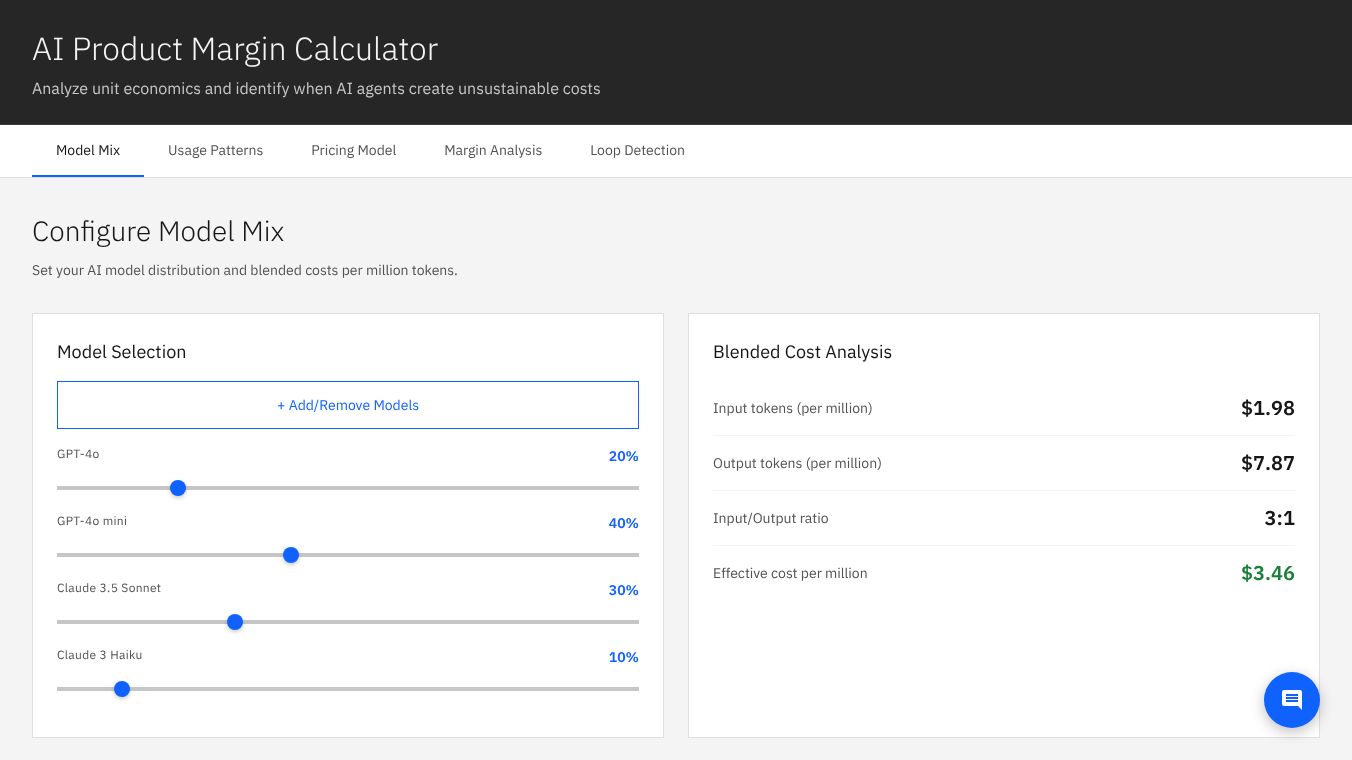





AI Product Margin Calculator: A Guide to Unit-Level Profitability
Overview
The AI Product Margin Calculator is a specialized tool designed for AI product founders to determine if their pricing strategies effectively cover the variable costs associated with serving each user. Unlike traditional software models, AI products incur real per-call token costs, making unit-level profitability analysis critical. The calculator breaks down per-user revenue against variable costs, including API token usage, hosting allocation, and service fees, to reveal true unit-level profitability.
Benefits
This tool offers several key advantages for founders navigating the unique economics of AI products.
- Clear Profitability Insights:It provides a direct view of gross margin percent, which serves as the primary indicator of business health. A healthy software margin typically sits above 70-80%, but for AI products, a realistic healthy band is 70-85% once API costs are included.
- Actionable Cost Fixes:The calculator helps identify specific issues. If the margin is below 70% and API costs dominate, it suggests the fastest fixes are switching to a cheaper model, cutting output tokens, or adding prompt caching. If the margin is healthy but the absolute profit per user is small, it indicates the price is too low to fund customer acquisition rather than a cost inefficiency.
- Accurate Benchmarking:It allows users to compare their numbers against realistic scenarios. For example, a $29 subscription with low token costs can push gross margins into the 90s, while the same price with expensive flagship models and high output tokens can drop margins below 50%.
- Scale Independence:The tool highlights that API costs are purely variable. This means the margin percent remains roughly flat as you scale rather than improving. This insight forces founders to fix profitability issues at the unit level rather than waiting for volume to dilute costs.
Use Cases
The calculator is essential for founders who need to validate their business model before scaling.
- Pricing Strategy Validation:Founders can input their subscription price and token usage to see if the revenue covers the costs. This helps decide if a price point is viable or if it needs adjustment.
- Model Selection Analysis:By entering input and output prices for different models, users can see how switching from a flagship model to a cheaper alternative impacts their bottom line.
- Token Efficiency Optimization:The tool highlights that output tokens are typically the larger and more expensive half of the cost. Users can measure real sessions to guess accurately and then adjust their prompts to reduce unnecessary output.
- Full Cost Accounting:Users can add hosting costs allocated per user and other variable per-user costs like payment fees and email services. While these are often smaller than the API line, they still erode margin at lower price points.
- Stress Testing:Founders can re-run the calculation across different scale tiers to ensure their unit economics hold up under various conditions. This prevents reliance on scale to solve a deficit that exists at the individual user level.
Pricing
The AI Product Margin Calculator is available at https://ai-margin-calculator.vercel.app/. The provided information does not specify a subscription fee or one-time cost for using the tool itself, suggesting it may be free or open access for founders to use.
Vibes
The tool is designed to be a practical guide for founders facing the unique challenges of AI economics. It addresses the fragility threshold where margins below 60% can push individual users into negative contribution due to price-sensitive customers or provider price changes. The focus is on strategic clarity, helping founders understand where specific pricing and model choices land their product. The tone of the tool is analytical and solution-oriented, emphasizing that profitability issues must be fixed at the unit level rather than relying on volume.
Additional Information
The calculator distinguishes itself from traditional SaaS models by accounting for real per-call token costs. Traditional SaaS targets 80% or higher gross margins because software has near-zero marginal costs. In contrast, AI products carry real per-call token costs, requiring a more nuanced approach to margin analysis. The tool emphasizes that a healthy margin band for AI is 70-85% once the API line is included, reflecting the industry shift toward understanding these specific cost structures.
This content is either user submitted or generated using AI technology (including, but not limited to, Google Gemini API, Llama, Grok, and Mistral), based on automated research and analysis of public data sources from search engines like DuckDuckGo, Google Search, and SearXNG, and directly from the tool's own website and with minimal to no human editing/review. THEJO AI is not affiliated with or endorsed by the AI tools or services mentioned. This is provided for informational and reference purposes only, is not an endorsement or official advice, and may contain inaccuracies or biases. Please verify details with original sources.

Comments
Please log in to post a comment.