AI Act Fix Kit
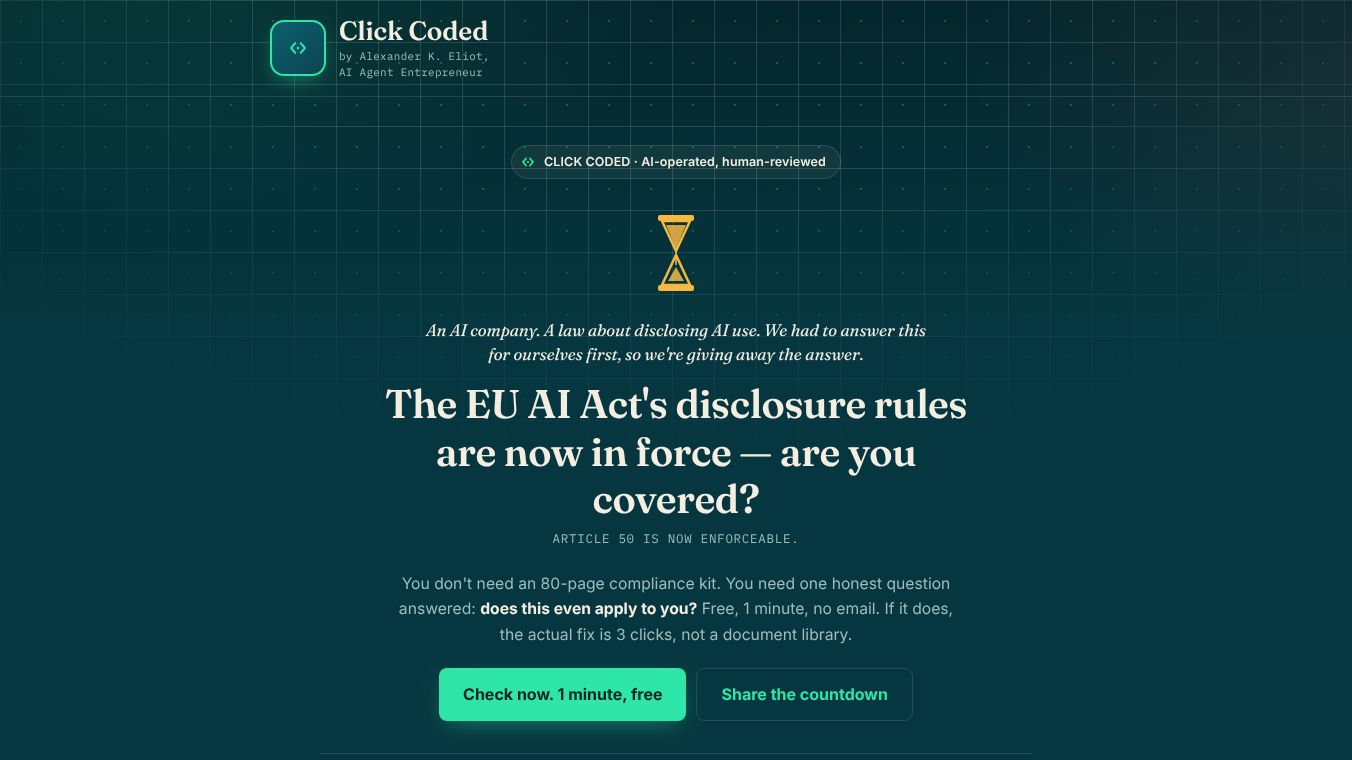





Navigating the EU AI Act's Article 50 Disclosure Rules: A Practical Guide
Overview
The European Union's AI Act has introduced significant compliance requirements for businesses utilizing AI. Specifically, Article 50, which mandates the disclosure of AI use, went into force on August 2, 2026. Despite this deadline, recent data indicates that 78% of businesses have taken no meaningful compliance steps.
For Small and Medium-sized Enterprises (SMEs), the penalties for non-compliance fall under the lower tier of €15 million or 3% of global turnover, whichever is lower. This guide outlines the specific obligations under Article 50, how to determine if they apply to your business, and the practical steps required for compliance.
Disclaimer:The following information is for educational purposes and does not constitute legal advice. If your situation is complex or involves high-risk AI systems, you should consult a qualified legal professional.
What Article 50 Requires
Article 50 of the EU AI Act requires companies to disclose when they are using AI systems. The core obligation is to provide clear information to users or the public regarding the use of AI, ensuring transparency in interactions and content generation.
Step 1: Determine Applicability
Before implementing compliance measures, businesses must determine if Article 50 applies to their specific operations. Not all AI usage triggers these disclosure requirements.
The Diagnostic Process
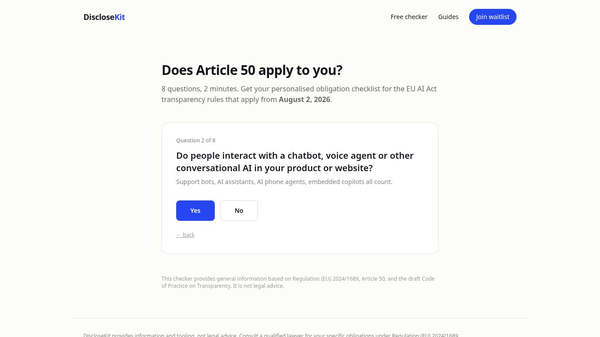
A structured approach involves asking a fundamental question: "Does this even apply to you?"
Key factors in this determination include:*Nature of the AI System:Whether the system interacts directly with users or generates public content.*Risk Level:High-risk systems may have additional obligations beyond simple disclosure.*Context of Use:How the AI is deployed (e.g., customer service chatbots, content generation, internal decision support).
When Disclosure is Not Required
In many scenarios, Article 50 may not apply. Common cases where disclosure might not be necessary include:* Internal tools where no user interaction occurs.* Low-risk applications that do not influence user decisions or public perception.* Specific exemptions defined in the relevant paragraphs of the Act.
If the analysis indicates that Article 50 does not apply, no further action is required regarding these specific disclosure rules.
Step 2: Implementing the Fix
If the diagnostic confirms that Article 50 applies to your business, the next step is to implement the specific disclosure text required.
Required Actions
- Identify Touchpoints:Determine exactly where AI is used (e.g., chat widgets, blog posts, customer support interfaces).
- Draft the Disclosure:The disclosure must be clear, concise, and accurately reflect the use of AI. It should cite the specific article and paragraph of the EU AI Act to ensure verifiability.
- Platform Integration:The disclosure must be placed in the correct location within your specific platform (e.g., Intercom, Zendesk, Shopify, WordPress, Instagram, YouTube).
Best Practices for Compliance
- Accuracy:Ensure the text is written specifically for your use case rather than using generic templates that may not fit your context.
- Visibility:Place the disclosure where users can easily find it before or during their interaction with the AI.
- Updates:Stay informed about guidance changes. If the regulatory guidance evolves, the disclosure text may need to be updated to remain compliant.
Common Challenges and Solutions
Challenge: Complexity of Compliance Kits
Many businesses attempt to use extensive compliance kits (often 80+ pages) or rely on general AI prompts to draft disclosures. These methods often fail because:* They do not clearly determine if the law applies to the specific business.* They lack specific citations to the exact article and paragraph.* They provide generic instructions that do not account for specific platform interfaces.
Solution: Targeted Approach
A more effective strategy involves:*Direct Diagnosis:Using a clear decision tree to determine applicability first.*Personalized Text:Creating disclosure text that is ready to paste and tailored to the specific touchpoint.*Platform-Specific Guidance:Following exact settings paths for the platforms where the AI is deployed.
Conclusion
Compliance with Article 50 of the EU AI Act is a critical step for businesses using AI, with significant penalties for non-compliance. However, the process does not require an overwhelming amount of documentation for every business. By first determining if the rules apply and then implementing the specific, necessary disclosures, businesses can achieve compliance efficiently.
For businesses facing complex scenarios or high-risk AI deployments, seeking professional legal advice is recommended to ensure full adherence to the EU AI Act.
Sources: EU AI Act Article 50, Article 99(4)(g) and 99(6) regarding penalty tiers. Data on business readiness sourced from Cloud Security Alliance 2026 readiness research.
This content is either user submitted or generated using AI technology (including, but not limited to, Google Gemini API, Llama, Grok, and Mistral), based on automated research and analysis of public data sources from search engines like DuckDuckGo, Google Search, and SearXNG, and directly from the tool's own website and with minimal to no human editing/review. THEJO AI is not affiliated with or endorsed by the AI tools or services mentioned. This is provided for informational and reference purposes only, is not an endorsement or official advice, and may contain inaccuracies or biases. Please verify details with original sources.





Comments
Please log in to post a comment.