Agentic Video Understanding in Gemini
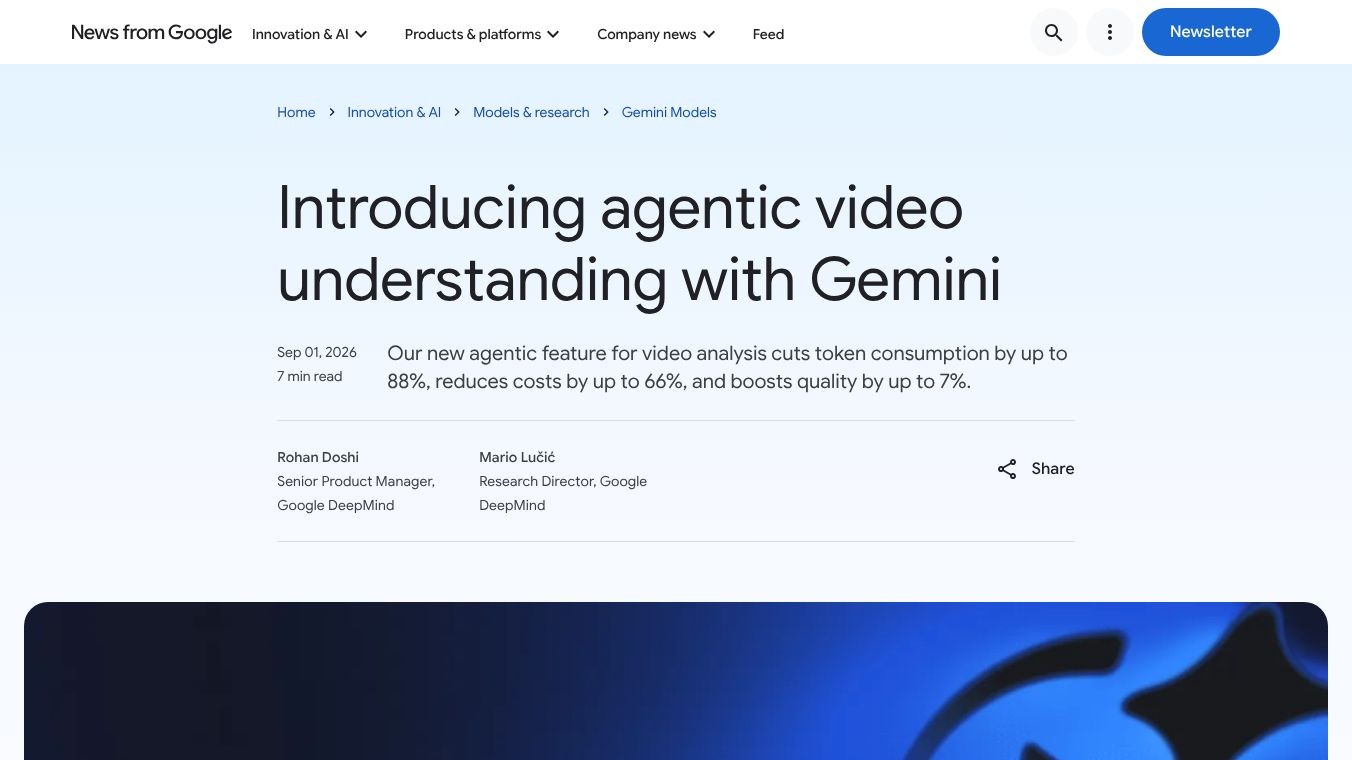





Agentic Video Understanding in Gemini
Introduction
Agentic Video Understanding in Gemini is a new feature from Google that allows the AI model to watch and analyze video content just like a human would. Instead of just seeing a stream of pixels, this tool can understand the story, context, and actions happening in a video. It can answer questions about what is occurring in the footage, summarize long videos, and even perform tasks based on what it sees. This capability marks a significant step forward in how AI interacts with visual media.
Benefits
This feature offers several powerful advantages for users and developers. First, it provides deep comprehension of video content. The system can identify objects, people, and actions while understanding the relationships between them. This means it can answer complex questions like "What happened to the person in the red shirt after the car arrived?" rather than just listing what objects are present.
Second, it enables autonomous task completion. The AI can take action based on its observations. For example, it can extract specific data from a video, create a summary, or trigger other tools to help solve a problem. This reduces the need for manual review and speeds up workflows.
Third, it supports long-form video analysis. The model can process hours of footage without losing track of the narrative. This is useful for analyzing training sessions, security footage, or long educational lectures where context is key.
Use Cases
There are many ways to apply this technology in real life. In education, teachers can use it to review classroom recordings and get instant summaries of student interactions or specific lesson moments. In healthcare, doctors might analyze surgical videos to identify key steps or complications without watching every second of the footage.
Businesses can use it for customer service by reviewing support calls and videos to find common issues or training opportunities. Security teams can scan surveillance footage to detect specific events like a package left at a door or a person entering a restricted area. Content creators can generate detailed captions or summaries for long-form videos to make them more accessible.
Pricing
Google has not released specific pricing details for Agentic Video Understanding in Gemini yet. As a new feature within the Gemini ecosystem, it may be available through existing Google Cloud subscriptions or as part of future API updates. Users should check the official Google Cloud documentation or contact sales for the most current pricing information.
Vibes
Public reception for this feature is very positive. Early feedback from developers and researchers highlights the impressive ability of the model to understand context and causality in video. Users appreciate how it moves beyond simple recognition to true understanding. The community is excited about the potential for this tool to automate complex video analysis tasks that were previously too time-consuming for humans.
Additional Information
This feature is part of Google's broader push to make AI more capable and autonomous. It builds on the foundation of the Gemini model, which is known for its strong reasoning and multimodal capabilities. Google is actively researching ways to expand these agentic capabilities to other types of media and tasks. The development team is focused on improving accuracy and reducing errors in complex scenarios.
This content is either user submitted or generated using AI technology (including, but not limited to, Google Gemini API, Llama, Grok, and Mistral), based on automated research and analysis of public data sources from search engines like DuckDuckGo, Google Search, and SearXNG, and directly from the tool's own website and with minimal to no human editing/review. THEJO AI is not affiliated with or endorsed by the AI tools or services mentioned. This is provided for informational and reference purposes only, is not an endorsement or official advice, and may contain inaccuracies or biases. Please verify details with original sources.
 No Info
Comments
Please log in to post a comment.