AgentGrade





Agent Readiness: How Websites Get Ready for AI Agents
What is AgentGrade?
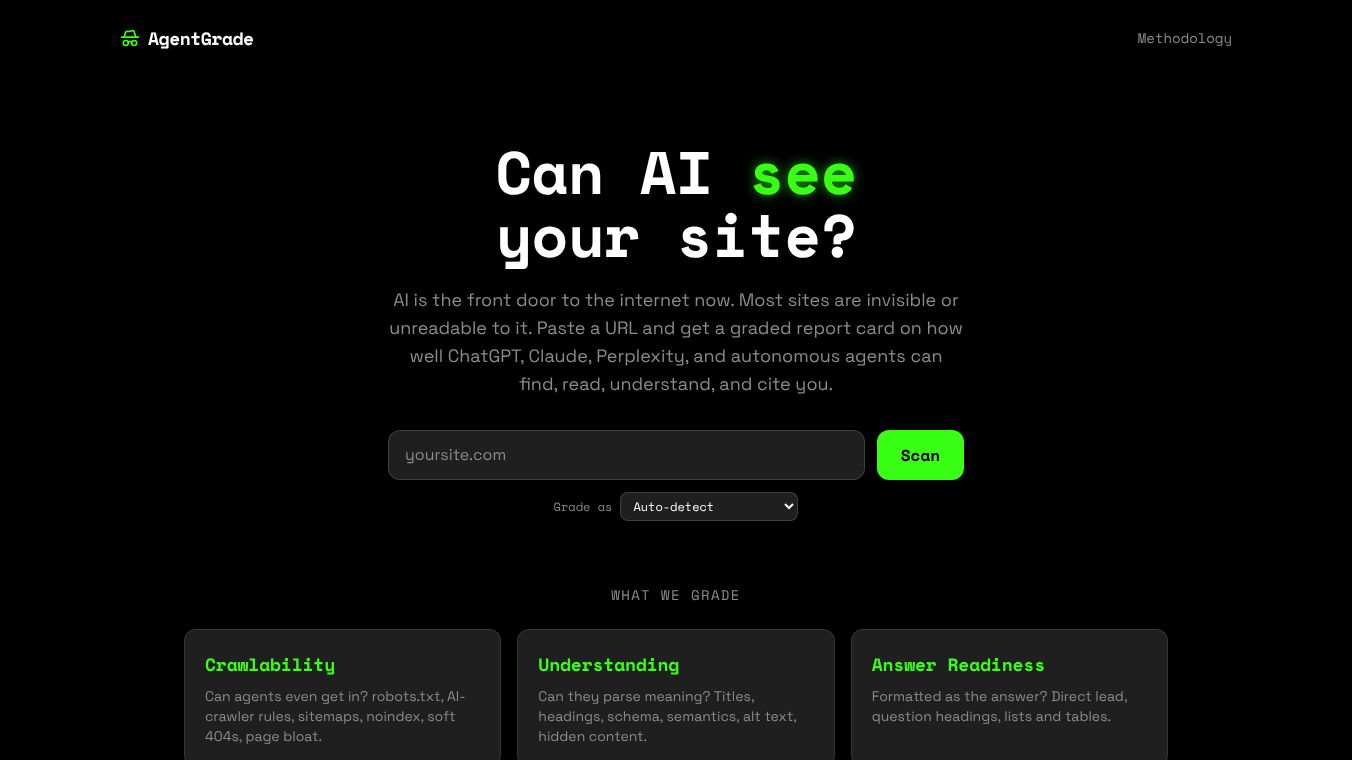
AgentGrade is a tool designed to help websites prepare for the future of the internet, where autonomous AI agents will browse, query, and make transactions on behalf of users. Unlike traditional web design that focuses on what humans see and click, AgentGrade measures how well a website exposes its capabilities to machines. It scans a domain to check if it can be easily understood and used by software agents that do not rely on visual rendering or JavaScript.
The tool provides a score from 0 to 100 and assigns a letter grade to show how ready a site is for this new era. It checks over 70 different signals across five key areas to ensure a website is addressable by AI.
Benefits
Using AgentGrade helps website owners stay competitive as AI agents begin to route a significant share of commercial traffic. The main benefits include:
- Future-Proofing Your Site:As platforms like ChatGPT and Google Gemini launch their own agents, websites that are not ready risk being bypassed in favor of competitors who are. AgentGrade identifies gaps before they become problems.
- Improved Discoverability:The tool checks for essential files like llms.txt and OpenAPI specs. Adding these helps agents find your tools and services quickly without getting lost in complex user interfaces.
- Better Transaction Capabilities:It verifies if your site can handle payments and data requests directly from an agent. This allows for features like micropayments for API calls without needing complex API keys.
- Clear Actionable Feedback:Instead of vague advice, AgentGrade gives specific hints on how to fix issues. For example, it tells you exactly which headers to add or which files to create to improve your score.
- Integration Ready:The tool offers an API and a command-line interface, making it easy to integrate into development workflows to ensure new code is always agent-ready.
Use Cases
AgentGrade is useful for a wide range of website owners and developers who want to ensure their digital presence works for both humans and machines.
- E-commerce Stores:Online shops can use the tool to ensure their product catalogs and checkout processes are accessible to shopping agents. This helps capture the growing market of AI-driven purchases.
- API Providers:Companies that offer services via API can use AgentGrade to expose their tools clearly. This allows other software to call their functions easily and reliably.
- Content Publishers:Bloggers and news sites can optimize their content so that AI agents can read and summarize it accurately. This improves the chances of their content being cited in AI answers.
- Developers and DevOps Teams:Engineering teams can run scans as part of their continuous integration and deployment pipelines. This ensures that every update to a website maintains or improves its agent readiness.
- Enterprise Platforms:Large organizations can use the tool to audit their internal and external portals. This ensures that their data and tools are available to enterprise AI agents that need to perform complex tasks.
Pricing
The provided article does not contain specific pricing details for AgentGrade. It mentions that the tool is available via a website scan, an API, and a command-line interface, but it does not list subscription costs or tiered pricing plans.
Vibes
The article highlights that the top 100 websites currently average a 55% readiness score, with many major social media platforms scoring zero because they block scanners or require logins. This indicates a high demand for tools like AgentGrade as the industry shifts toward the agentic web. The tone suggests that early adoption is critical, as agents are already routing measurable traffic to sites that are prepared for them.
Additional Information
AgentGrade is built around several emerging standards that define the agentic web. These include the Model Context Protocol for tool discovery, x402 for payment protocols, and llms.txt for content discovery. The tool evaluates these standards along with traditional protocols like sitemaps and robots.txt. It is designed to work alongside existing SEO practices but focuses specifically on machine addressability rather than human search rankings.
This content is either user submitted or generated using AI technology (including, but not limited to, Google Gemini API, Llama, Grok, and Mistral), based on automated research and analysis of public data sources from search engines like DuckDuckGo, Google Search, and SearXNG, and directly from the tool's own website and with minimal to no human editing/review. THEJO AI is not affiliated with or endorsed by the AI tools or services mentioned. This is provided for informational and reference purposes only, is not an endorsement or official advice, and may contain inaccuracies or biases. Please verify details with original sources.

Comments
Please log in to post a comment.