agentglass
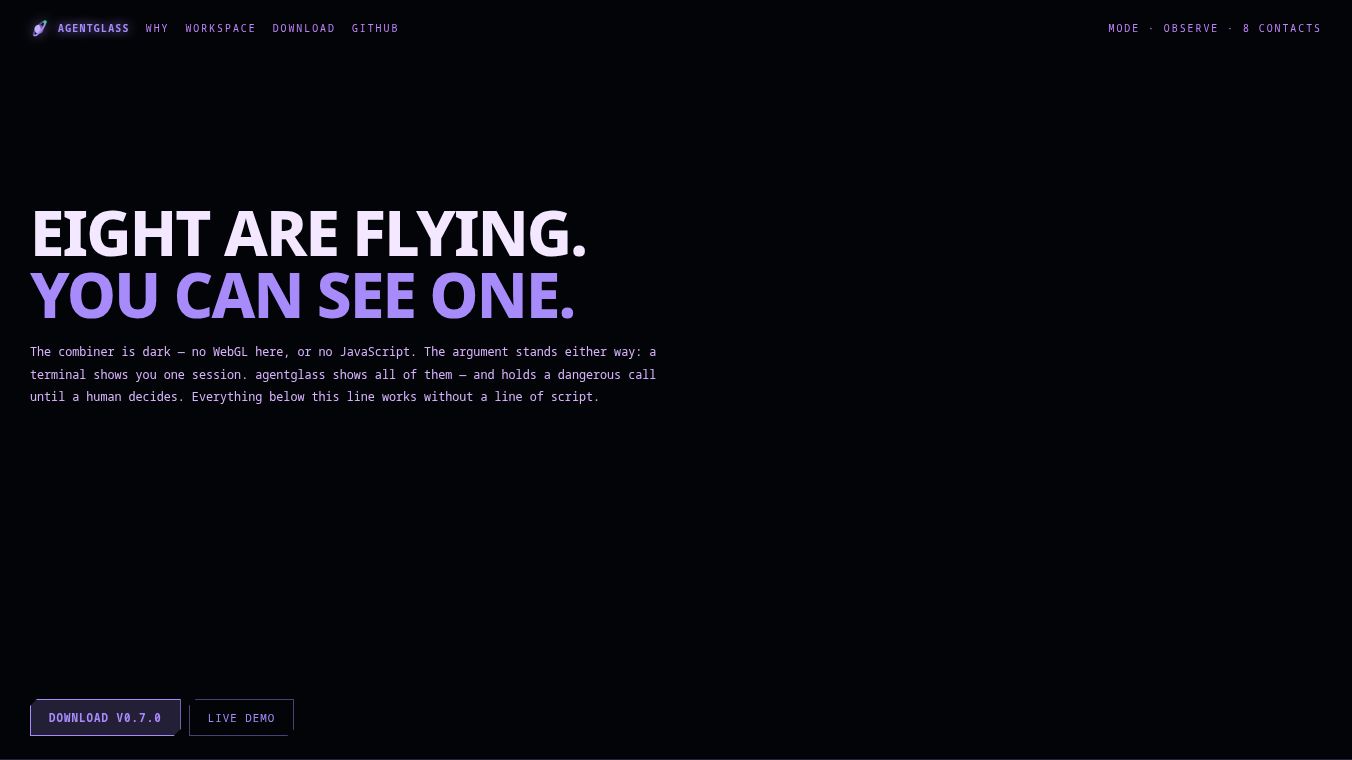





AgentGlass: A Head-Up Display for Your Development Fleet
Overview
AgentGlass is a lightweight, open-source tool designed to act as a head-up display for developers running multiple AI agents. Just as a pilot's head-up display keeps instruments visible without requiring them to look down, AgentGlass allows developers to monitor, control, and interact with multiple agent sessions simultaneously without losing focus on their primary work. It provides a unified view of all running agents, their tool usage, costs, and context, ensuring that no session is lost to a closed terminal tab.
Benefits
AgentGlass offers several key advantages for developers managing complex workflows. It tracks every contact, tool call, token, and dollar spent across all providers and projects on the machine. Unlike standard terminals where history dies with the tab, AgentGlass maintains a persistent record of every session. It visualizes the distance from center as context usage, helping users identify which agents are nearing their context limits. The application offers six distinct modes, accessible via a single key press, consolidating essential development tools into one interface. These modes include source control, diff viewer, pull requests, Docker management, terminal, and chat. AgentGlass prioritizes privacy and local execution. It runs entirely on the user's machine using SQLite for local storage and loopback networking. Nothing phones home, ensuring that sensitive code and agent interactions remain local. The dashboard provides real-time metrics on spend, tokens, health, throughput, and tool mix.
Use Cases
AgentGlass is ideal for developers who run multiple AI agents simultaneously. In a typical workflow, a developer might run eight agents at once. AgentGlass allows them to see all eight agents flying at once, lock onto a specific contact to view details, monitor tool calls and costs in real-time, and interact with agents via chat or terminal commands without leaving the dashboard. It is suitable for environments where managing multiple sessions across different terminals can be distracting or lead to lost context. The tool is available for macOS, Linux, and Windows, making it accessible to a wide range of developers. It is particularly useful for teams or individuals who need to manage Docker projects, review code diffs, and interact with AI models while keeping a clear overview of their entire development fleet.
Pricing
AgentGlass is open-source and available under the MIT license. It is free to use and does not require a subscription or payment. The application ships as a single binary for each operating system, eliminating the need for additional installations or cloning of repositories.
Vibes
AgentGlass is well-received for its ability to streamline the management of multiple AI agents. Users appreciate its focus on privacy, ease of use, and powerful integration of development tools. The tool empowers developers to maintain control over their fleet without the distraction of scattered terminals or lost context. Its real-time monitoring and unified interface have been highlighted as significant steps forward in managing complex development environments involving multiple AI agents.
Additional Information
AgentGlass is built using a modern, open-source stack. It uses Bun for the language, SQLite for the database, React and Vite for the frontend, and Electron for the desktop framework. The application includes 22 Phosphor icons for styling. It is available in three airframes, or installers, for macOS, Linux, and Windows. The server ships inside the app, requiring no additional installations or cloning of repositories. Upon first run, users can configure hooks for live streaming and cost tracking by editing their settings file. The application supports opt-in hooks for pretool use gates, live streaming, and cost per event tracking. For users preferring a repository-based setup, they can clone the repo and run a specific script to install hooks, though the desktop app requires no cloning.
This content is either user submitted or generated using AI technology (including, but not limited to, Google Gemini API, Llama, Grok, and Mistral), based on automated research and analysis of public data sources from search engines like DuckDuckGo, Google Search, and SearXNG, and directly from the tool's own website and with minimal to no human editing/review. THEJO AI is not affiliated with or endorsed by the AI tools or services mentioned. This is provided for informational and reference purposes only, is not an endorsement or official advice, and may contain inaccuracies or biases. Please verify details with original sources.

Comments
Please log in to post a comment.