Agent Swarm





Research context and background
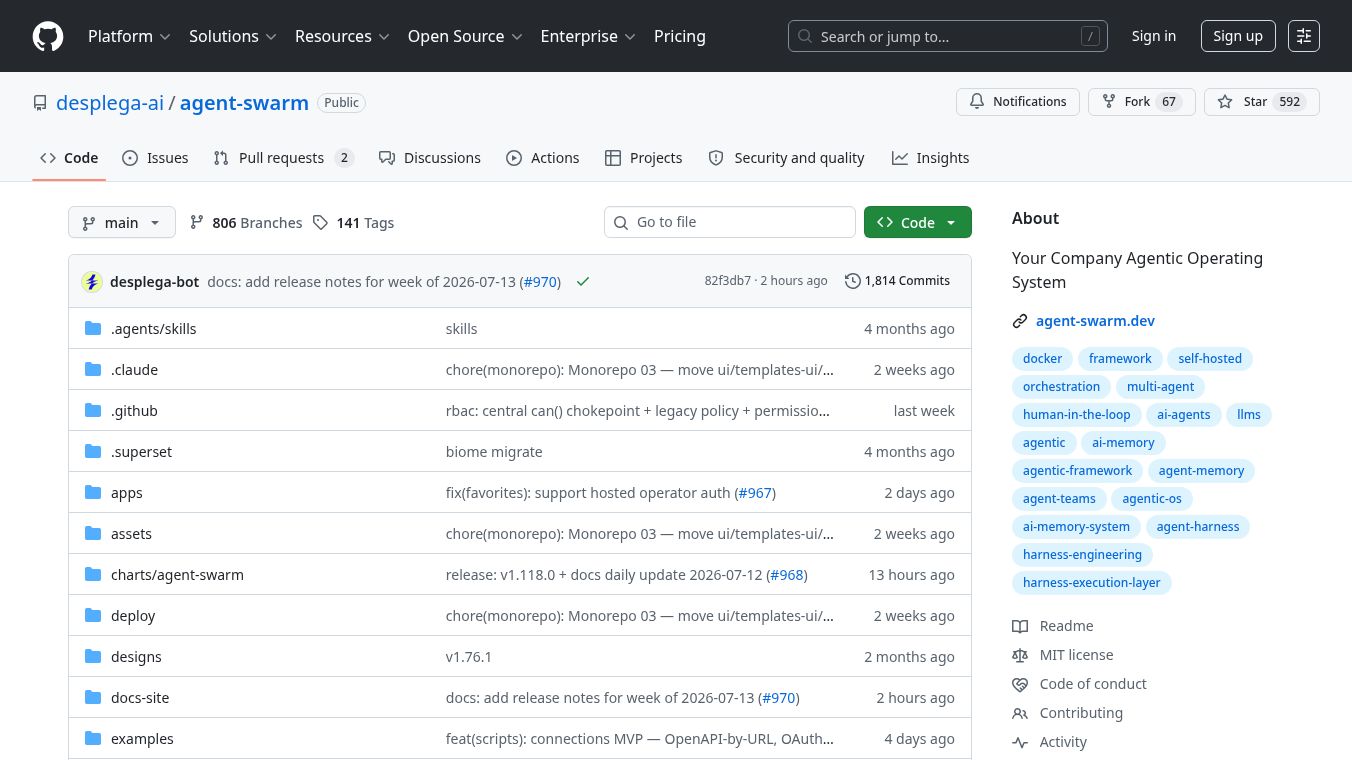
Agent Swarm is an open-source framework designed to help developers build and manage groups of AI agents that work together to solve complex problems. It is available on GitHub under the repository desplega-ai/agent-swarm. The tool focuses on making it easier to create multi-agent systems without needing deep expertise in distributed computing or advanced orchestration logic. It aims to simplify the process of coordinating multiple AI models so they can collaborate effectively on tasks that are too large for a single agent to handle alone.
Benefits
The main advantage of Agent Swarm is its ability to break down big problems into smaller parts and assign them to different agents. This allows teams to tackle complex workflows that would otherwise be difficult to manage. The framework provides a clear structure for communication between agents, ensuring that information flows smoothly and tasks are completed in the right order. It also supports scalability, meaning users can start with a small group of agents and expand the team as their needs grow. Because it is open-source, developers have full access to the code, which allows for customization and integration with other tools they already use.
Use Cases
Agent Swarm is useful for anyone looking to automate complex business processes or research tasks. For example, a customer service team could use it to create agents that handle different stages of a support ticket, from initial inquiry to resolution. In research, a group of agents could be set up to gather data from multiple sources, analyze it, and generate a report. Developers can also use it to build internal tools that require multiple steps of logic, such as data cleaning, validation, and formatting. It is particularly helpful for teams that want to experiment with AI collaboration without building everything from scratch.
Pricing
Agent Swarm is open-source and available for free on GitHub. There are no licensing fees or subscription costs to use the base framework. Users can download the code and deploy it on their own infrastructure. While the core tool is free, users may incur costs related to hosting the AI models or running the agents on cloud services, depending on their specific setup and usage volume.
Vibes
As an open-source project, Agent Swarm has not yet gathered a large number of public reviews or testimonials. The community on GitHub is the primary source of feedback, where developers discuss features, report bugs, and suggest improvements. Early adopters appreciate its simplicity and the way it lowers the barrier to entry for multi-agent systems. Some users note that the documentation is still growing and that the ecosystem of plugins or integrations is in its early stages. Overall, the reception is positive among those interested in experimenting with AI orchestration, though many are still waiting to see how the project evolves over time.
Additional Information
Agent Swarm was created by the team behind Desplega AI, a group focused on making AI development more accessible. The project is hosted on GitHub and follows standard open-source practices, allowing anyone to contribute to its development. There are currently no major corporate partnerships or significant funding announcements tied specifically to the project. Its growth relies on community contributions and the natural adoption by developers looking for flexible tools to build multi-agent applications.
This content is either user submitted or generated using AI technology (including, but not limited to, Google Gemini API, Llama, Grok, and Mistral), based on automated research and analysis of public data sources from search engines like DuckDuckGo, Google Search, and SearXNG, and directly from the tool's own website and with minimal to no human editing/review. THEJO AI is not affiliated with or endorsed by the AI tools or services mentioned. This is provided for informational and reference purposes only, is not an endorsement or official advice, and may contain inaccuracies or biases. Please verify details with original sources.



Comments
Please log in to post a comment.