




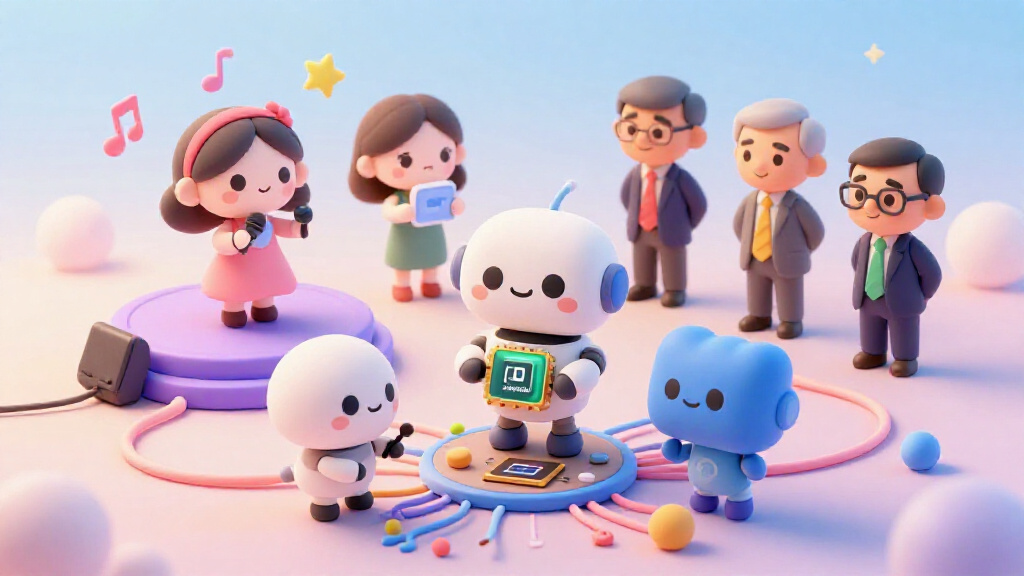
Several major players in the tech industry are making significant moves in the field of artificial intelligence. OpenAI has unveiled its first custom AI chip, Jalapeño, optimized for large language model inference, marking a shift towards custom silicon for AI workloads. This trend is also seen in companies like ByteDance, which has partnered with Qualcomm to develop custom ASICs for improved performance and efficiency.
Not all voices in the industry are supportive of AI, however. Madonna has spoken out against the use of AI in music, calling it 'the opposite of making art' and emphasizing the importance of human creativity in the process.
In the enterprise world, Salesforce employees have expressed concerns about Anthropic's new AI product, Claude Tag, which integrates with Slack, worrying about potential misuse such as snooping on conversations or stealing ideas.
Google's leadership is also making headlines, with former engineer Arvind Jain highlighting a key trait shared by Sundar Pichai, Larry Page, and Sergey Brin: the ability to think big and have confidence. This insight comes as Google continues to push the boundaries of AI technology.
Meanwhile, The Lancet's website recently experienced an AI-related error, underscoring the infrastructure challenges faced by scientific publishers in integrating AI. On a more innovative note, Netflix is developing AI video editing tools, Vera and VOID, aimed at enhancing precision and realism for creators while maintaining original content integrity.
Key Takeaways
• OpenAI unveils its first custom AI chip, Jalapeño, for large language model inference. • ByteDance partners with Qualcomm to develop custom ASICs for AI workloads. • Madonna criticizes AI in music, calling it 'the opposite of making art'. • Salesforce employees worry about Anthropic's Claude Tag integration with Slack. • Sundar Pichai, Larry Page, and Sergey Brin share the ability to think big and have confidence. • The Lancet's website experiences an AI-related error, highlighting infrastructure challenges. • Netflix develops AI video editing tools, Vera and VOID, for enhanced precision and realism. • AI companies are shifting towards custom silicon for improved performance and efficiency. • Google continues to push the boundaries of AI technology under Sundar Pichai's leadership. • The integration of AI in various industries faces challenges and concerns about misuse and ethics.AI Companies Building Their Own Chips
AI companies like ByteDance are now building their own custom chips to improve performance and efficiency. Qualcomm has struck a deal with ByteDance to supply millions of custom ASICs and help them turn their in-house chip design into a production-ready semiconductor. This shift shows that AI companies are moving beyond buying generic chips and focusing on custom silicon built for specific workloads.
The Future of AI: Custom Silicon
The future of AI is moving towards custom silicon, with companies like OpenAI, TAALAS, and others developing specialized chips for AI workloads. OpenAI has unveiled its first custom AI chip, Jalapeño, which is optimized for large language model inference. This shift towards custom silicon could make AI faster, cheaper, and more ubiquitous.
Madonna Slams AI in Music
Madonna has spoken out against the use of AI in music, saying it's the 'opposite of making art'. She believes that relying on AI takes away from the creative process and the passion that goes into making music.
Madonna on AI
Madonna has expressed her concerns about the use of AI in music, saying it's the 'opposite of making art'. She believes that AI can be a tool, but it should not replace human creativity.
Salesforce Worries About Anthropic's Slack Integration
Salesforce employees are concerned about Anthropic's new AI product, Claude Tag, which integrates with Slack. They worry that it could be used to snoop on conversations or steal ideas.
What AI Will Do to Our Minds
The rise of AI is changing the way we think and learn. With AI becoming more prevalent, there is a need to rethink how we assess knowledge and understanding.
Browser Agents Need Better Eyes
AI browser agents need better visual understanding to navigate the web efficiently. Current agents struggle with complex websites and pop-ups, showing the need for improved visual capabilities.
Google Execs Share Key Trait
Former Google engineer Arvind Jain says Sundar Pichai, Larry Page, and Sergey Brin share a key trait: the ability to think big and have confidence. Jain learned this lesson from observing Pichai during his time at Google.
Top AI Execs to Watch
Christopher O'Connell, Rhino.ai's executive vice president of global sales and alliances, is a top AI exec to watch. He has driven innovation and growth in AI-based software modernization.
The Lancet's AI Hurdle
The Lancet's website experienced an AI-related error, highlighting infrastructure challenges in AI integration for scientific publishers.
Netflix Tackles AI Video Editing
Netflix is developing AI video editing tools, Vera and VOID, to enhance precision and realism for creators. These tools aim to provide more control over visual effects and maintain original content integrity.
Sources
- The Companies Winning AI Are Starting to Build Their Own Chips
- The Future of AI Is Being Etched in Silicon
- Madonna Says Using AI Is the 'Opposite of Making Art'
- Madonna Says Using AI Is the ‘Opposite of Making Art’
- Salesforce Employees Worry Over Anthropic’s Invasion of Slack
- What Will AI Do To Our Minds?
- Browser Agents Need Better Eyes, Not Models
- Ex-Google engineer says Larry Page, Sergey Brin and Sundar Pichai share the same trait—it’s the lesson he swears by as a $7.2 billion AI CEO
- Top AI Execs to Watch in 2026: Rhino.ai's Christopher O'Connell
- The Lancet's AI Hurdle
- Netflix Tackles AI Video Editing Challenges
Comments
Please log in to post a comment.