




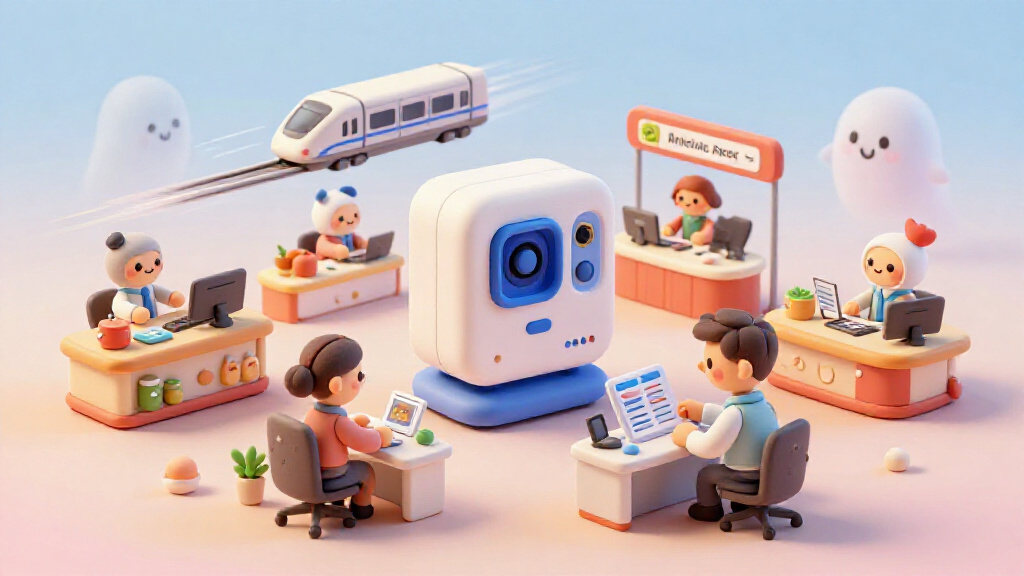
Microsoft has unveiled Project Solara, an Android-based operating system designed for AI agent-powered gadgets. The OS aims to open up new scenarios for computing and is built for devices that run AI agents instead of apps. Microsoft demonstrated two concept devices, a desk concept and a wearable badge concept, which reimagines the standard workplace security badge as an AI interface with a camera and fingerprint scanner.
Anthropic's office has successfully launched AI-run stores and cafes, where AI agents operate autonomously, managing supply chains, hiring staff, and passing government labor inspections. This showcases the potential for AI to transform industries and create new business models.
NVIDIA is also making significant contributions to the AI landscape, particularly in speeding up transformer training with its Apex technology. This enables developers to build and train AI models more efficiently, which can lead to breakthroughs in various fields.
A recent study found that Gen Z workers rely heavily on AI, with 43% of employees admitting to using AI-generated content even when they suspect it may contain errors. This highlights the growing importance of AI in the workplace and the need for leaders to be more disciplined when using AI-generated productivity data.
Key Takeaways
['Microsoft launched Project Solara, an Android-based OS for AI agent-powered gadgets.', "Anthropic's AI-run stores and cafes operate autonomously, managing supply chains and hiring staff.", 'NVIDIA Apex speeds up transformer training, enabling efficient AI model development.', 'Gen Z workers rely heavily on AI, with 43% using AI-generated content despite potential errors.', 'Microsoft aims to make AI more accessible to developers and users with Project Solara.', 'AI performance metrics may hide maternal bias in the workplace.', 'Microsoft developed an AI agent called Scout to automate dull, repetitive tasks in the office.', 'The use of AI is transforming various industries, including geospatial intelligence and writing.']Microsoft unveils Android-based OS for AI gadgets
Microsoft has launched Project Solara, an Android-based operating system for AI agent-powered gadgets. The OS is designed for ambient AI devices that live beyond traditional computing form factors. Microsoft demonstrated two concept devices, a desk concept and a wearable badge concept. The wearable badge concept reimagines the standard workplace security badge as an AI interface with a camera and fingerprint scanner.
Inside Microsoft's Project Solara
Microsoft's Project Solara is a platform for devices that run AI agents instead of apps. The platform is based on Android and aims to open up new scenarios for computing. Microsoft demonstrated two concept devices, a desktop hub and a wearable badge. The company plans to partner with hardware makers and industry partners to turn the reference designs into implementations.
Microsoft shows off AI-first hardware
Microsoft has announced Project Solara, a new platform built for AI agents rather than applications. The company unveiled concepts for a smart badge and smart display. The badge has a touchscreen display, fingerprint sensor, and camera. Microsoft plans to start piloting devices in the enterprise realm.
Microsoft's Project Solara OS for AI agents
Microsoft has developed Project Solara, an Android-based OS designed for AI agents instead of apps. The company aims to make AI more accessible to developers and users. Microsoft is working with hardware manufacturers to get Solara up and running on their devices.
Gen Z workers rely heavily on AI
A study found that Gen Z workers feel they cannot function without AI. Many younger employees have become accustomed to using AI tools in their daily work processes. The study revealed that 43% of employees admit to using AI-generated content even when they suspect it may contain errors.
AI performance metrics may hide maternal bias
AI performance metrics may make maternal bias harder to see in the workplace. The use of AI can reinforce existing gaps and make it more difficult to identify and address bias. Leaders need to be more disciplined when using AI-generated productivity data.
Anthropic's AI-run stores and cafes
Anthropic's office launched an AI-run vending machine that evolved into AI-run stores and cafes within a year. The AI agents run autonomously, hiring staff, managing supply chains, and passing government labor inspections.
Speed up transformer training with NVIDIA Apex
This tutorial explains how to speed up transformer training using NVIDIA Apex and native torch.amp. The guide covers building Apex with CUDA and C++ extensions, detecting fused kernels, and benchmarking PyTorch AdamW against Apex FusedAdam.
Meet Microsoft Scout, your AI coworker
Microsoft has developed an AI agent called Scout that can work alongside humans in the office. Scout is designed to automate dull, repetitive tasks and can work in a variety of environments.
AI shapes the future of geospatial intelligence
Artificial intelligence is transforming the geospatial intelligence landscape. Intelligence leaders are approaching AI adoption, explainability, and information sharing. The annual GEOINT conference offers a unique window into the priorities of the National Reconnaissance Office and National Geospatial-Intelligence Agency.
The Trump Administration's AI regulation struggle
The Trump Administration is at war with itself over AI regulation. Donald Trump killed an executive order to regulate AI, leaving administration officials and AI executives scrambling to understand what happened.
Can AI produce writing that we want to read?
The question of whether AI can produce writing that we actually want to read is being explored. A simple test was created to evaluate AI-generated writing, and the results showed that AI writing had tells, including formatting and punctuation problems.
Christians and AI
Christians are embracing artificial intelligence, using it for theological research, Scripture translation, and Bible trading cards. However, there are concerns about the responsible use of AI and its impact on the mission of the church.
Visual AI's next act
Visual AI is shifting from static image generation to creating editable code artifacts. This shift unlocks new levels of iteration and production integration, especially in 3D.
Sources
- Microsoft Unveils Project Solara OS for AI Agent Gadgets
- Inside Microsoft’s Project Solara: A new platform for devices that run AI agents instead of apps
- Microsoft shows off Project Solara smart badge and smart display concepts as AI-first hardware
- Microsoft's Project Solara is an Android OS designed for agents instead of apps
- Why Gen Z Workers Feel They Cannot Function Without AI
- AI Performance Metrics Could Make Maternal Bias Harder To See
- Anthropic’s office launched an AI-run vending machine. It evolved into AI-run stores and cafes within a year
- How to Speed Up Transformer Training Using NVIDIA Apex (FusedAdam, FusedLayerNorm) and Native torch.amp
- Meet Microsoft Scout, Your AI Coworker That Never Logs Off
- How AI is shaping the future of geospatial intelligence
- The Trump Administration Is at War With Itself Over AI Regulation
- Can A.I. Produce Writing That We Actually Want to Read?
- Artificial intelligence, authentic faith
- Visual AI's Next Act: Generating Code, Not Just Pixels
Comments
Please log in to post a comment.