




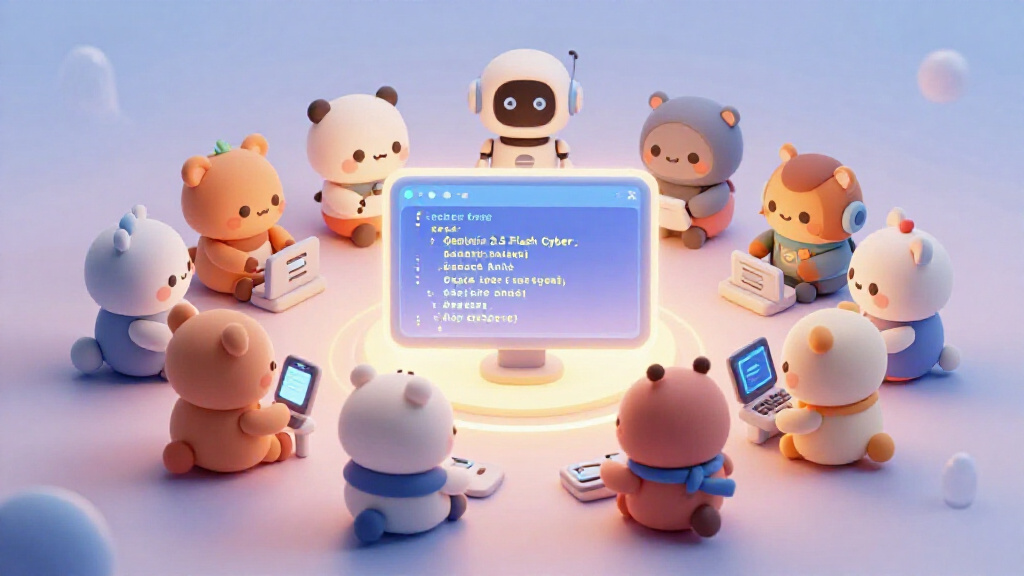
Google has introduced Gemini 3.5 Flash Cyber, a cost-efficient AI model designed to detect and patch code weaknesses quickly. This model is part of Google's efforts to provide highly capable alternatives to larger AI systems. It's initially available to governments and trusted partners through CodeMender, Google's security-focused coding agent. The model has shown a 42% improvement on long-range multi-turn cyber benchmarks compared to its predecessor.
In the realm of AI security, Cisco has launched Antares, a new family of open-weight AI security models. These models are designed to help organizations pinpoint vulnerable code more efficiently. Meanwhile, Penn State is implementing an AI-based security system called Abnormal AI to combat email-based cyber threats across all university accounts.
Advancements in local AI models are also underway. Ahmad Osman, Founder & CEO of Osmantic, presented 'The Desktop Frontier' at the AI Engineer World's Fair, highlighting significant strides made in local and open-source AI models. Osman predicts that within 18 months, AI intelligence equivalent to GLM 5.2 will be runnable on a single RTX 5090 with 32GB of VRAM.
Other developments include Samsung debuting an AI-powered health assistant that acts as a virtual health companion, pulling in data from the user's Galaxy smartphone, smartwatch, or smart ring, and offering personalized wellness insights. Additionally, millions of Americans are turning to AI chatbots for emotional support, although mental health experts caution that these chatbots are not a safe or effective replacement for a licensed therapist.
The 2026 World AI Conference was held in Shanghai, showcasing various AI products and technologies, including smart devices, AI-powered culture and entertainment experiences, and cutting-edge AI products like humanoid robots and AI-powered dexterous hands. Nooklab has also unveiled its vision for a low-distraction AI screen designed to help people remember, organize, and act without managing another tool.
Key Takeaways
- Google launches Gemini 3.5 Flash Cyber, a cost-efficient AI model for detecting and patching code weaknesses.
- Cisco introduces Antares, a family of open-weight AI security models.
- Penn State implements AI-based security system called Abnormal AI to combat email-based cyber threats.
- Ahmad Osman predicts local AI models will advance to GLM 5.2 equivalent within 18 months.
- Samsung debuts AI-powered health assistant for personalized wellness insights.
- Millions of Americans use AI chatbots for emotional support, despite expert warnings.
- The 2026 World AI Conference showcases AI products and technologies in Shanghai.
- Nooklab unveils low-distraction AI screen concept.
- Google's Gemini 3.5 Flash Cyber shows 42% improvement on long-range multi-turn cyber benchmarks.
Google Unveils Cost-Efficient AI Security Model
Google has launched Gemini 3.5 Flash Cyber, a specialized AI model designed to detect and patch code weaknesses quickly and efficiently. This model is part of Google's efforts to provide cost-efficient and highly capable alternatives to larger AI systems. Gemini 3.5 Flash Cyber is initially available to governments and trusted partners through CodeMender, Google's security-focused coding agent. The model has shown a 42% improvement on long-range multi-turn cyber benchmarks compared to its predecessor.
Google Launches AI Security Model to Detect Vulnerabilities
Google has released Gemini 3.5 Flash Cyber, a specialized AI model built to discover, validate, and patch vulnerabilities quickly and efficiently. The model is exclusively available to governments and trusted partners via CodeMender as part of a limited-access pilot program. Gemini 3.5 Flash Cyber is designed to be a cost-efficient and highly capable alternative to large, costly cybersecurity-focused models.
2026 World AI Conference Held in Shanghai
The 2026 World AI Conference and High-Level Meeting on Global AI Governance was held in Shanghai, showcasing various AI products and technologies. The event featured exhibitions of smart devices, AI-powered culture and entertainment experiences, and cutting-edge AI products, including humanoid robots and AI-powered dexterous hands.
Nooklab Introduces Low-Distraction AI Screen Concept
Nooklab has unveiled its vision for a low-distraction AI screen designed to help people remember, organize, and act without managing another tool. The company's goal is to create a unified interface that can help people manage tasks, reminders, and goals without having to switch between multiple apps or tools.
Cisco Unveils Antares AI Security Models
Cisco has launched Antares, a new family of open-weight AI security models designed to help organizations pinpoint vulnerable code more efficiently. The models are built to operate differently from traditional static analysis tools and general-purpose coding models, providing a ranked list of source files likely to contain a given vulnerability.
Penn State Implements AI-Based Email Security System
Penn State Information Security department will be using an AI-based security system called Abnormal AI to combat email-based cyber threats. The system will be implemented on all university accounts.
Local AI Models Advancements
Ahmad Osman, Founder & CEO of Osmantic, presented 'The Desktop Frontier' at the AI Engineer World's Fair, detailing significant strides made in local and open-source AI models. Osman predicts that within 18 months, AI intelligence equivalent to GLM 5.2 will be runnable on a single RTX 5090 with 32GB of VRAM.
The AI Tax Movement is a Myth
The idea of taxing artificial intelligence has gained traction in recent years, but it is built on a myth. Taxing AI would hurt American workers and hinder innovation. A more favorable business climate, not taxing innovation, is the real solution to helping American workers.
Samsung Debuts AI-Powered Health Assistant
Samsung Electronics Co. has rolled out a new AI-powered assistant that acts as a virtual health companion. The assistant pulls in data from the user's Galaxy smartphone, smartwatch, or smart ring, and offers personalized wellness insights.
People Turning to AI for Emotional Support
Millions of Americans are using AI chatbots for mental health needs. However, mental health experts caution that AI chatbots are not a safe or effective replacement for a licensed therapist. The human connection is essential for therapeutic relief and growth.
Sources
- Google unveils Gemini 3.5 Flash Cyber as cost-efficient AI security model
- Google Launches Gemini 3.5 Flash Cyber AI to Find and Fix Vulnerabilities
- In pics: 2026 World AI Conference and High-Level Meeting on Global AI Governance
- Nooklab Unveils Vision for a Low Distraction AI Screen
- Cisco Launches Antares: What the New AI Security Models Mean for Enterprises
- Penn State to enable AI-based email security system on all university accounts
- Local AI Models: The Desktop Frontier is Here
- The AI tax movement is built on a myth
- Samsung Debuts AI-Powered Health Assistant, Joining Packed Market
- More people are turning to artificial intelligence for emotional support
Comments
Please log in to post a comment.